Source scans · vol_II_p038
recto · open full
scan recto
verso · open full
scan verso
Bṛhaddeśī · Volume II
pp. 1–59folio 038
Devanāgarī (Bṛhaddeśī)
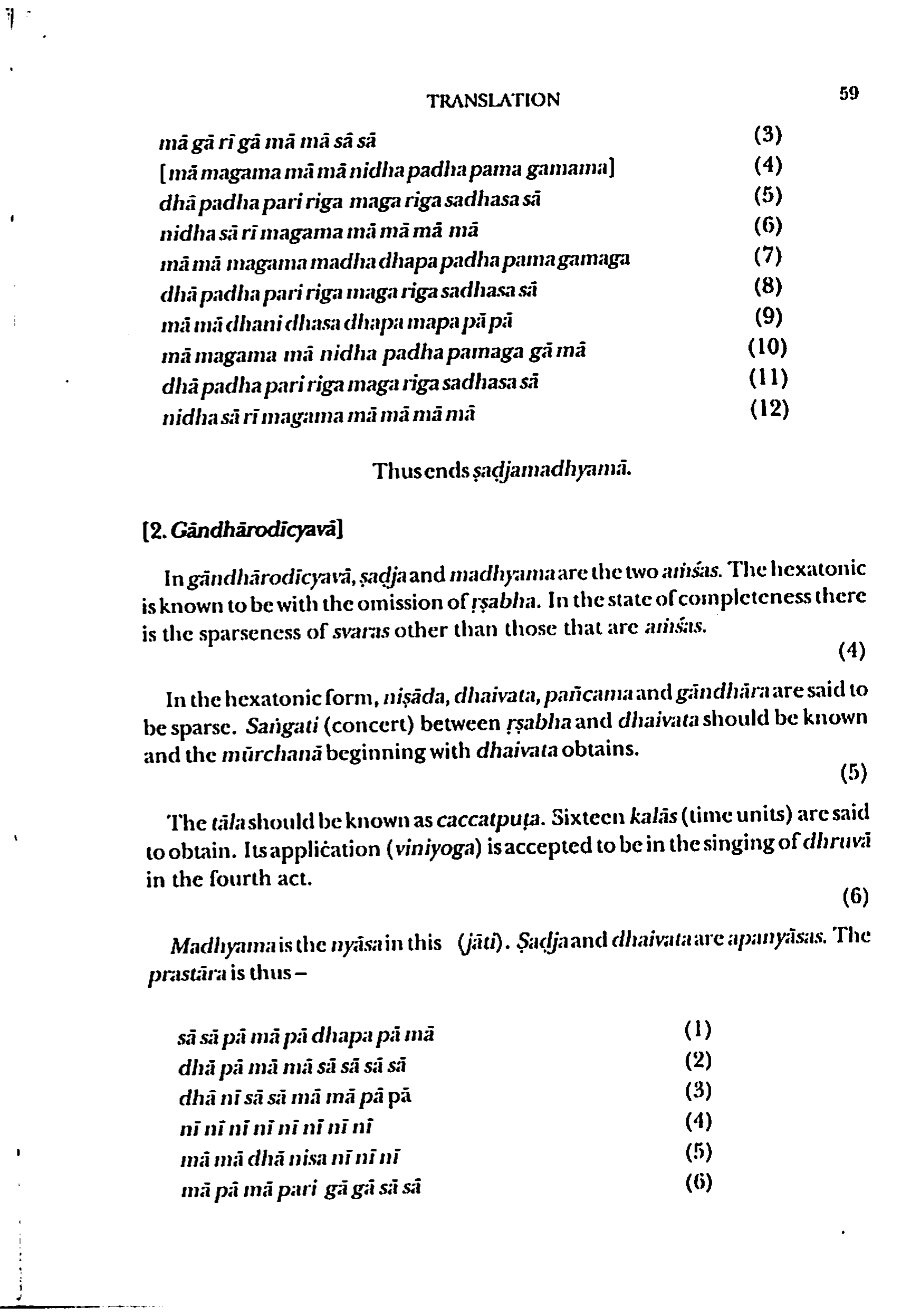
मा गारी गामा मासा सा
(3)
[मा मगम मा मा निध पध पम गमम]
(8)
धा गध परि रिग गरि गस धस धा
(4)
निध सा री मृगम मा मा मा मा
(६)
मां मां मंगमं मंधं धंपं पंधं पंमं गंमंगं
(৩)
धा पध परि रिंग मंग रिंग संधस सा
(८)
मां मां धनि धस धप पम पा पा
(9)
मा मग मां मां पध पम गम गस
(१०)
धा पध परि रिम मग रिग सधस सा
(११)
निंधं सां री मगम मा मा मा मा
(१२)
॥ [इति] षड्जमध्यमा
(स॥
गान्धारोदीच्यवायां तु द्वावंशौ षड्जमध्यमौ ।
रिलोपात् षाडवं ज्ञेयं पूर्णत्वेंऽशेतराल्पता॰(शोन्तरात्मना? शेतराल्पता) ॥४॥ अल्पा निधपगान्धारा: षाडवत्वे प्रकीर्तिता: ।5 रिधयो: सङ्गतिर्ज्ञेया धैवतादिश्च मूर्छना62 ॥५॥ स(गनिज्ञे ? ङ्गतिर्जे)या तालश्चचत्पुटो ज्ञेय:10 कला: षोडश कीर्तिता: ।11 विनियोगो ध्रुवागाने चतुर्थप्रेक्षणे१६९अस्यां मध्यमो न्यास: । षड्जधैवतावपन्यासौ । १७°प्रस्तार: - मत:12 ॥६॥ म(ध्य)मो
(१)
सा सा पा मा पा धप पा मा
(२)
धा पा मा मा सा सा सा सा धा नी सा सा मा मा पा पा
(3)
नी नी नी नी नी नी नी (8) मा मा धा निस नी नी नी नी
(4)
मा पा मा परि गा गा सा सा (\(\xi\)
ordered sequence list
ṣaḍjamadhyamā mūrcchanā prastāra (continuation, items 3-12) — Continuation of the prastāra (enumeration of permutations) for ṣaḍjamadhyamā mūrcchanā; ends with closure '|| [iti] ṣaḍjamadhyamā ||'.
index · svaras
index · svaras
index · svaras
index · svaras
index · svaras
index · svaras
index · svaras
index · svaras
index · svaras
index · svaras
— ṣaḍjamadhyamā prastāra
ordered sequence list
gāndhārodīcyavā mūrcchanā prastāra (items 1-6) — Beginning of prastāra (enumeration) for the second mūrcchanā, gāndhārodīcyavā, following verses 4-6 defining it (ṣāḍava by ri-lopa, m(dhya)mo nyāsa, ṣaḍja/dhaivata apanyāsa).
index · svaras
index · svaras
index · svaras
index · svaras
index · svaras
index · svaras
— [2. gāndhārodīcyavā] prastāraḥ
English — Sharma (translation)
(3)
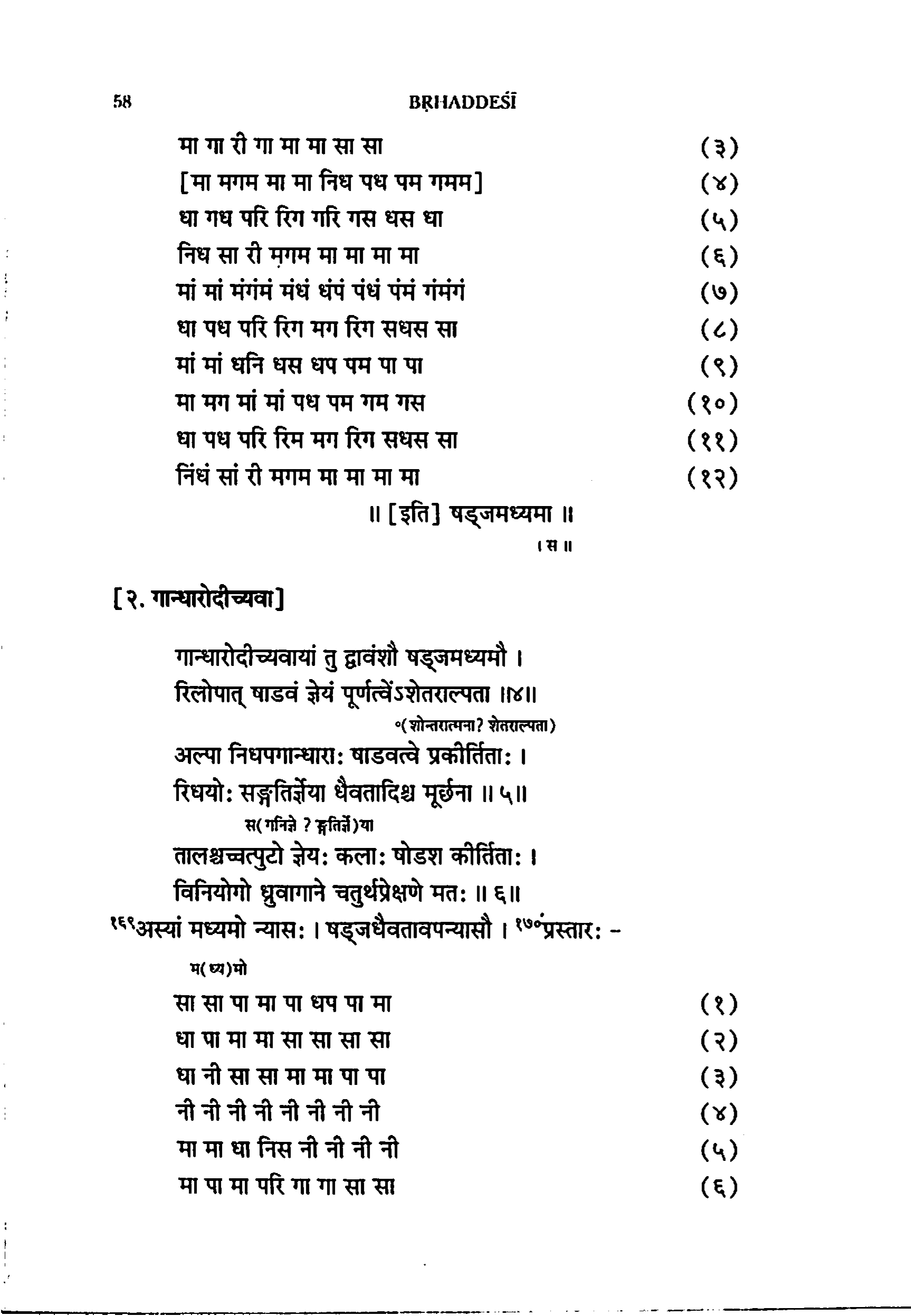
mā gā rī gā mā mā sā sā (4)
[mā magama mā mā nidha padha pama gamama]
(5)
dhā padha pari riga maga riga sadhasa sā
(6)
nidha sā rī magama mā mā mā mā
(7)
mā mā magama madha dhapa padha pama gamaga
(8)
dhā padha pari riga maga riga sadhasa sā
(9)
mā mā dhani dhasa dhapa mapa pā pā
(10)
mā magama mā nidha padha pamaga gā mā
(11)
dhā padha pari riga maga riga sadhasa sā
(12)
nidha sā rī magama mā mā mā mā Thus ends şadjamadhyamā. In gāndhārodīcyavā, ṣadjaand madhyama are the two amśas.3 The hexatonic is known to be with the omission of rşabha.4 In the state of completeness there is the sparseness of svaras other than those that are anisas.
(4)
In the hexatonic form, niṣāda, dhaivata, pañcama and gāndhāra are said to be sparse.5 Saigati (concert) between ṛṣabha and dhaivata should be known2 and the mūrchanā beginning with dhaivata obtains.6
(5)
The tāla should be known as caccatpuța.10 Sixteen kalās (time units) are said to obtain.11 Its application (viniyoga) is accepted to be in the singing of dhruvā in the fourth act.12
(6)
Madhyamais the nyāsain this (jāti).7 Ṣaḍja and dhaivata are apanyāsas.8 The prastāra is thus -9
(1)
sā sā pā mā pā dhapa pā mā
(2)
dhā pā mā mā sā sā sā sā
(3)
dhã nĩ sã sã mã mã pã pã
(4)
ករី ករី ករី ករី ករី ករី ករី ករី
(5)
mã mã dhã nisa nĩ nĩ nĩ
(6)
mā pā mā pari gā gā sā sā
1.[citation]Ṣaḍjamadhyamā is a jāti (melodic type) that concludes the first section of the text.॥ [इति] षड्जमध्यमा
2.[relation] Saigati (concert/coordination) between ṛṣabha and dhaivata should be understood in Gāndhārodīcyavā.रिधयोः सङ्गतिर्ज?्ञेया धैवतादिश्च मूर्छना
5.[structural] In hexatonic form, niṣāda, dhaivata, pañcama and gāndhāra are characterized as sparse svaras.अल्पा निधपगान्धाराः षाडवत्वे प्रकीर्तिताः ।
6.[structural] Mūrchanā (melodic movement) begins with dhaivata in the context of Gāndhārodīcyavā.धैवतादिश्च मूर्छना
7.[structural] Madhyama serves as the nyāsa (resting tone) in Gāndhārodīcyavā.अस्या मध्यमो न्यासः ।
8.[structural] Ṣaḍja and dhaivata function as apanyāsas (secondary resting tones) in Gāndhārodīcyavā.षड्जधैवतावपन्यासौ ।
9.[structural] The prastāra (expansion/elaboration pattern) of Gāndhārodīcyavā is provided in systematic melodic sequences.प्रस्तारः
10.[structural] Caccatpuța is the tāla (rhythmic cycle) associated with Gāndhārodīcyavā.तालश्चचत्पुटो ज?्ञेयः
11.[structural] Sixteen kalās (time units) are prescribed for the tāla of Gāndhārodīcyavā.कलाः षोडश कीर्तिताः ।
12.[structural] The viniyoga (application) of Gāndhārodīcyavā is in the dhruvā song of the fourth act.विनियोगो ध्रुवागाने चतुर्थप्रेक्षणे मतः
1.[citation] Ṣaḍjamadhyamā is a jāti (melodic type) that concludes the first section of the text.Thus ends şadjamadhyamā.
2.[relation]Saigati (concert/coordination) between ṛṣabha and dhaivata should be understood in Gāndhārodīcyavā.Saigati (concert) between ṛṣabha and dhaivata should be known
3.[structural]Gāndhārodīcyavā is a jāti characterized by two amśas (divisions): ṣaḍja and madhyama.In gāndhārodīcyavā, ṣadjaand madhyama are the two amśas.
4.[structural]The hexatonic form (ṣāḍava) of Gāndhārodīcyavā is created by omission of ṛṣabha.The hexatonic is known to be with the omission of rşabha.
5.[structural]In hexatonic form, niṣāda, dhaivata, pañcama and gāndhāra are characterized as sparse svaras.In the hexatonic form, niṣāda, dhaivata, pañcama and gāndhāra are said to be sparse.
6.[structural]Mūrchanā (melodic movement) begins with dhaivata in the context of Gāndhārodīcyavā.the mūrchanā beginning with dhaivata obtains.
7.[structural]Madhyama serves as the nyāsa (resting tone) in Gāndhārodīcyavā.Madhyamais the nyāsain this (jāti).
8.[structural]Ṣaḍja and dhaivata function as apanyāsas (secondary resting tones) in Gāndhārodīcyavā.Ṣaḍja and dhaivata are apanyāsas.
9.[structural]The prastāra (expansion/elaboration pattern) of Gāndhārodīcyavā is provided in systematic melodic sequences.The prastāra is thus -
10.[structural]Caccatpuța is the tāla (rhythmic cycle) associated with Gāndhārodīcyavā.The tāla should be known as caccatpuța.
11.[structural]Sixteen kalās (time units) are prescribed for the tāla of Gāndhārodīcyavā.Sixteen kalās (time units) are said to obtain.
12.[structural]The viniyoga (application) of Gāndhārodīcyavā is in the dhruvā song of the fourth act.Its application (viniyoga) is accepted to be in the singing of dhruvā in the fourth act.