Source scans · vol_II_p037
recto · open full
scan recto
verso · open full
scan verso
Bṛhaddeśī · Volume II
pp. 0–57folio 037
Devanāgarī (Bṛhaddeśī)
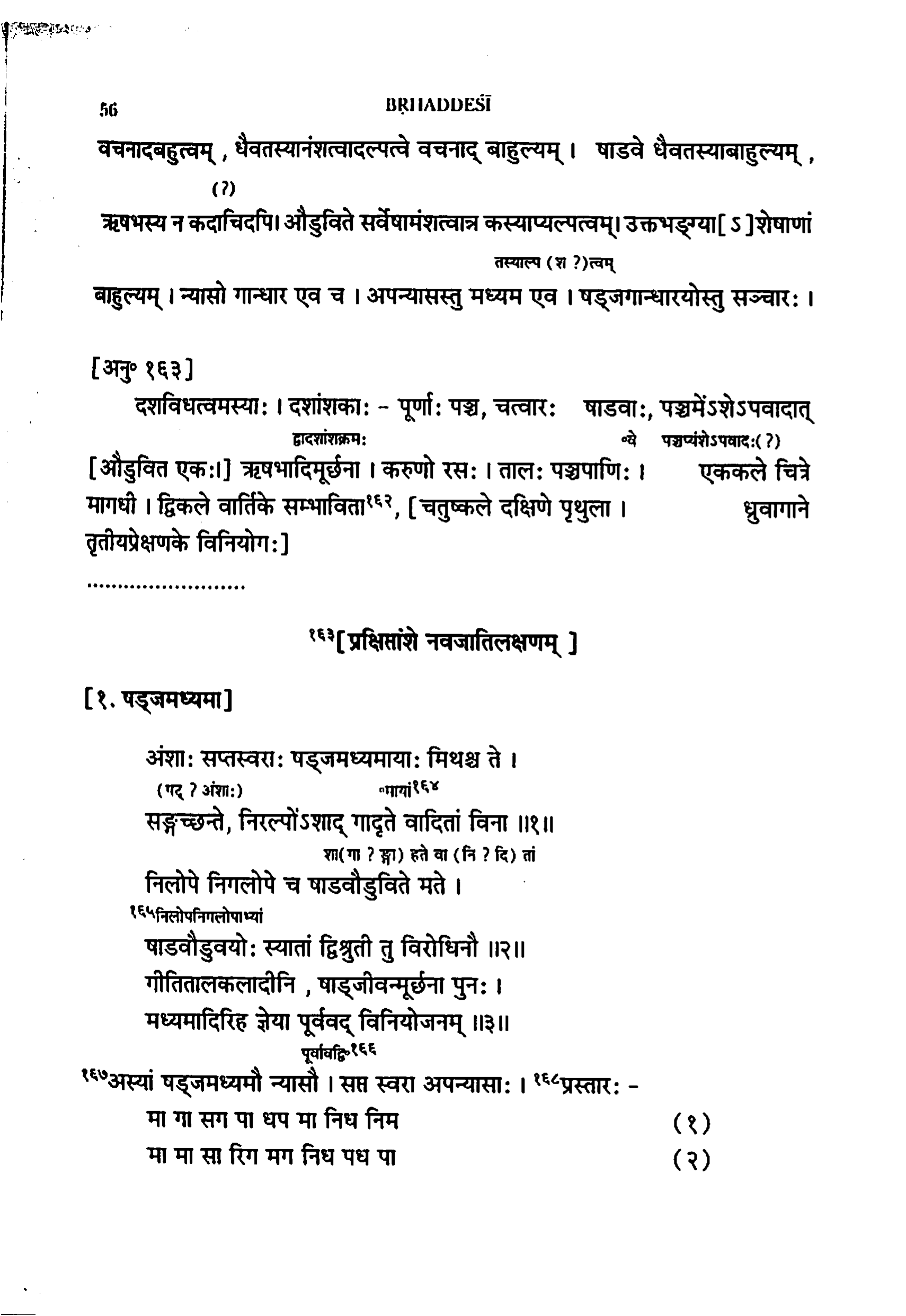
वचनादबहुत्वम् , धैवतस्यानंशत्वादल्पत्वे वचनाद् बाहुल्यम्तस्याल्प (श ?)त्वम् । षाडवे धैवतस्याबाहुल्यम् ,
(7)
ऋषभस्य न कदाचिदिप। औडुविते सर्वेषामंशत्वात्र कस्याप्यल्पत्वम्12। उक्तभङ्ग्या[ ऽ ]शेषाणां
बाहुत्यम् । न्यासो गान्धार एव च । अपन्यासस्तु मध्यम एव । षड्जगान्धारयोस्त् सञ्चार:2
[अनु॰ १६३]
दशविधत्वमस्या: । दशांशका:द्वादशांशक्रम: - पूर्णा: पञ्च, चत्वार: षाडवा:, पञ्चमेंऽशेऽपवादात् पञ्चप्यंशेऽपवादः(?)
[औडुवित एक:।] ऋषभादिमूर्छना9 । करुणो रस: । ताल: पञ्चपाणि:3
एककले चित्रे
मागधी । द्विकले वार्तिके सम्भाविता१६२, [चतुष्कले दक्षिणे पृथुला ।
ध्रवागाने तृतीयप्रेक्षणके विनियोग:] १६३[प्रक्षिसांशे नवजातिलक्षणम् ]
अंशा: सप्तस्वरा:(पद् ? अंशा:) षड्जमध्यमाया:•मायां <i>६६</i>४ मिथश्च ते ।
सङ्गच्छन्ते, निरल्पोंऽशाद् गादृते वादितां विना6 ॥१॥ शा(गा ? ङ्गा) हते वा (नि ? दि) तां निलोपे१६५निलोपनिगलोपाभ्यां निगलोपे च षाडवौड्विते मते।13 षाडवौडुवयो: स्यातां द्विश्रुती तु विरोधिनौ ॥२॥
गीतितालकलादीनि , षाड्जीवन्मूर्छना पुन:।
मध्यमादिरिह ज्ञेया पूर्ववद्पूर्वावद्विरहर्द् विनियोजनम्4 ॥३॥ १६७अस्यां षड्जमध्यमौ न्यासौ7सप्त स्वरा अपन्यासा:8१६८प्रस्तार: - मा गा सग पा धप मा निध निम(१) मा मा सा रिंग मंग निध पंध पा
(२)
table
ṣaḍjamadhyamā_jāti_prastāra — Prastāra (svara phrase enumeration) for ṣaḍjamadhyamā jāti, under section [praśniṃśe navajātilakṣaṇam] §1. ṣaḍjamadhyamā. Numbered phrase rows (1), (2) follow the line 'asyāḥ ṣaḍjamadhyamāyāḥ nyāsāḥ ... prastāraḥ -'.
indexsvara_phrase
1mā mā sā rga dha pa ma ga ni dha ni ma
2mā mā sā riga ma ga pa dha pa dha pā
— प्रस्तार
English — Sharma (translation)
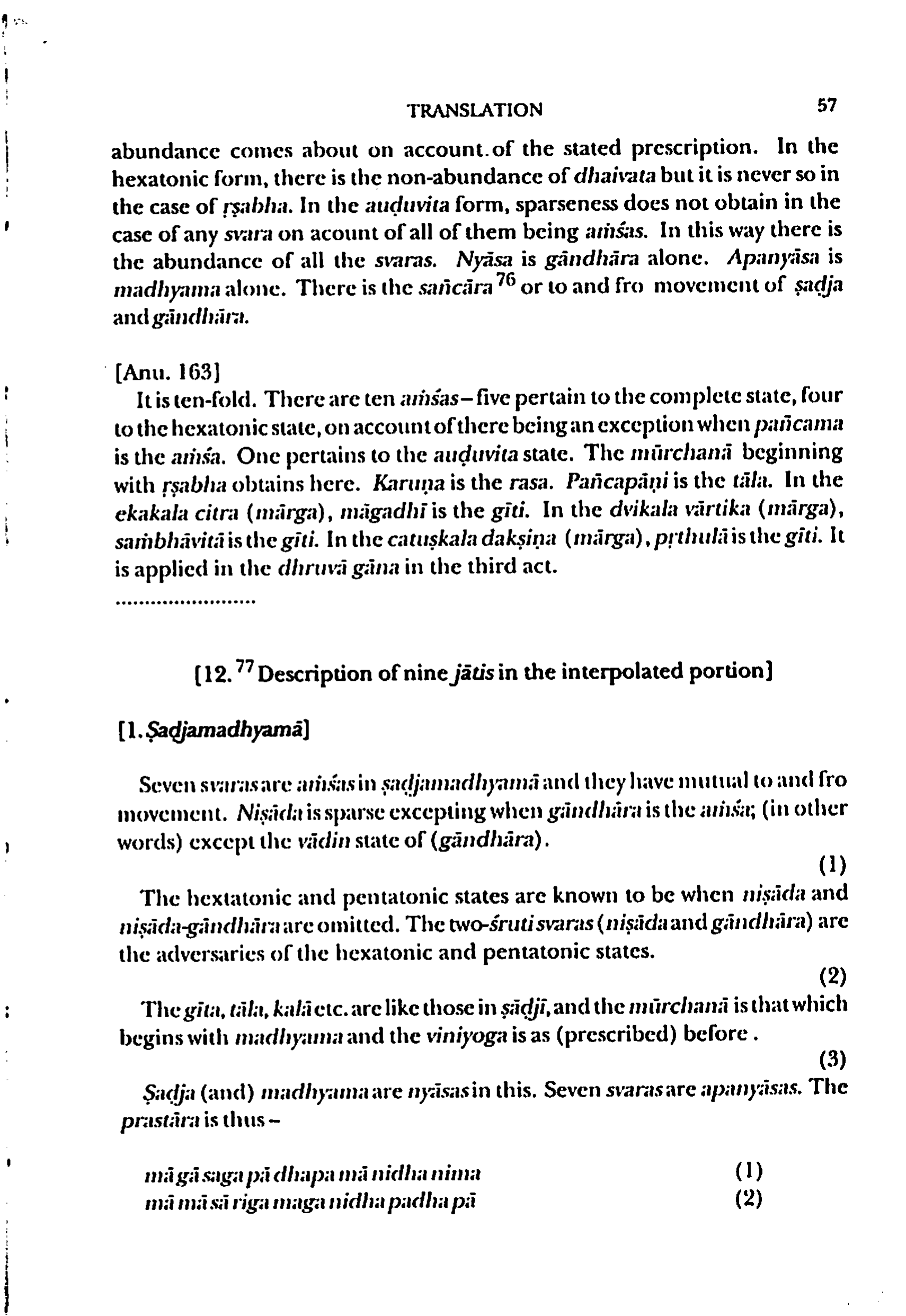
¶ Visi abundance comes about on account of the stated prescription. In the hexatonic form, there is the non-abundance of dhaivata but it is never so in the case of ṛṣabha.11 In the auduvita form, sparseness does not obtain in the case of any svara on acount of all of them being amsas.12 In this way there is the abundance of all the svaras. Nyāsa is gāndhāra alone. Apanyāsa is madhyama alone. There is the sancāra 76 or to and fro movement of sadja and gändhära.2
[Anu. 163]
It is ten-fold. There are ten amsas - five pertain to the complete state, four to the hexatonic state, on account of there being an exception when pañcama is the ainsa. One pertains to the auduvita state. The mūrchanā beginning with ṛṣabha obtains here.9 Karuṇa is the rasa. Pañcapāṇi is the tāla.3 In the ekakala citra (mārga), māgadhī is the gīti. In the dvikala vārtika (mārga), sambhāvitā is the gīti. In the catuṣkala dakṣiṇa (mārga), pṛthulā is the gīti. It is applied in the dhruva gana in the third act. . . . . . . . . . . . . . . . . . . . .
[12. 77 Description of nine jātis in the interpolated portion]
Seven svaras are amśas in şadjamadhyamā and they have mutual to and fro movement.5 Niṣāda is sparse excepting when gāndhāra is the aniśa; (in other words) except the vādin state of (gāndhāra).6
(1)
The hextatonic and pentatonic states are known to be when niṣāda and niṣāda-gāndhāra are omitted.13 The two-śruti svaras (niṣāda and gāndhāra) are the adversaries of the hexatonic and pentatonic states.
(2)
The gīta, tāla, kalā etc. are like those in ṣāḍjī, and the mūrchanā is that which ፥ begins with madhyama and the viniyoga is as (prescribed) before.4
(3)
Ṣadja (and) madhyama are nyāsas in this. Seven svaras are apanyāsas.8 The prastāra is thus - ı (1) mā gā saga pā dhapa mā nidha nima (2) mā mā sā riga maga nidha padha pā10
1.[citation] Visi jāti is discussed in Anu. 163 of the source text[अनु॰ १६३]
2.[definition] Sancāra refers to the to and fro movement of sadja and gāndhāra in Visiषड्जगान्धारयोस्त् सञ्चारः
3.[relation] Pañcapāṇi is the tāla associated with Visiतालः पञ्चपाणिः
4.[relation] The viniyoga of Şadjamadhyamā is prescribed as in the previous jātiपूर्ववद् विनियोजनम्
6.[structural] In Şadjamadhyamā, niṣāda is sparse except when gāndhāra is the vādinनिरल्पोंऽशाद् गादृते वादिता विना
7.[structural] Şadjamadhyamā has two nyāsas: şadja and madhyamaअस्या षड्जमध्यमौ न्यासौ
8.[structural] Şadjamadhyamā has seven apanyāsas (all svaras except the nyāsas)सप्त स्वरा अपन्यासाः
9.[structural] The mūrchanā of Visi begins with ṛṣabhaऋषभादिमूर्छना
12.[structural] In the auduvita form, sparseness does not occur for any svara because all are amsasऔडुविते सर्वेषामंशत्वात्र कस्याप्यल्पत्वम्
13.[structural] The hexatonic and pentatonic states occur when niṣāda and niṣāda-gāndhāra are omittedनिलोपे निगलोपे च षाडवौड्विते मते।
1.[citation]Visi jāti is discussed in Anu. 163 of the source text[Anu. ¹⁶³]
2.[definition]Sancāra refers to the to and fro movement of sadja and gāndhāra in VisiThere is the sancāra 76 or to and fro movement of sadja and gändhära.
3.[relation]Pañcapāṇi is the tāla associated with VisiPañcapāṇi is the tāla.
4.[relation]The viniyoga of Şadjamadhyamā is prescribed as in the previous jātithe viniyoga is as (prescribed) before.
5.[structural]Şadjamadhyamā is a jāti with seven svaras as amsas that have mutual to and fro movementSeven svaras are amśas in şadjamadhyamā and they have mutual to and fro movement.
6.[structural]In Şadjamadhyamā, niṣāda is sparse except when gāndhāra is the vādinNiṣāda is sparse excepting when gāndhāra is the aniśa; (in other words) except the vādin state of (gāndhāra).
7.[structural]Şadjamadhyamā has two nyāsas: şadja and madhyamaṢaḍja (and) madhyama are nyāsas in this.
8.[structural]Şadjamadhyamā has seven apanyāsas (all svaras except the nyāsas)Seven svaras are apanyāsas.
9.[structural]The mūrchanā of Visi begins with ṛṣabhaThe mūrchanā beginning with ṛṣabha obtains here.
10.[structural]The prastāra is a sequential enumeration of svaras following a specified patternThe prastāra is thus - ı (1) mā gā saga pā dhapa mā nidha nima (2) mā mā sā riga maga nidha padha pā
11.[structural]The hexatonic form (şāḍava) has non-abundance of dhaivata but not of ṛṣabhaIn the hexatonic form, there is the non-abundance of dhaivata but it is never so in the case of ṛṣabha.
12.[structural]In the auduvita form, sparseness does not occur for any svara because all are amsasIn the auduvita form, sparseness does not obtain in the case of any svara on acount of all of them being amsas.
13.[structural]The hexatonic and pentatonic states occur when niṣāda and niṣāda-gāndhāra are omittedThe hextatonic and pentatonic states are known to be when niṣāda and niṣāda-gāndhāra are omitted.