Source scans · vol_II_p041
recto · open full
scan recto
verso · open full
scan verso
Bṛhaddeśī · Volume II
pp. 64–65folio 041
Devanāgarī (Bṛhaddeśī)
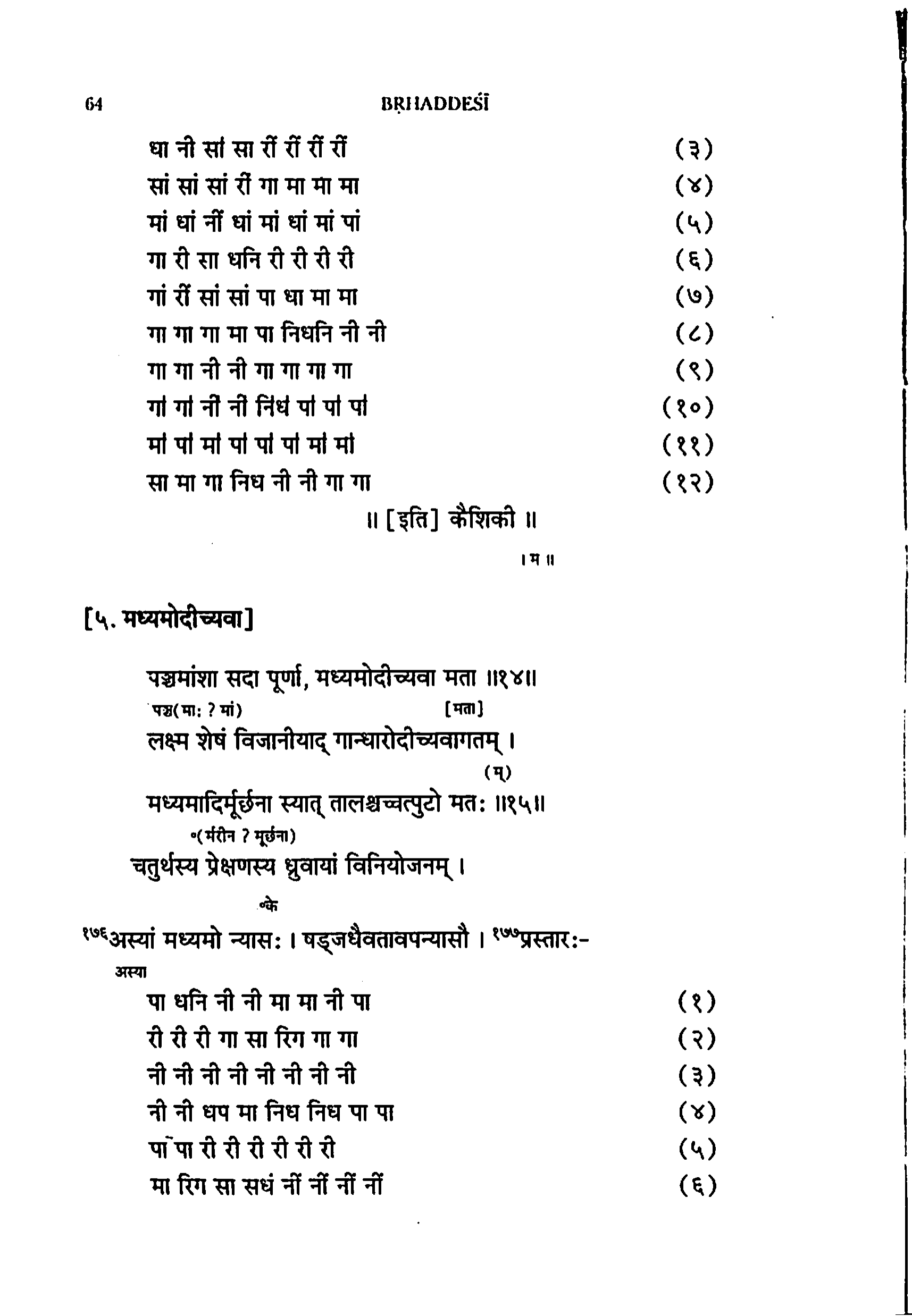
धा नी सां सा रीं रीं रीं रीं
(३)
सां सां सां री गा मा मा मा
(8)
मां धां नीं धां मां धां मां पां
(4)
गारी साधित रीरीरीरी
(६)
गां रीं सां सां पा धा मा मा (v) गा गा गा मा पा निधनि नी नी
(८)
गा गा नी नी गा गा गा गा
(९)
गा गा नी नी निध पा पा पा
(१०)
मां पो मो पो पो मो मो
(११)
सा मा गा निध नी नी गा गा
(१२)
॥ [इति] कैशिकी ॥
[५. मध्यमोदीच्यवा]1 म ॥ पञ्चमांशांपञ्च(मा: ? मां) सदा पूर्णा, मध्यमोदीच्यवा मता ॥१४॥5
[मता]
लक्ष्म शेषं विजानीयाद् गान्धारोदीच्यवागतम्(म्)43 मध्यमादिर्मूर्छना॰(मंरीन ? मूर्छना) स्यात्6 तालश्चचत्पुटो मत: ॥१५॥7
चतुर्थस्य प्रेक्षणस्य ध्रुवायां विनियोजनम्
্ক १७६अस्यांअस्या मध्यमो न्यास: ।8 षड्जधैवतावपन्यासौ ।2 १७७प्रस्तार:-9 पा धनि नी नी मा मा नी पा
(१)
री री री गा सा रिग गा गा
(२)
नी नी नी नी नी नी नी
(3)
नी नी धप मा निध निध पा पा
(8)
पांपारी री री री री री
(4)
मा रिग सा सधं नीं नीं नीं नीं (६)
ordered sequence list
kaiśikī prastāra (continuation) — Continuation of prastāra sequences for kaiśikī jāti (items 3-12), each line numbered, ending with || [iti] kaiśikī ||
index · svaras
index · svaras
index · svaras
index · svaras
index · svaras
index · svaras
index · svaras
index · svaras
index · svaras
index · svaras
— (३)–(१२)
ordered sequence list
madhyamodīcyavā prastāra (beginning) — Beginning of prastāra for jāti #5 madhyamodīcyavā, preceded by definitional verses (14-15) and prose stating madhyama nyāsa, ṣaḍja-dhaivata apanyāsa, prastāra introduced by 'prastāraḥ'
index · svaras
index · svaras
index · svaras
index · svaras
index · svaras
index · svaras
— (१)–(६)
English — Sharma (translation)
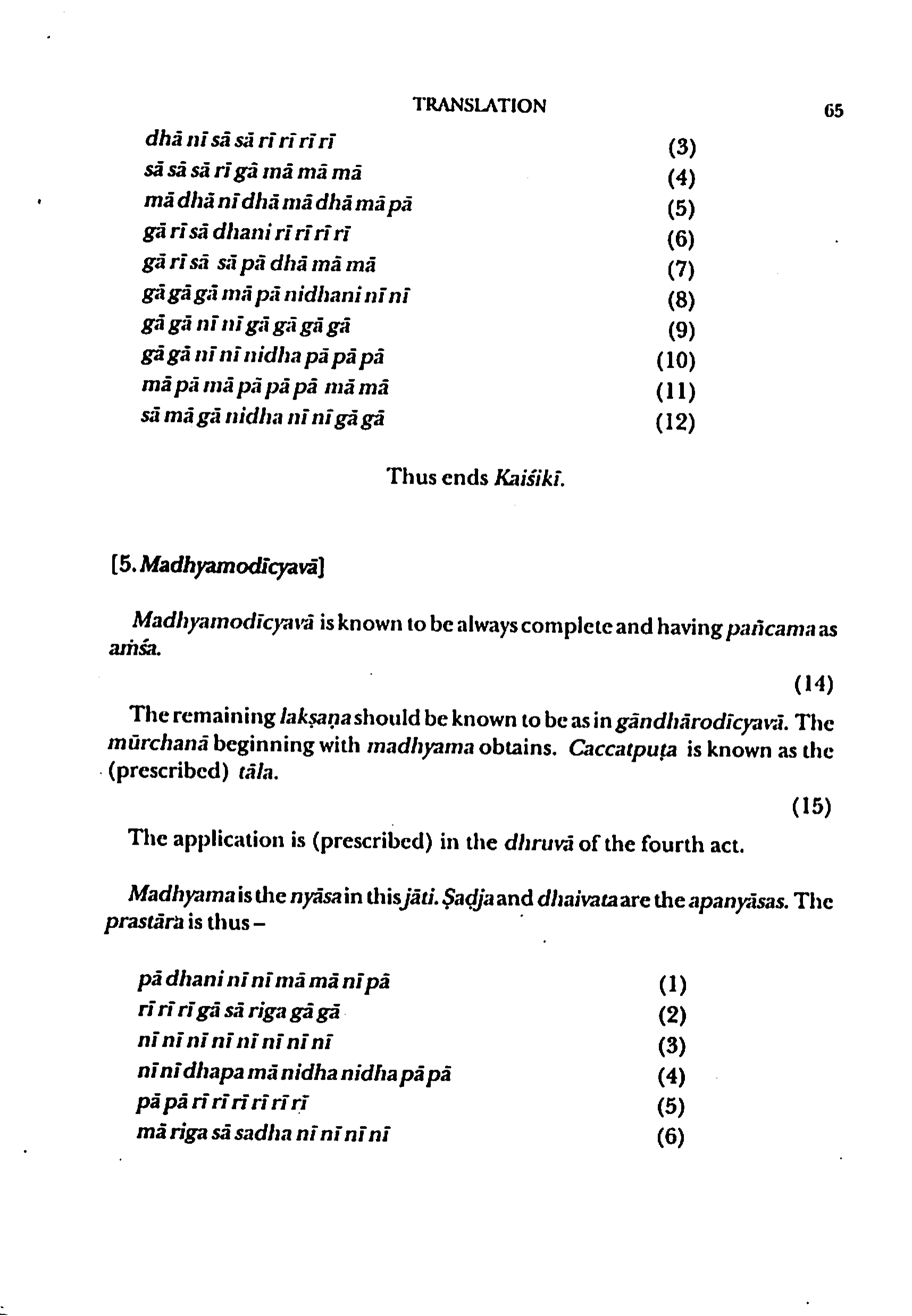
dhā nī sā sā rī rī rī rī
(3)
sā sā sā rī gā mā mā mā
(4)
mā dhā nī dhā mā dhā mā pā . (5) gā rī sā dhani rī rī rī rī
(6)
gā rī sā sā pā dhā mā mā
(7)
gā gā gā mā pā nidhani nī nī
(8)
gã gã nĩ nĩ gã gã gã gã
(9)
gā gā nī nī nidha pā pā pā
(10)
mā pā mā pā pā pā mā mā
(11)
sā mā gā nidha nī nī gā gā
(12)
Thus ends Kaišikī. Madhyamodīcyavā is known to be always complete and having pañcama as amsa.5
(14)
The remaining lakṣaṇa should be known to be as in gāndhārodīcyavā.43 The mūrchanā beginning with madhyama obtains.6 Caccatpuța is known as the (prescribed) tāla.
(15)
The application is (prescribed) in the dhruvā of the fourth act. Madhyama is the nyāsa in this jāti.8 Ṣadja and dhaivata are the apanyāsas. The prastāra is thus –9 pā dhani nī nī mā mā nī pā
(1)
rī rī rī gā sā riga gā gā .
(2)
nī nī nī nī nī nī nī nī
(3)
nī nī dhapa mā nidha nidha pā pā (4) pā pā rī rī rī rī rī rī
(5)
mā riga sā sadha nī nī nī nī
(6)
ordered sequence list
prastara of Kaiśikī jāti (continuation, items 3–12) — Translation, p.65. Numbered svara-phrase prastāra concluding Kaiśikī jāti before 'Thus ends Kaiśikī.'
index · svaras
index · svaras
index · svaras
index · svaras
index · svaras
index · svaras
index · svaras
index · svaras
index · svaras
index · svaras
— (3)–(12)
ordered sequence list
prastara of Madhyamodīcyavā jāti (items 1–6) — Translation, p.65. Section [5. Madhyamodīcyavā], following the statement 'The prastāra is thus —'.
index · svaras
index · svaras
index · svaras
index · svaras
index · svaras
index · svaras
— (1)–(6)
1.[citation]Kaišikī is a named rāga or melodic type documented in this treatise section॥ [इति] कैशिकी ॥
2.[enumeration]Ṣaḍja and dhaivata are the apanyāsas (non-concluding important notes) for Madhyamodīcyavāषड्जधैवतावपन्यासौ ।
3.[relation]The remaining characteristics of Madhyamodīcyavā should be understood as those of gāndhārodīcyavāलक्ष्म शेषं विज?ानीयाद् गान्धारोदीच्यवागतम्
4.[relation]Gāndhārodīcyavā serves as a reference type for understanding the remaining characteristics of Madhyamodīcyavāलक्ष्म शेषं विज?ानीयाद् गान्धारोदीच्यवागतम्
5.[structural]Madhyamodīcyavā is always complete and has pañcama as its amsa (characteristic pitch)पञ्चमांशा सदा पूर्णा, मध्यमोदीच्यवा मता ॥१४॥
6.[structural]A mūrchanā (melodic progression) beginning with madhyama is prescribed for Madhyamodīcyavāमध्यमादिर्मूर्छना स्यात्
7.[structural]Caccatpuța is the prescribed tāla for Madhyamodīcyavāतालश्चचत्पुटो मतः ॥१५॥
8.[structural]Madhyama is the nyāsa (concluding note) in the Madhyamodīcyavā jātiअस्या मध्यमो न्यासः ।
9.[structural]A prastāra (systematic melodic elaboration) is provided for the Madhyamodīcyavā jātiप्रस्तारः-
1.[citation] Kaišikī is a named rāga or melodic type documented in this treatise sectionThus ends Kaišikī.
2.[enumeration] Ṣaḍja and dhaivata are the apanyāsas (non-concluding important notes) for MadhyamodīcyavāṢaḍja and dhaivata are the apanyāsas.
3.[relation] The remaining characteristics of Madhyamodīcyavā should be understood as those of gāndhārodīcyavāThe remaining lakṣaṇa should be known to be as in gāndhārodīcyavā.
4.[relation] Gāndhārodīcyavā serves as a reference type for understanding the remaining characteristics of MadhyamodīcyavāThe remaining lakṣaṇa should be known to be as in gāndhārodīcyavā.
5.[structural] Madhyamodīcyavā is always complete and has pañcama as its amsa (characteristic pitch)Madhyamodīcyavā is known to be always complete and having pañcama as amsa.
6.[structural] A mūrchanā (melodic progression) beginning with madhyama is prescribed for MadhyamodīcyavāThe mūrchanā beginning with madhyama obtains.
7.[structural] Caccatpuța is the prescribed tāla for MadhyamodīcyavāCaccatpuța is known as the (prescribed) tāla.
8.[structural] Madhyama is the nyāsa (concluding note) in the Madhyamodīcyavā jātiMadhyama is the nyāsa in this jāti.
9.[structural] A prastāra (systematic melodic elaboration) is provided for the Madhyamodīcyavā jātiThe prastāra is thus –