Source scans · vol_II_p056
recto · open full
scan recto
verso · open full
scan verso
Bṛhaddeśī · Volume II
pp. 94–95folio 056
Devanāgarī
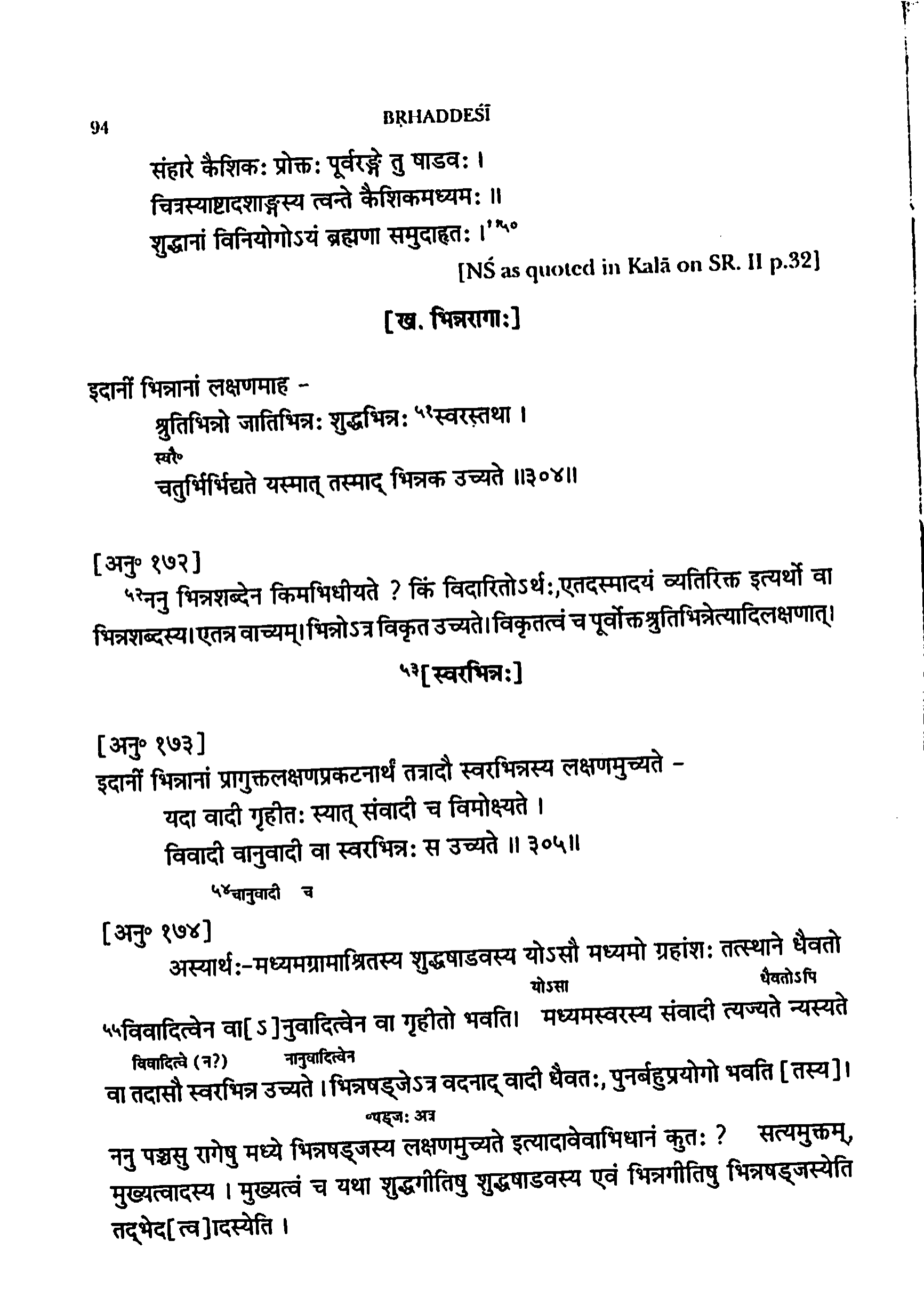
संहारे कैशिक: प्रोक्त: पूर्वरङ्गे तु षाडव:7
चित्रस्याष्टादशाङ्गस्य त्वन्ते कैशिकमध्यमः॥
शुद्धानां विनियोगोऽयं ब्रह्मणा समुदाहतः ।'"५०
[NŚ as quoted in Kalā on SR. II p.32]
[ख. भिन्नरागाः]
इदानीं भिन्नानां लक्षणमाह -
श्रुतिभिन्नोस्वरै॰ जातिभिन्नः शुद्धभिन्नः ५१स्वरस्तथा ।
चतुर्धिर्भिद्यते यस्मात् तस्माद् भित्रक उच्यते ॥३०४॥
[अनुः १७२]
५२ननु भित्रशब्देन किमभिधीयते ? किं विदारितोऽर्थः, एतदस्मादयं व्यतिरिक्त इत्यर्थो वा भित्रशब्दस्य। एतत्र वाच्यम्। भित्रोऽत्र विकृत उच्यते। विकृतत्वं च पूर्वोक्तश्रुतिभित्रेत्यादिलक्षणात्।3 ५३[स्वरभिन्न:]
[अनु॰ १७३]
इदानीं भिन्नानां प्रागुक्तलक्षणप्रकटनार्थं तत्रादौ स्वरभिन्नस्य लक्षणमुच्यते - यदा वादी गृहीत: स्यात् संवादी च विमोक्ष्यते । विवादी वानुवादी५४चानुवादी च वा स्वरिभन्न: स उच्यते4 ॥३०५॥
[अन्॰ १७४]
अस्यार्थ:-मध्यमग्रामाश्रितस्यनानुवादित्वेनविवादित्वे (न?)व्यह्ज: अत्र शुद्धषाडवस्य योऽसौयोऽसा मध्यमो ग्रहांश: तत्स्थानेधैवतोऽपि धैवतो5 ५५विवादित्वेन वा[ऽ]नुवादित्वेन वा गृहीतो भवति। मध्यमस्वरस्य संवादी त्यज्यते न्यस्यते
वा तदासौ स्वरिभन्न उच्यते । भिन्नषड्जेऽत्र वदनाद् वादी धैवतः, पुनर्बहुप्रयोगो भवति [तस्य]।
ननु पश्चसु रागेषु मध्ये भित्रषड्जस्य लक्षणमुच्यते इत्यादावेवाभिधानं कृत:?सत्यमुक्तम् मुख्यत्वादस्य । मुख्यत्वं च यथा शुद्धगीतिषु शुद्धषाडवस्य एवं भिन्नगीतिषु भिन्नषड्जस्येति
तद्भेद[त्व]ादस्येति6
English — Sharma (translation)
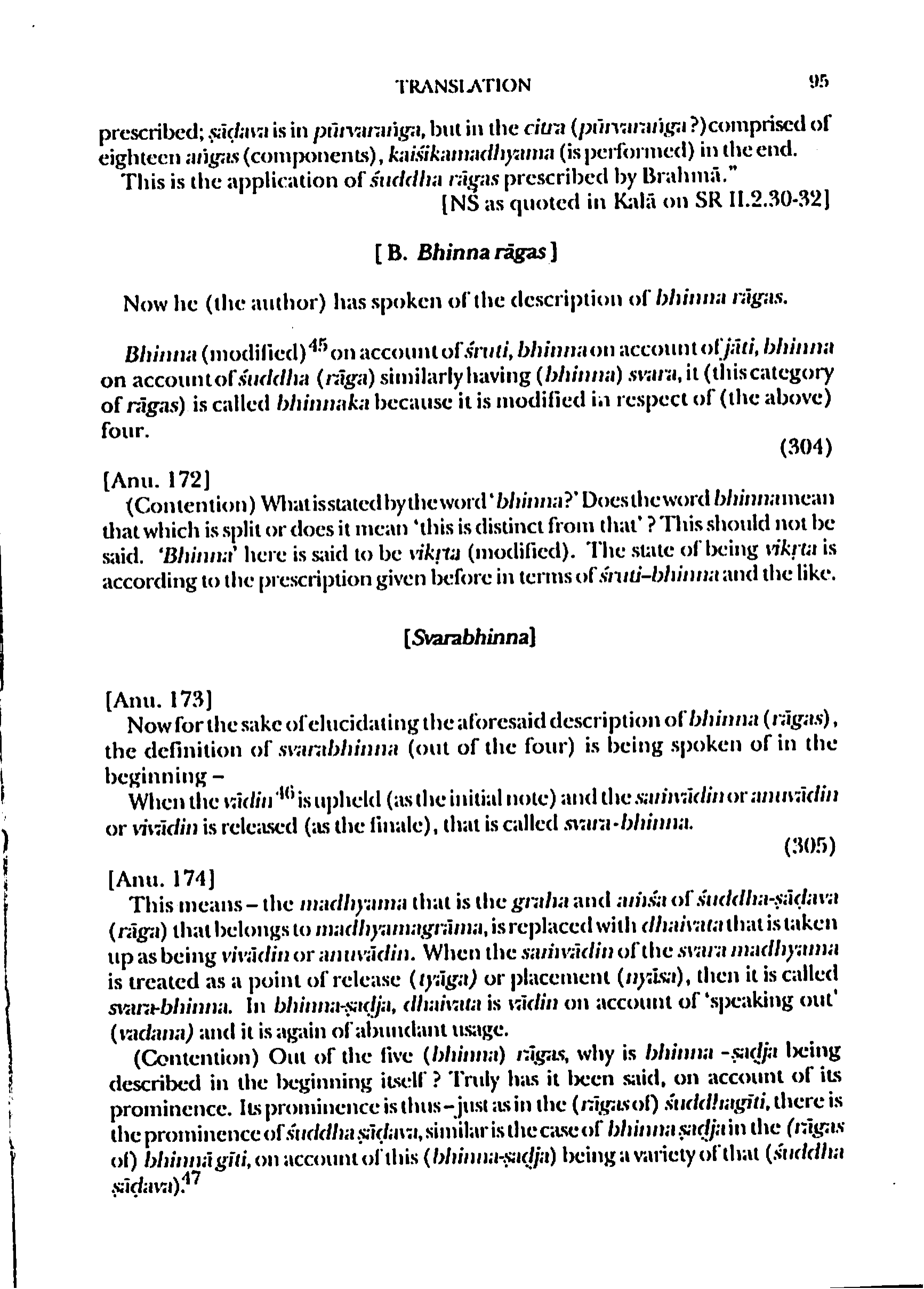
prescribed; ṣāḍava is in pūrvaranga7, but in the citra (pūrvaranga?)comprised of eighteen aigas (components), kaišikamadhyama (is performed) in the end. This is the application of śuddha rāgas prescribed by Brahmā."
[NS as quoted in Kalā on SR II.2.30-32]
Now he (the author) has spoken of the description of bhinna rāgas. Bhinna (modified) 45 on account of śruti, bhinna on account of jāti, bhinna on account of śuddha (rāga) similarly having (bhinna) svara, it (this category of rāgas) is called bhinnaka because it is modified in respect of (the above) four.2
(304)
[Anu. 172]
(Contention) Whatisstated by the word 'bhinna?' Does the word bhinnamean that which is split or does it mean 'this is distinct from that'? This should not be said. 'Bhinna' here is said to be vikṛta (modified). The state of being vikṛta is according to the prescription given before in terms of śruti-bhinna and the like.3
[Anu. 173]
Now for the sake of elucidating the aforesaid description of bhinna (rāgas), the definition of svarabhinna (out of the four) is being spoken of in the beginning - When the <math>v\bar{a}din^{46}</math> is upheld (as the initial note) and the <math>sainv\bar{a}din</math> or <math>anuv\bar{a}din</math> or vivādin is released (as the finale), that is called svara-bhinna.
(305)
[Anu. 174]
This means – the madhyama that is the graha and amsa of suddha-sādava (rāga) that belongs to madhyamagrāma, is replaced with dhaivata5 that is taken up as being vivādin or anuvādin. When the samvādin of the svara madhyama is treated as a point of release (tyāga) or placement (nyāsa), then it is called svara-bhinna. In bhinna-ṣaḍja, dhaivata is vādin on account of 'speaking out' (vadana) and it is again of abundant usage. (Contention) Out of the five (bhinna) rāgas, why is bhinna -ṣaḍja being described in the beginning itself? Truly has it been said, on account of its prominence.8 Its prominence is thus-just as in the (rāgas of) śuddhagīti, there is the prominence of śuddha ṣāḍava, similar is the case of bhinna ṣaḍjain the (rāgas of) bhinna gīti, on account of this (bhinna-ṣadja) being a variety of that (śuddha sādava).47
2.[definition]Bhinna rāgas are modified in respect of four categories: śruti, jāti, śuddha rāga, and svaraश्रुतिभिन्नो ज?ातिभिन्नः शुद्धभिन्नः स्वरस्तथा । स्वरै॰ चतुर्धिर्भिद्यते यस्मात् तस्माद् भित्रक उच्यते
3.[definition]The term bhinna is understood as vikṛta (modified), characterized by the distinctions of śruti-bhinna and similar categoriesभित्रोऽत्र विकृत उच्यते। विकृतत्वं च पूर्वोक्तश्रुतिभित्रेत्यादिलक्षणात्।
4.[definition]Svarabhinna is defined as when the vādin is upheld as initial note and the sainvādin, anuvādin, or vivādin is released as finaleयदा वादी गृहीतः स्यात् संवादी च विमोक्ष्यते । विवादी वानुवादी वा स्वरिभन्नः स उच्यते
5.[structural]In svarabhinna, the madhyama note of śuddha-ṣāḍava is replaced with dhaivata functioning as vivādin or anuvādinमध्यमग्रामाश्रितस्य शुद्धषाडवस्य योऽसौ मध्यमो ग्रहांशः तत्स्थाने धैवतो
6.[structural]In bhinnagīti rāgas, bhinna-ṣaḍja holds prominence, being a variety of śuddha ṣāḍavaभिन्नगीतिषु भिन्नषड्जस्येति तद्भेद[त्व]ादस्येति
7.[structural]The ṣāḍava rāga is prescribed in the pūrvaraṅga (preliminary section)पूर्वरङ्गे तु षाडवः
8.[structural] Among the five bhinna rāgas, bhinna-ṣaḍja is described first on account of its prominenceसत्यमुक्तम्
9.[structural]In śuddhagīti rāgas, śuddha ṣāḍava holds prominenceजैसा शुद्धगीतिषु शुद्धषाडवस्य एवं भिन्नगीतिषु भिन्नषड्जस्य
1.[citation]The cited verse on śuddha rāga applications is found in the Kalā commentary on the Sangīta-Ratnākara[NŚ as quoted in Kalā on SR. II p.32]
2.[definition] Bhinna rāgas are modified in respect of four categories: śruti, jāti, śuddha rāga, and svaraBhinna (modified) 45 on account of śruti, bhinna on account of jāti, bhinna on account of śuddha (rāga) similarly having (bhinna) svara, it (this category of rāgas) is called bhinnaka because it is modified in respect of (the above) four.
3.[definition] The term bhinna is understood as vikṛta (modified), characterized by the distinctions of śruti-bhinna and similar categories'Bhinna' here is said to be vikṛta (modified). The state of being vikṛta is according to the prescription given before in terms of śruti-bhinna and the like.
5.[structural] In svarabhinna, the madhyama note of śuddha-ṣāḍava is replaced with dhaivata functioning as vivādin or anuvādinthe madhyama that is the graha and amsa of suddha-sādava (rāga) that belongs to madhyamagrāma, is replaced with dhaivata
7.[structural] The ṣāḍava rāga is prescribed in the pūrvaraṅga (preliminary section)ṣāḍava is in pūrvaranga
8.[structural]Among the five bhinna rāgas, bhinna-ṣaḍja is described first on account of its prominenceTruly has it been said, on account of its prominence.