Source scans · vol_II_p055
recto · open full
scan recto
verso · open full
scan verso
Bṛhaddeśī · Volume II
pp. 92–93folio 055
Devanāgarī (Bṛhaddeśī)
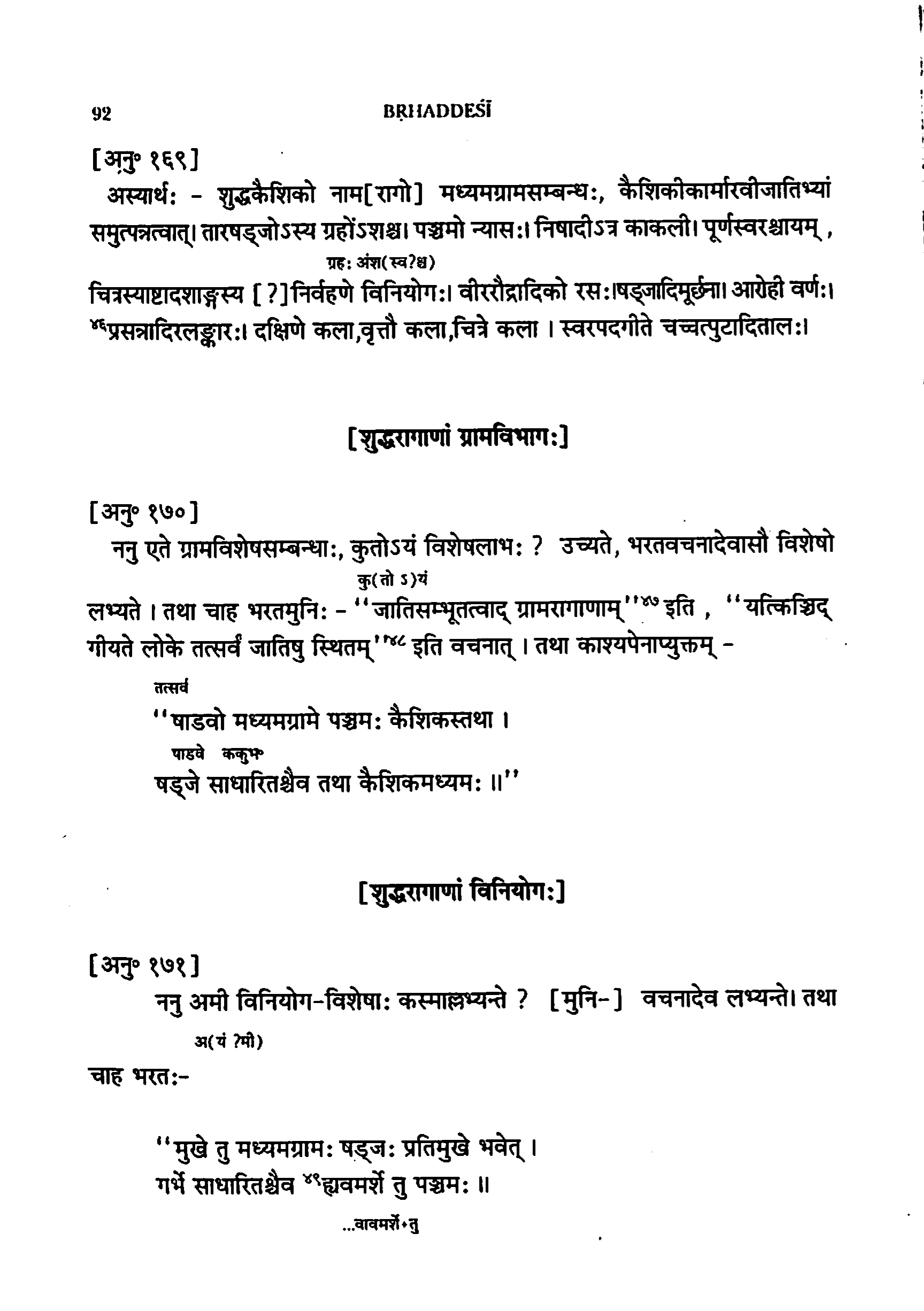
[अनुः १६९]
अस्यार्थ: - शुद्धकैशिको नाम[रागो] मध्यमग्रामसम्बन्धः, कैशिकोकार्मारवीजातिभ्यां समुत्पन्नत्वात्7तारषड्जोऽस्य ग्रहोंऽशश्च10ग्रह: अंश(स्व?ध)पञ्चमो न्यासः11निषादीऽत्र काकली8। पूर्णस्वरश्चायम् ,
चित्रस्याष्ट्रादशाङ्गस्य [?]निर्वहणे विनियोगः। वीररौद्रादिको रसः15षङ्जादिमूर्छना12आरोही वर्णः13
४६प्रसन्नादिरलङ्कार:14। दक्षिणे कला,वृत्तौ कला,चित्रे कला । स्वरपदगीते चच्चत्पुटादिताल:।
[शुद्धरागाणां ग्रामविभागः]
[अनु॰ १७०]
ननु एते ग्रामविशेषसम्बन्धाः, कुतोऽयंकु(तो ऽ)यं विशेषलाभः ? उच्यते, भरतवचनादेवासौ विशेषो लभ्यते । तथा चाह भरतमुनि: - ''जातिसम्भूतत्वाद् ग्रामरागाणाम्''४० इति , ''यत्किञ्चिद् गीयते लोकेतत्सर्व तत्सर्वं जातिषु स्थितम् ' '४८ इति वचनात् । तथा काश्यपेनाप्युक्तम् -
''षाडवोपाडवे ककुभ् मध्यमग्रामे पञ्चम: कैशिकस्तथा ।
षड्जे साधारितश्चैव तथा कैशिकमध्यम:॥'' [शुद्धरागाणांअ(यं ?मी)चाह भरत:- विनियोगः]
[अनु॰ १७१]
ननु अमी विनियोग-विशेषा: कस्माल्लभ्यन्ते ? [मुनि-] वचनादेव लभ्यन्ते। तथा
‘‘मुखे तु मध्यमग्राम: षड्ज: प्रतिमुखे भवेत्1
गर्भे साधारितश्चैव2 ४९ह्मवमर्शे...वावमर्शे • तु तु पञ्चम:3
English — Sharma (translation)
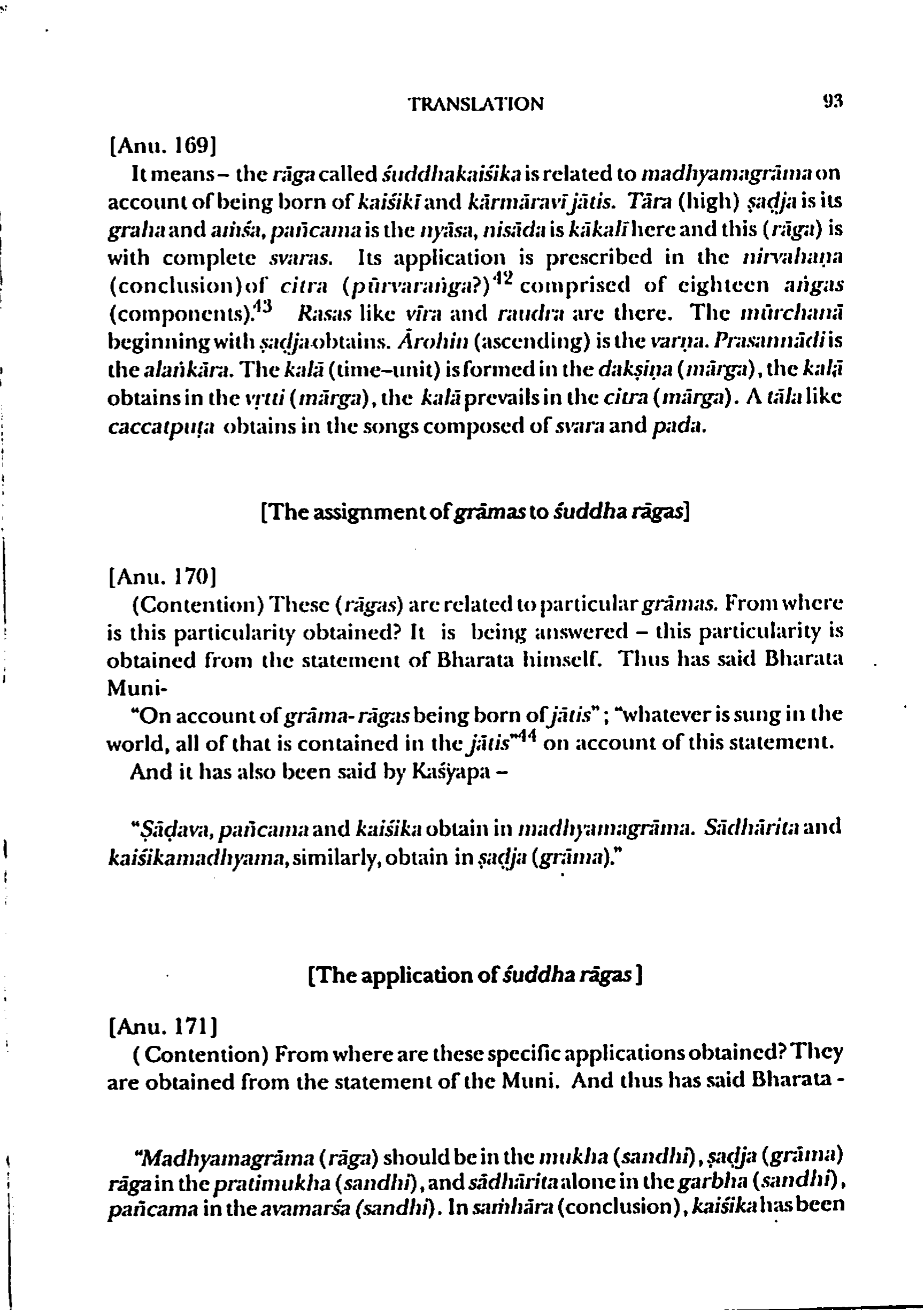
[Anu. 169]
It means - the rāga called śuddhakaiśika is related to madhyamagrāma on account of being born of kaišikī and kārmāravī jātis7. Tāra (high) şadja is its graha and amśa, pańcama is the nyāsa11, nisāda is kākalī here8 and this (rāga) is with complete svaras. Its application is prescribed in the nirvahana (conclusion) of citra (pūrvaranga?) 42 comprised of eighteen angas (components).43 Rasas like vīra and raudra are there.15 The mūrchanā beginning with sadja obtains12. Arohin (ascending) is the varṇa13. Prasannādi is the alankāra. The kalā (time-unit) is formed in the dakṣiṇa (mārga), the kalā obtains in the vṛtti (mārga), the kalā prevails in the citra (mārga). A tāla like caccatputa obtains in the songs composed of svara and pada.
[The assignment of grāmas to śuddha rāgas]
[Anu. 170]
(Contention) These (rāgas) are related to particular grāmas. From where is this particularity obtained? It is being answered - this particularity is obtained from the statement of Bharata himself. Thus has said Bharata Muni- "On account of grāma-rāgas being born of jātis4"; "whatever is sung in the world, all of that is contained in the jātis5"44 on account of this statement. And it has also been said by Kasyapa - "Şādava, pañcama and kaiśika obtain in madhyamagrāma.9 Sādhārita and kaišikamadhyama, similarly, obtain in sadja (grāma)."
[The application of suddha ragas]
[Anu. 171]
(Contention) From where are these specific applications obtained? They are obtained from the statement of the Muni. And thus has said Bharata - "Madhyamagrāma (rāga) should be in the mukha (sandhi)6, şadja (grāma) rāgain the pratimukha (sandhi), and sādhārita alone in the garbha (sandhi)2, pañcama in the avamarśa (sandhi)3. In samhāra (conclusion), kaiśika has been
1.[attribution]Şadja grāma rāga should be in the pratimukha (sandhi) according to Bharataषड्ज?: प्रतिमुखे भवेत्
2.[attribution]Sādhārita rāga should be placed in the garbha (sandhi) according to Bharataगर्भे साधारितश्चैव
3.[attribution]Pañcama should be in the avamarśa (sandhi) according to Bharataह्मवमर्शे तु पञ्चमः
4.[attribution]Grāma-rāgas are born from jātis according to Bharata"ज?ातिसम्भूतत्वाद् ग्रामरागाणाम्"
5.[attribution]All that is sung in the world is contained in the jātis, according to Bharata"यत्किञ्चिद् गीयते लोके तत्सर्वं ज?ातिषु स्थितम्"
6.[attribution]Madhyamagrāma rāga should be placed in the mukha (sandhi) according to Bharata"मुखे तु मध्यमग्रामः
7.[definition]śuddhakaiśika is a rāga related to madhyamagrāma, born from kaišikī and kārmāravī jātisशुद्धकैशिको नाम[रागो] मध्यमग्रामसम्बन्धः, कैशिकोकार्मारवीज?ातिभ्या समुत्पन्नत्वात्
8.[relation]Nisāda is identified as kākalī in śuddhakaiśikaनिषादीऽत्र काकली
9.[relation]Śādava, pañcama, and kaiśika obtain in madhyamagrāma according to Kasyapa"षाडवो मध्यमग्रामे पञ्चमः कैशिकस्तथा
10.[structural]In śuddhakaiśika, tāra (high) şadja serves as both graha and aṁśaतारषड्ज?ोऽस्य ग्रहोंऽशश्च
11.[structural]Pañcama functions as the nyāsa in śuddhakaiśika rāgaपञ्चमो न्यासः
12.[structural]The mūrchanā of śuddhakaiśika begins with sadjaषङ्ज?ादिमूर्छना
13.[structural]The varṇa of śuddhakaiśika is arohin (ascending)आरोही वर्णः
14.[structural]Prasannādi is the alaṅkāra employed in śuddhakaiśikaप्रसन्नादिरलङ्कारः
15.[structural]Vīra and raudra rasas are attributed to śuddhakaiśikaवीररौद्रादिको रसः
2.[attribution] Sādhārita rāga should be placed in the garbha (sandhi) according to Bharatasādhārita alone in the garbha (sandhi)
3.[attribution] Pañcama should be in the avamarśa (sandhi) according to Bharatapañcama in the avamarśa (sandhi)
4.[attribution] Grāma-rāgas are born from jātis according to BharataOn account of grāma-rāgas being born of jātis
5.[attribution] All that is sung in the world is contained in the jātis, according to Bharatawhatever is sung in the world, all of that is contained in the jātis
6.[attribution] Madhyamagrāma rāga should be placed in the mukha (sandhi) according to BharataMadhyamagrāma (rāga) should be in the mukha (sandhi)
7.[definition] śuddhakaiśika is a rāga related to madhyamagrāma, born from kaišikī and kārmāravī jātisthe rāga called śuddhakaiśika is related to madhyamagrāma on account of being born of kaišikī and kārmāravī jātis
8.[relation] Nisāda is identified as kākalī in śuddhakaiśikanisāda is kākalī here
9.[relation] Śādava, pañcama, and kaiśika obtain in madhyamagrāma according to KasyapaŞādava, pañcama and kaiśika obtain in madhyamagrāma.
10.[structural] In śuddhakaiśika, tāra (high) şadja serves as both graha and aṁśaTāra (high) şadja is its graha and aṁśa
11.[structural] Pañcama functions as the nyāsa in śuddhakaiśika rāgapańcama is the nyāsa
12.[structural] The mūrchanā of śuddhakaiśika begins with sadjaThe mūrchanā beginning with sadja obtains
13.[structural] The varṇa of śuddhakaiśika is arohin (ascending)Arohin (ascending) is the varṇa
14.[structural] Prasannādi is the alaṅkāra employed in śuddhakaiśikaPrasannādi is the alaṅkāra
15.[structural] Vīra and raudra rasas are attributed to śuddhakaiśikaRasas like vīra and raudra are there.