Source scans · vol_II_p065
recto · open full
scan recto
verso · open full
scan verso
Bṛhaddeśī · Volume II
pp. 112–113folio 065
Devanāgarī
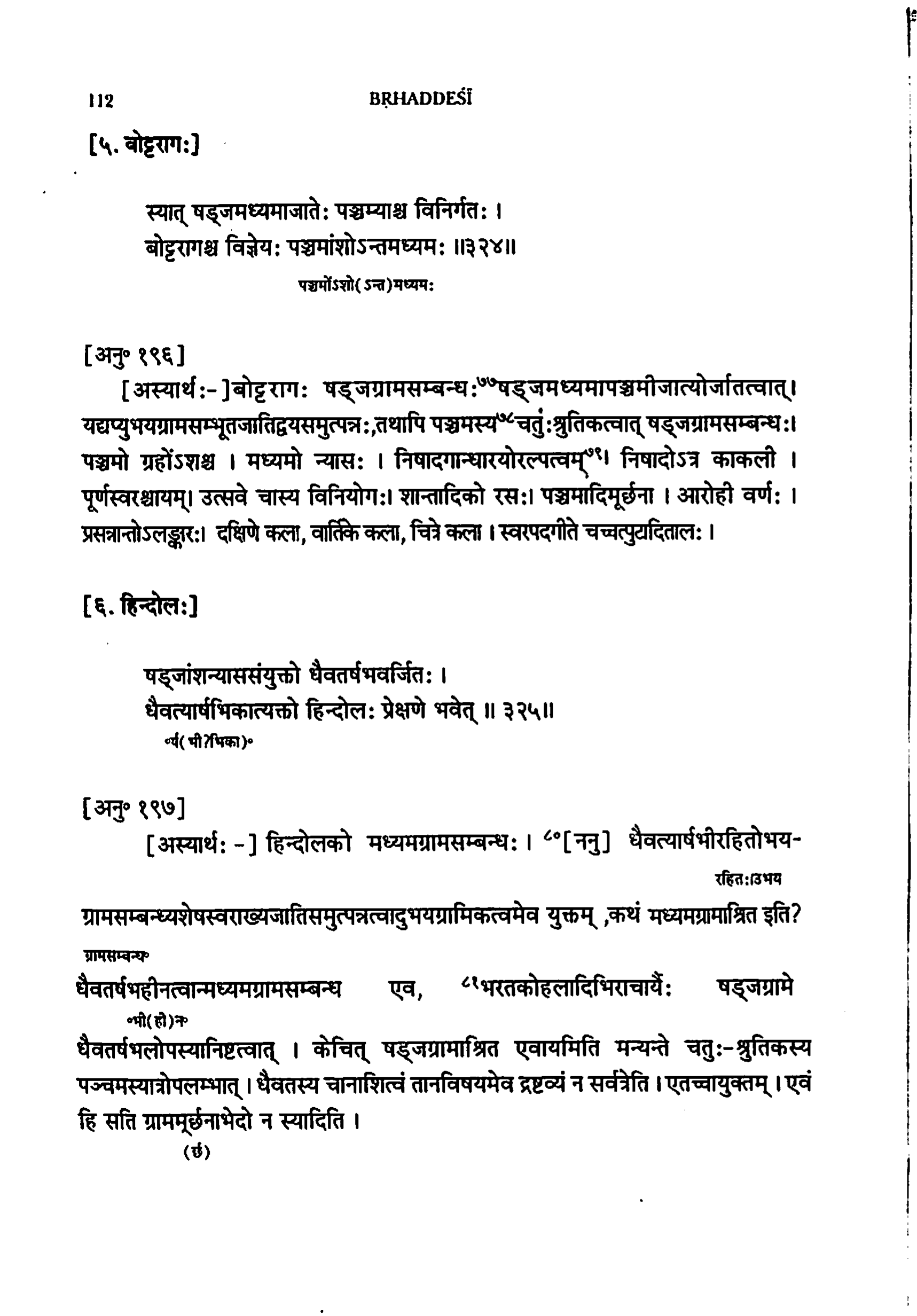
स्यात् षड्जमध्यमाजाते: पञ्चम्याश्च विनिर्गत:2
बोट्टरागश्च विज्ञेय: पञ्चमांशोऽन्तमध्यम:7पञ्चमोंऽशो( ऽन्त)मध्यमः ॥३२४॥
[अनुः १९६]
[अस्यार्थ:-]बोट्टराग: षड्जग्रामसम्बन्ध:७७षड्जमध्यमापञ्चमीजात्योर्जातत्वात्।
यद्यप्युभयग्रामसम्भूतजातिद्वयसमुत्पन्नः,तथापि पञ्चमस्य७८चतुंःश्रुतिकत्वात् षड्जग्रामसम्बन्धः5
पञ्चमो ग्रहोंऽशश्च । मध्यमो न्यास: । निषादगान्धारयोरल्पत्वम्७९निषादोऽत्र काकली11
पूर्णस्वरश्चायम्। उत्सवे चास्य विनियोगः8। शान्तादिको रसः। पञ्चमादिमूर्छना9 । आरोही वर्णः ।
प्रसन्नान्तोऽलङ्कारः12। दक्षिणे कला, वार्तिक कला, चित्रे कला । स्वरपदगीते चच्चत्पुटादितालः ।
[६. हिन्दोल:]
षड्जांशन्याससंयुक्तो धैवतर्षभवर्जित:10
धैवत्यार्षभिकात्यक्तोर्व्य(भी?भिका)॰ हिन्दोल: प्रेक्षणे भवेत् ॥३२५॥ [अनु॰ १९७]रहित:।उभय [अस्यार्थ: -] हिन्दोलको मध्यमग्रामसम्बन्ध:3°[ननु] धैवत्यार्षभीरहितोभय- ग्रामसम्बन्ध्यशेषस्वराख्यजातिसमुत्पत्रत्वादुभयग्रामिकत्वमेवग्रामसम्बन्धः युक्तम् ,कथं मध्यमग्रामाश्रित इति? धैवतर्षभहीनत्वान्मध्यमग्रामसम्बन्ध॰भी(ही)क एव, ८१भरतकोहलादिभिराचार्यै:षड्जग्रामे धैवतर्षभलोपस्यानिष्टत्वात् । केचित् षड्जग्रामाश्रित एवायमिति मन्यन्ते चतुः-श्रुतिकस्य पञ्चमस्यात्रोपलम्भात् । धैवतस्य चानाशित्वं तानविषयमेव द्रष्टव्यं न सर्वत्रेति । एतच्चायुक्तम् । एवं
हि सित ग्राममूर्छनाभेदो(छ) न स्यादिति4
English — Sharma (translation)
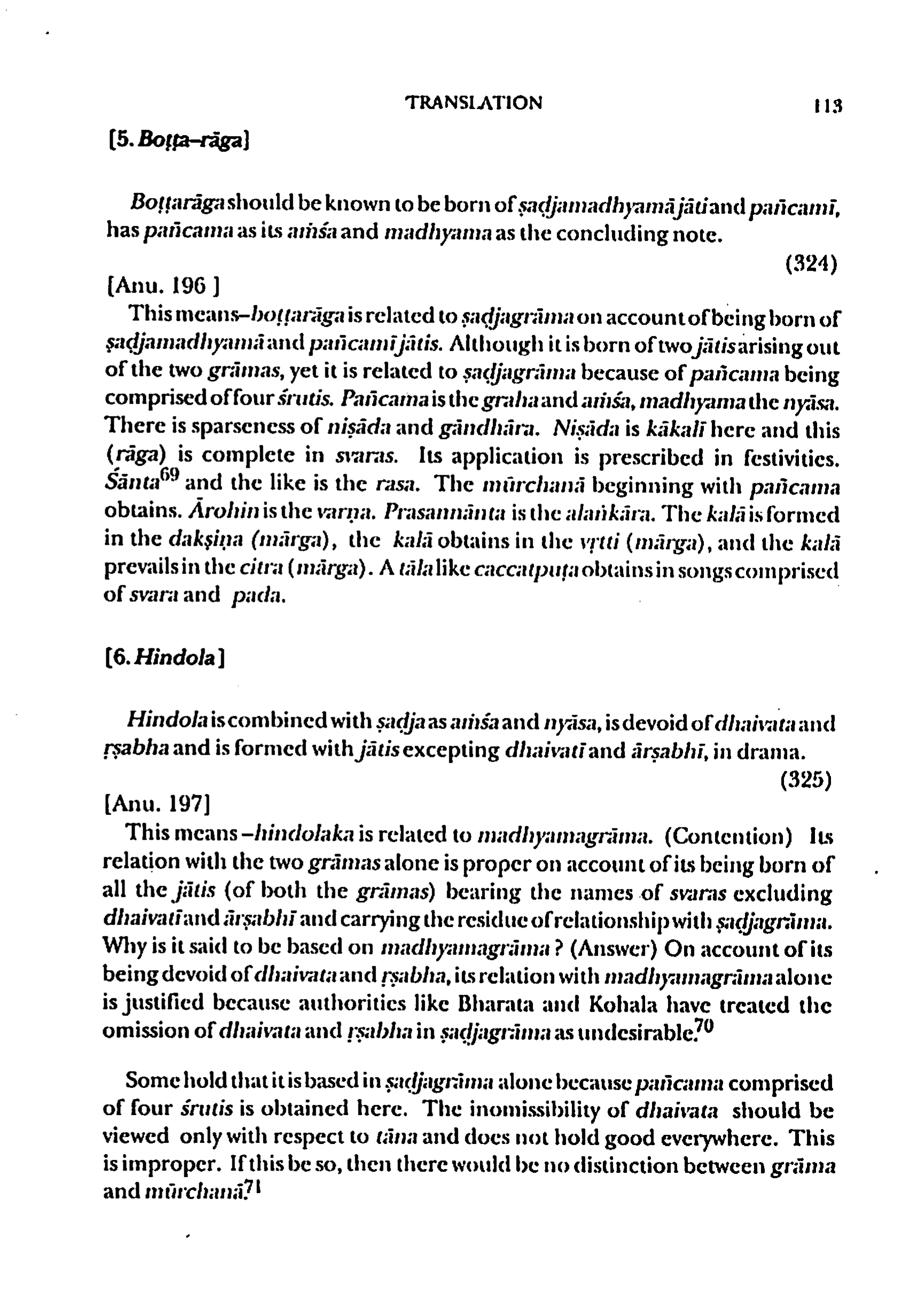
Boṭṭarāgashould be known to be born of ṣaḍjamadhyamājāti and pancamī2, has pañcama as its amsa and madhyama as the concluding note7.
(324)
[Anu. 196]
This means-bottarāga is related to ṣaḍjagrāma on account of being born of şadjamadhyamā and pancamī jātis. Although it is born of two jātis arising out of the two grāmas, yet it is related to sadjagrāma because of pañcama being comprised of four śrutis5. Pañcama is the graha and aniśa, madhyama the nyāsa. There is sparseness of niṣāda and gāndhāra. Niṣāda is kākalī here11 and this (rāga) is complete in svaras. Its application is prescribed in festivities8. Śānta69 and the like is the rasa. The mūrchanā beginning with paūcama obtains9. Ārohin is the varņa. Prasannānta is the alankāra. The kalā is formed in the dakṣiṇa (mārga), the kalā obtains in the vṛtti (mārga), and the kalā prevails in the citra (mārga). A tāla like caccatpuţa obtains in songs comprised of svara and pada.
[6. Hindola]
Hindolais combined with ṣaḍja as amśa and nyāsa, is devoid of dhaivata and ṛṣabha and is formed with jātis excepting dhaivatī and ārṣabhī, in drama.
(325)
[Anu. 197]
This means -hindolaka is related to madhyamagrāma3. (Contention) Its relation with the two grāmas alone is proper on account of its being born of all the jātis (of both the grāmas) bearing the names of svaras excluding dhaivatī and ārṣabhī and carrying the residue of relationship with ṣaḍjagrāma. Why is it said to be based on madhyamagrāma? (Answer) On account of its being devoid of dhaivata and ṛṣabha, its relation with madhyamagrāma alone is justified because authorities like Bharata and Kohala have treated the omission of dhaivata and ṛṣabha in ṣadjagrāma as undesirable1.670 Some hold that it is based in sadjagrāma alone because pañcama comprised of four śrutis is obtained here. The inomissibility of dhaivata should be viewed only with respect to tāna and does not hold good everywhere. This is improper. If this be so, then there would be no distinction between grāma and mürchanā471 ,
1.[attribution]Bharata and Kohala are authorities who treat the omission of dhaivata and ṛṣabha in ṣaḍjagrāma as undesirableभरतकोहलादिभिराचार्यैः षड्जग्रामे धैवतर्षभलोपस्यानिष्टत्वात्
2.[definition]Boţţa-rāga is born from ṣaḍjamadhyamā and pancamī jātisस्यात् षड्जमध्यमाज?ातेः पञ्चम्याश्च विनिर्गतः
3.[relation]Hindola is related to madhyamagrāmaहिन्दोलको मध्यमग्रामसम्बन्धः
4.[relation]Mūrchanā and grāma are conceptually distinct entitiesग्राममूर्छनाभेदो न स्यादिति
5.[relation]Boţţa-rāga is related to ṣaḍjagrāma because pañcama comprises four śrutisयद्यप्युभयग्रामसम्भूतजातिद्वयसमुत्पन्नः,तथापि पञ्चमस्य चतुःश्रुतिकत्वात् षड्जग्रामसम्बन्धः
6.[relation]Hindola's relation with madhyamagrāma is justified because of absence of dhaivata and ṛṣabha, which authorities like Bharata and Kohala treat as undesirable in ṣaḍjagrāmaधैवतर्षभहीनत्वान्मध्यमग्रामसम्बन्ध एव, भरतकोहलादिभिराचार्यैः षड्जग्रामे धैवतर्षभलोपस्यानिष्टत्वात्
7.[structural]Boţţa-rāga has pañcama as its amśa (characteristic note) and madhyama as its nyāsa (concluding note)बोट्टरागश्च विज?्ञेयः पञ्चमांशोऽन्तमध्यमः
8.[structural]Boţţa-rāga is prescribed for application in festivities (utsava)उत्सवे चास्य विनियोगः
9.[structural]Boţţa-rāga has mūrchanā beginning with pañcamaपञ्चमादिमूर्छना
10.[structural]Hindola has ṣaḍja as both amśa and nyāsa, and is devoid of dhaivata and ṛṣabhaषड्ज?ांशन्याससंयुक्तो धैवतर्षभवर्ज?ितः
11.[structural]In Boţţa-rāga, niṣāda is kākalīनिषादोऽत्र काकली
12.[structural]Prasannānta is the alaṅkāra of Boţţa-rāgaप्रसन्नान्तोऽलङ्कारः
1.[attribution] Bharata and Kohala are authorities who treat the omission of dhaivata and ṛṣabha in ṣaḍjagrāma as undesirableauthorities like Bharata and Kohala have treated the omission of dhaivata and ṛṣabha in ṣadjagrāma as undesirable
2.[definition] Boţţa-rāga is born from ṣaḍjamadhyamā and pancamī jātisBoṭṭarāgashould be known to be born of ṣaḍjamadhyamājāti and pancamī
3.[relation] Hindola is related to madhyamagrāmahindolaka is related to madhyamagrāma
4.[relation] Mūrchanā and grāma are conceptually distinct entitiesthen there would be no distinction between grāma and mürchanā
5.[relation] Boţţa-rāga is related to ṣaḍjagrāma because pañcama comprises four śrutisAlthough it is born of two jātis arising out of the two grāmas, yet it is related to sadjagrāma because of pañcama being comprised of four śrutis
6.[relation] Hindola's relation with madhyamagrāma is justified because of absence of dhaivata and ṛṣabha, which authorities like Bharata and Kohala treat as undesirable in ṣaḍjagrāmaOn account of its being devoid of dhaivata and ṛṣabha, its relation with madhyamagrāma alone is justified because authorities like Bharata and Kohala have treated the omission of dhaivata and ṛṣabha in ṣadjagrāma as undesirable.
7.[structural] Boţţa-rāga has pañcama as its amśa (characteristic note) and madhyama as its nyāsa (concluding note)has pañcama as its amsa and madhyama as the concluding note
8.[structural] Boţţa-rāga is prescribed for application in festivities (utsava)Its application is prescribed in festivities
9.[structural] Boţţa-rāga has mūrchanā beginning with pañcamaThe mūrchanā beginning with paūcama obtains
10.[structural] Hindola has ṣaḍja as both amśa and nyāsa, and is devoid of dhaivata and ṛṣabhaHindolais combined with ṣaḍja as aṁśa and nyāsa, is devoid of dhaivata and ṛṣabha
11.[structural] In Boţţa-rāga, niṣāda is kākalīNiṣāda is kākalī here
12.[structural] Prasannānta is the alaṅkāra of Boţţa-rāgaPrasannānta is the alaṅkāra