Source scans · vol_II_p072
recto · open full
scan recto
verso · open full
scan verso
Bṛhaddeśī · Volume II
pp. 126–127folio 072
Devanāgarī (Bṛhaddeśī)
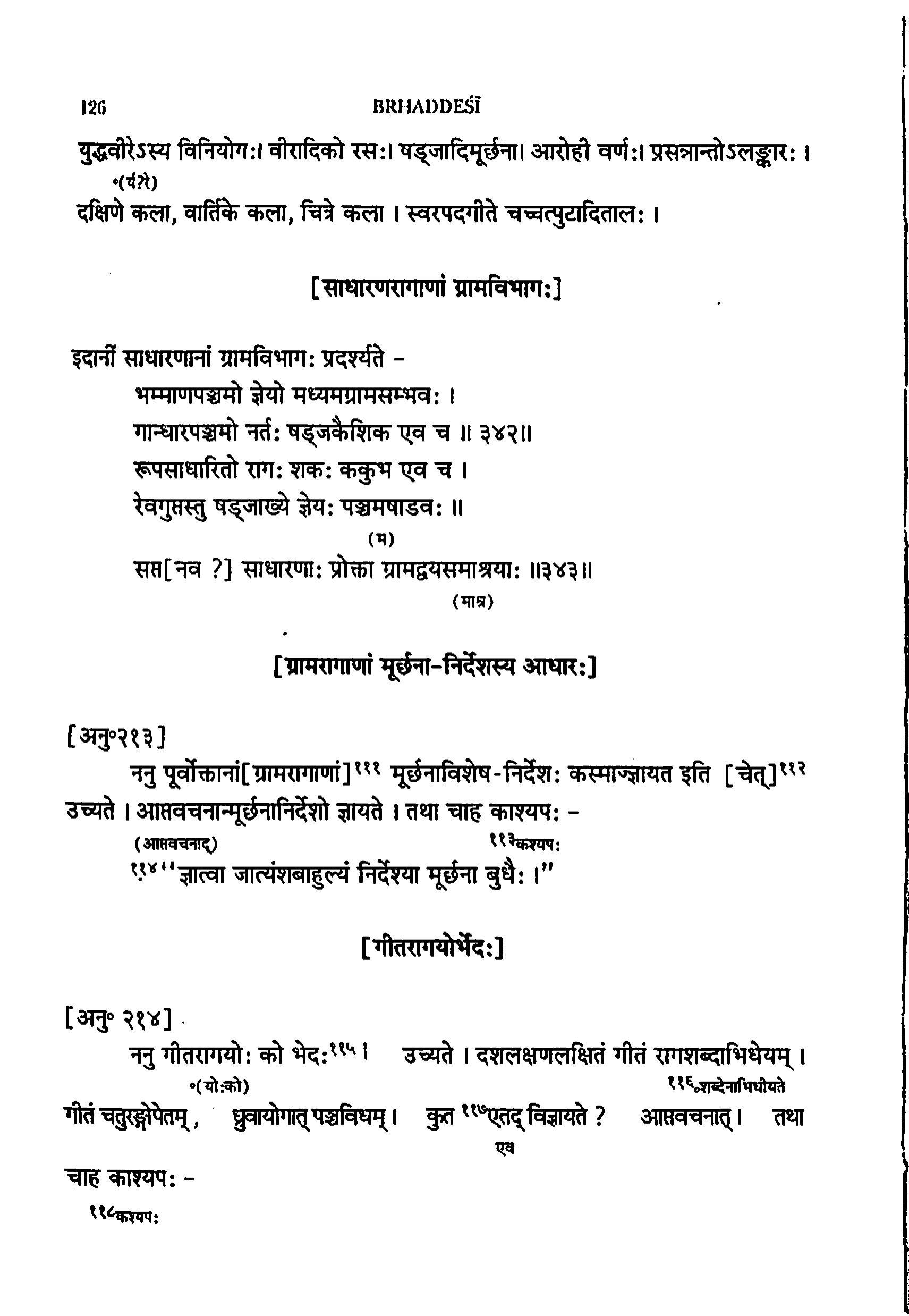
युद्धवीरेऽस्य॰(र्य?रे) विनियोगः। वीरादिको रसः।7 षड्जादिमूर्छना। आरोही वर्णः। प्रसन्नान्तोऽलङ्कारः
दक्षिणे कला, वार्तिके कला, चित्रे कला । स्वरपदगीते चच्चत्पुटादिताल:11
[साधारणरागाणां ग्रामविभागः]
इदानीं साधारणानां ग्रामविभाग: प्रदर्श्यते - भम्माणपञ्चमो ज्ञेयो मध्यमग्रामसम्भव:। गान्धारपञ्चमो नर्त: षड्जकैशिक एव च ॥३४२॥5 रूपसाधारितो रागः शकः ककुभ एव च। रेवगुप्तस्तु षड्जाख्ये ज्ञेयः पञ्चमषाडवः ॥6ZZANNZZWE0__ZZANNZZWS0__ (뭐) सप्त[नव ?] साधारणाः प्रोक्ता ग्रामद्वयसमाश्रयाः ॥३४३॥
[ग्रामरागाणां मूर्छना-निर्देशस्य आधार:]
[अनु॰२१३]
ननु पूर्वोक्तानां[ग्रामरागाणां]१११ मूर्छनाविशेष-निर्देश: कस्माज्जायत इति [चेत्]११२ उच्यते । आसवचनान्पूर्छनानिर्देशो(आसवचनाद्) ज्ञायते ।1 तथा चाह काश्यप:११३कश्यप: - ९१४‘‘ज्ञात्वा जात्यंशबाहुल्यं निर्देश्या मूर्छना बुधै:।3
[गीतरागयोर्भेद:]
[अनु॰ २१४] . नन् गीतरागयो:॰(यो:को) को भेद:११५ । उच्यते । दशलक्षणलिक्षतं गीतं रागशब्दाभिधेयम्११६ शब्देनाभिधीयते4 गीतं चतुरङ्गेपेतम्चाह काश्यप: - ,10 ध्रुवायोगात् पञ्चविधम् ।8 कुत ११७एतद्एव विज्ञायते ? आसवचनात् ।ZZANNZZWE2__ZZANNZZWS2__ ११८कश्यप:
English — Sharma (translation)
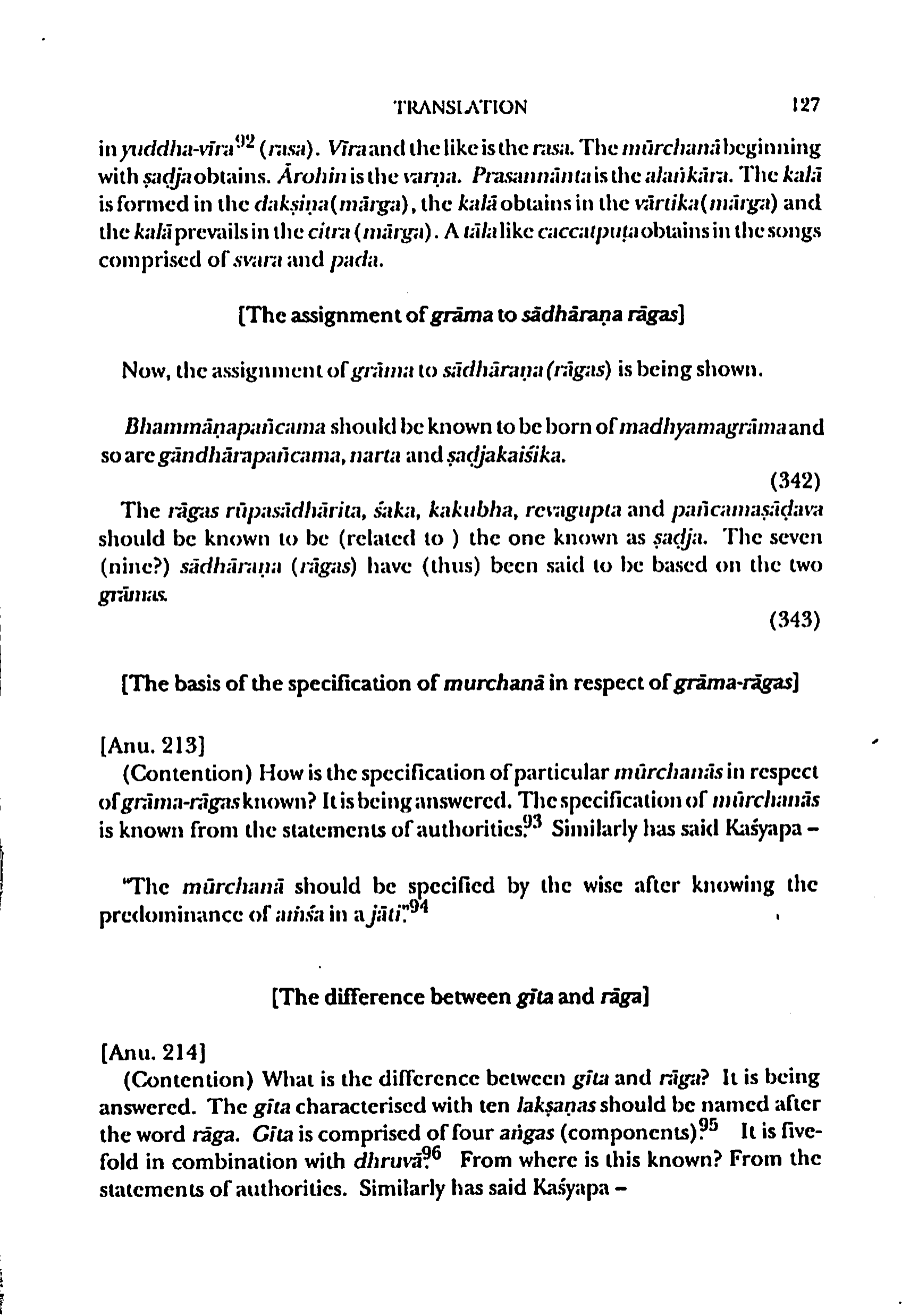
in yuddha-vīra 92 (rasa). Vīra and the like is the rasa.7 The mūrchanā beginning with ṣaḍjaobtains. Ārohin is the varṇa. Prasannāntais the alaṅkāra. The kalā is formed in the dakṣiṇa(mārga), the kalā obtains in the vārtika(mārga) and the kalā prevails in the citra (mārga). A tāla like caccatpuṭa obtains in the songs comprised of svara and pada.11
[The assignment of grāma to sādhāraņa rāgas]
Now, the assignment of grāma to sādhāraņa (rāgas) is being shown. Bhammāṇapañcama should be known to be born of madhyamagrāma and so are gāndhārapañcama, narta and ṣaḍjakaiśika.5
(342)
The rāgas rūpasādhārita, śaka, kakubha, revagupta and pañcamaṣāḍava should be known to be (related to ) the one known as sadja.6 The seven (nine?) sādhāraņa (rāgas) have (thus) been said to be based on the two grämas.9
(343)
[The basis of the specification of murchanā in respect of grāma-rāgas]
[Anu. 213]
(Contention) How is the specification of particular mūrchanās in respect of grāma-rāgas known? It is being answered. The specification of mūrchanās is known from the statements of authorities.1 Similarly has said Kasyapa - "The mūrchanā should be specified by the wise after knowing the predominance of amsa in a jāti."3294
[The difference between gita and raga]
[Anu. 214]
(Contention) What is the difference between gita and raga? It is being answered. The gita characterised with ten lakṣaṇas should be named after the word rāga.4 Gīta is comprised of four angas (components).1095 It is five- fold in combination with dhruva896 From where is this known? From the statements of authorities. Similarly has said Kasyapa -
1.[attribution] The specification of mūrchanās in grāma-rāgas is known from statements of authoritiesआसवचनान्पूर्छनानिर्देशो ज?्ञायते ।
2.[citation] Kasyapa is cited as an authority on mūrchanā specification based on amsa predominanceतथा एव चाह काश्यपः - ११८कश्यपः
3.[definition] Mūrchanā should be specified by the wise after knowing the predominance of amsa in a jātiज?्ञात्वा ज?ात्यंशबाहुल्यं निर्देश्या मूर्छना बुधैः।
4.[definition] Gita is characterised with ten lakṣaṇas and should be named rāgaदशलक्षणलिक्षतं गीतं रागशब्दाभिधेयम् ।
5.[enumeration] These four rāgas are born of madhyamagrāmaभम्माणपञ्चमो ज?्ञेयो मध्यमग्रामसम्भवः। गान्धारपञ्चमो नर्तः षड्जकैशिक एव च ॥ ३४२॥
6.[enumeration] These five rāgas are related to the ṣaḍja grāmaरूपसाधारितो रागः शकः ककुभ एव च। रेवगुप्तस्तु षड्ज?ाख्ये ज?्ञेयः पञ्चमषाडवः ॥
7.[relation]yuddha-vīra is associated with vīra rasa and the likeयुद्धवीरेऽस्य विनियोगः। वीरादिको रसः।
8.[relation] Gita becomes five-fold when combined with dhruvaध्रुवायोगात् पञ्चविधम् ।
9.[structural]sādhāraņa rāgas are assigned to one of two grāmasसप्त[नव ?] साधारणा प्रोक्ता ग्रामद्वयसमाश्रया
10.[structural] Gita is comprised of four aṅgasगीतं चतुरङ्गेपेतम् ,
11.[structural] Caccatpuṭa is a type of tāla that obtains in songs comprised of svara and padaस्वरपदगीते चच्चत्पुटादितालः
1.[attribution]The specification of mūrchanās in grāma-rāgas is known from statements of authoritiesThe specification of mūrchanās is known from the statements of authorities.
2.[citation]Kasyapa is cited as an authority on mūrchanā specification based on amsa predominanceSimilarly has said Kasyapa - "The mūrchanā should be specified by the wise after knowing the predominance of amsa in a jāti."
3.[definition]Mūrchanā should be specified by the wise after knowing the predominance of amsa in a jāti"The mūrchanā should be specified by the wise after knowing the predominance of amsa in a jāti."
4.[definition]Gita is characterised with ten lakṣaṇas and should be named rāgaThe gita characterised with ten lakṣaṇas should be named after the word rāga.
5.[enumeration]These four rāgas are born of madhyamagrāmaBhammāṇapañcama should be known to be born of madhyamagrāma and so are gāndhārapañcama, narta and ṣaḍjakaiśika.
6.[enumeration]These five rāgas are related to the ṣaḍja grāmaThe rāgas rūpasādhārita, śaka, kakubha, revagupta and pañcamaṣāḍava should be known to be (related to ) the one known as sadja.
7.[relation] yuddha-vīra is associated with vīra rasa and the likein yuddha-vīra 92 (rasa). Vīra and the like is the rasa.
8.[relation]Gita becomes five-fold when combined with dhruvaIt is five- fold in combination with dhruva
9.[structural] sādhāraņa rāgas are assigned to one of two grāmasThe seven (nine?) sādhāraņa (rāgas) have (thus) been said to be based on the two grämas.
10.[structural]Gita is comprised of four aṅgasGīta is comprised of four angas (components).
11.[structural]Caccatpuṭa is a type of tāla that obtains in songs comprised of svara and padaA tāla like caccatpuṭa obtains in the songs comprised of svara and pada.