caccatpuṭa technical_term
Dictionary: not in dictionary ·
Pages: 11 ·
Occurrences: 12 ·
Affirmations: 11 ·
Graph degree: 40 (in 0, out 40)
Variants (3):
caccatpuṭa (9), caccatputa (2), Caccatpuṭa (1)
Generative rules (3) ↗ filter all
R_40_caccatputa_assignmentassignment · 10 att.
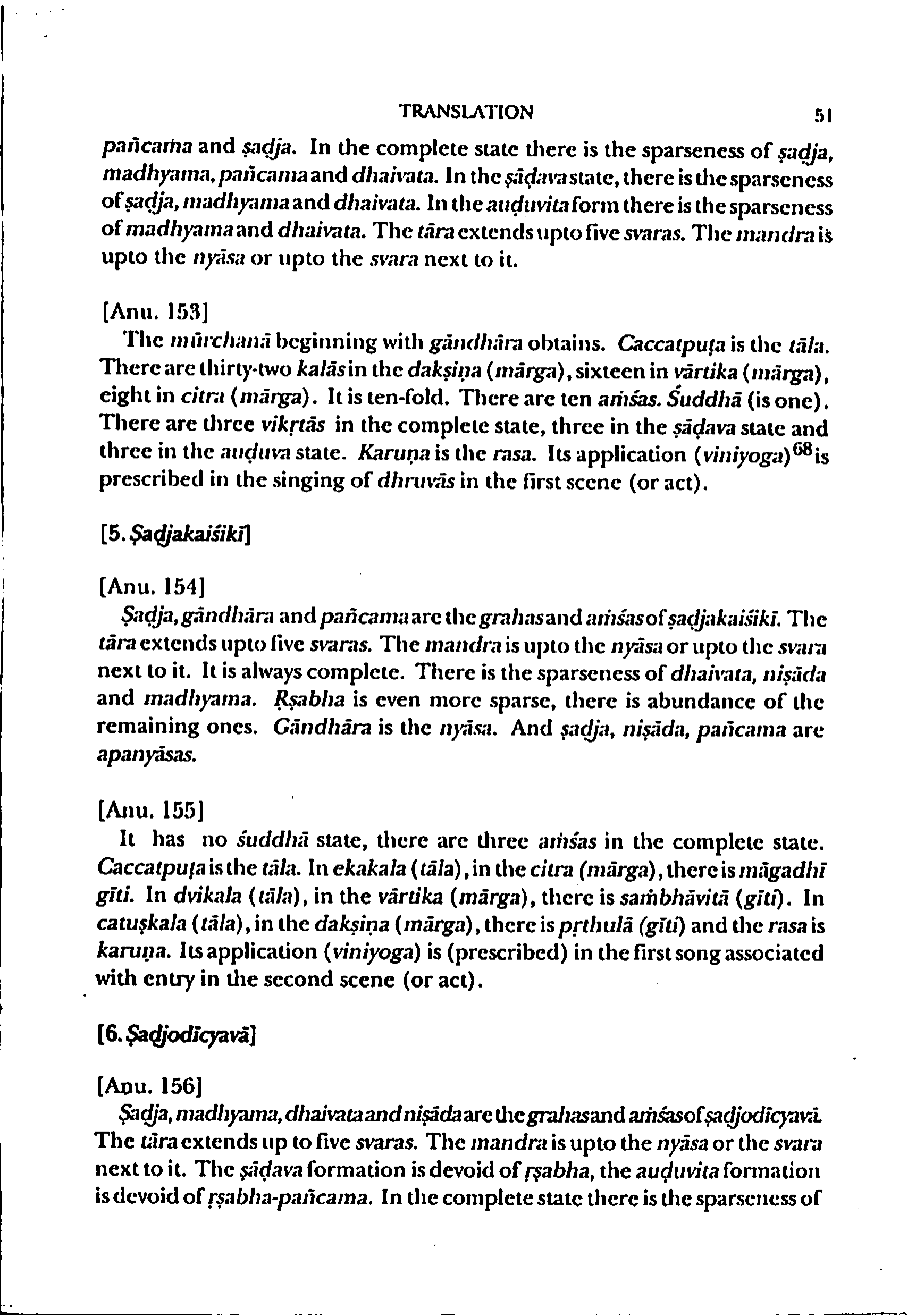
Caccatpuṭa is the tāla assigned to songs comprised of svara and pada across many rāgas (śuddhaṣāḍava, śuddhasādhrita, bhinna-ṣaḍja, bhinnakaiśika, Ţakkakaiśika,R_40_caccatputa_kala_margarelation · 10 att.
Caccatpuṭa tāla varies by time division (ekakala→citra/māgadhī; dvikala→vārtika/sambhāvitā; catuṣkala→dakṣiṇa)R_383_caccatputarelation · 1 att.
Caccatputa-type tāla applies to songs comprised of svara and pada (e.g. in takkarāga).
Pseudocode (DSL v1.1) ↗ full DSL (raw text)
RULE id: caccatpuṭa (cluster 40)
SCOPE: technical_term family
STATUS: empirical
CONFIDENCE: empirical
PROTECT: false
Essence pseudocode — identity + RECORD. The page citations for each slot value are in the Grammar record table above (audit trail). The full DSL adds ASSERTIONS with verbatim quotes (see Affirmations below) and CITED_RULES (see Graph relations).
Graph relations
Outgoing (15)
--[structural]--> pada (8)--[structural]--> svaras (8)--[structural]--> tāla (8)--[relation]--> pada (2)--[relation]--> svaras (2)--[relation]--> tāla (2)--[structural]--> rāga (2)--[structural]--> pañcamaṣāḍava (1)--[structural]--> mālavapañcama (1)--[relation]--> ṭakkarāga (1)--[structural]--> vesaraṣāḍava (1)--[structural]--> sauvīraka (1)--[relation]--> bhinna (1)--[structural]--> bhinnakaiśika (1)--[structural]--> Ţakkakaiśika (1)
Incoming (0)
none
Affirmations (11)
Caccatputa is a tala that can be applied in different time divisions (ekakala, dvikala, catuskala) with different margas
"Caccatpuṭa is the tāla.
În ekakala (tāla), in the citra (mārga), there is māgadhī gīti,
ad (tāla), in the vārtika (mārga), there is sambhāvitā (gīti). In catușkala (tāla), in the dakșiņa (mārga)"
TRANSLATION
<sup>51</sup>
pañcama and șadja. In the complete state there is the sparseness of șadja,
madhyama, pañcama and dhaivata. In the ṣāḍava state, there is the sparseness
of şadja, madhyama and dhaivata. In the auduvita form there is the sparseness
of madhyama and dhaivata. The tāra extends upto five svaras. The mandra is
upto the nyāsa or upto the svara next to it.
[Anu. 153]
The mūrchanā beginning with gāndhāra obtains. Caccatpuṭa is the tāla.
There are thirty-two kalās in the dakṣiṇa (mārga), sixteen in vārtika (mārga),
eight in citra (mārga). It is ten-fold. There are ten amśas. Śuddhā (is one).
There are three vikṛtās in the complete state, three in the ṣāḍava state and
three in the auduva state. Karuna is the rasa. Its application (viniyoga) 68 is
prescribed in the singing of dhruvās in the first scene (or act).
[5. Şadjakaisiki]
[Anu. <sup>154</sup>]
Ṣaḍja, gāndhāra and pañcama are the grahas and amsas of ṣaḍjakaisikī. The
tāra extends upto five svaras. The mandra is upto the nyāsa or upto the svara
next to it. It is always complete. There is the sparseness of dhaivata, niṣāda
and madhyama. Ṛṣabha is even more sparse, there is abundance of the
remaining ones. Gāndhāra is the nyāsa. And şadja, niṣāda, pañcama are
apanyāsas.
[Anu. 155]
It has no śuddhā state, there are three amśas in the complete state.
Caccatpuța is the tāla. În ekakala (tāla), in the citra (mārga), there is māgadhī
gīti. In dvikala (tāla), in the vārtika (mārga), there is sambhāvitā (gīti). In
catușkala (tāla), in the dakșiņa (mārga), there is pṛthulā (gīti) and the rasa is
karuṇa. Its application (viniyoga) is (prescribed) in the first song associated
with entry in the second scene (or act).
[6. Şadjodicyava]
[Apu. 156]
Şadja, madhyama, dhaivata and nişāda are the grahas and amsas of şadjodīcyavā.
The tara extends up to five svaras. The mandra is upto the nyasa or the svara
next to it. The şādava formation is devoid of ṛṣabha, the auduvita formation
is devoid of ṛṣabha-pañcama. In the complete state there is the sparseness of
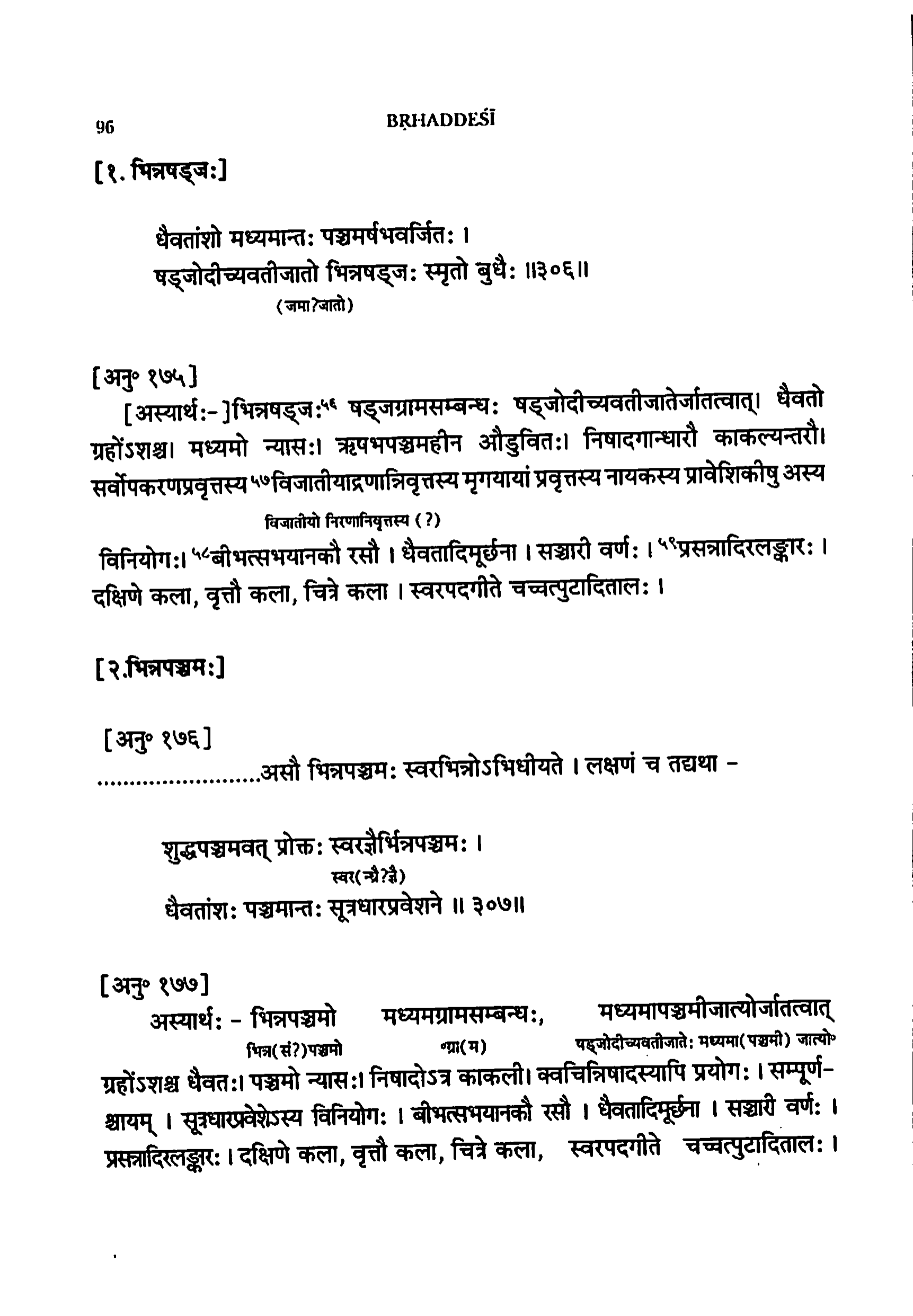
Caccatpuṭa is a type of tāla used in songs comprised of svara and pada for bhinna-ṣaḍja
"स्वरपदगीते चच्चत्पुटादितालः"
BRHADDEŚĪ
<sup>96</sup>
[१. भिन्नषड्ज?ः]
धैवतांशो मध्यमान्तः पञ्चमर्षभवर्ज?ितः ।
षड्ज?ोदीच्यवतीज?ातो भिन्नषड्ज?: स्मृतो बुधैः ॥३०६॥
(जमा?ज?ातो)
[अनु <sup>१७५</sup>]
[अस्यार्थः-]भित्रषड्ज?ः पड्जग्रामसम्बन्धः षड्ज?ोदीच्यवतीज?ातेर्ज?ातत्वात्। धैवतो
ग्रहोंऽशश्च। मध्यमो न्यासः। ऋषभपञ्चमहीन औडुवितः। निषादगान्धारौ काकल्यन्तरौ।
सर्वोपकरणप्रवृत्तस्य ५७विज?ातीयाद्रणान्निवृत्तस्य मृगयाया प्रवृत्तस्य नायकस्य प्रावेशिकीषु अस्य
विज?ातीयो निरणानियृत्तस्य (?)
विनियोगः। <sup>५८</sup>बीभत्सभयानकौ रसौ । धैवतादिमूर्छना । सञ्चारी वर्णः । <sup>५९</sup>प्रसन्नादिरलङ्कारः ।
दक्षिणे कला, वृत्तौ कला, चित्रे कला । स्वरपदगीते चच्चत्पुटादितालः ।
[२.भिन्नपञ्चमः]
[अन्॰ <sup>१७६</sup>]
.असौ भिन्नपञ्चमः स्वरभिन्नोऽभिधीयते । लक्षणं च तद्यथा -
शुद्धपञ्चमवत् प्रोक्तः स्वरज्ञैर्भित्रपञ्चमः।
स्वर(न्ग्रे?ई)
धैवतांशः पञ्चमान्तः सूत्रधारप्रवेशने ॥ ३०७॥
[अन्॰ <sup>१७७</sup>]
अस्यार्थः - भित्रपञ्चमो मध्यमग्रामसम्बन्धः, मध्यमापञ्चमीज?ात्योर्ज?ातत्वात्
पङ्ज?ोदीच्यवतीज?ातेः मध्यमा(पञ्चमी) ज?ात्यो॰
ण्या(म)
भिन्न(सं?)पञ्चमो
ग्रहोंऽशश्च धैवतः। पञ्चमो न्यासः। निषादोऽत्र काकली। क्वचित्रिषादस्यापि प्रयोगः । सम्पूर्ण-
श्चायम् । सूत्रधारप्रवेशेऽस्य विनियोगः । बीभत्सभयानकौ रसौ । धैवतादिमूर्छना । सञ्चारी वर्णः ।
प्रसन्नादिख्लङ्कारः । दक्षिणे कला, वृत्तौ कला, चित्रे कला, स्वरपदगीते चच्चत्पुटादितालः ।
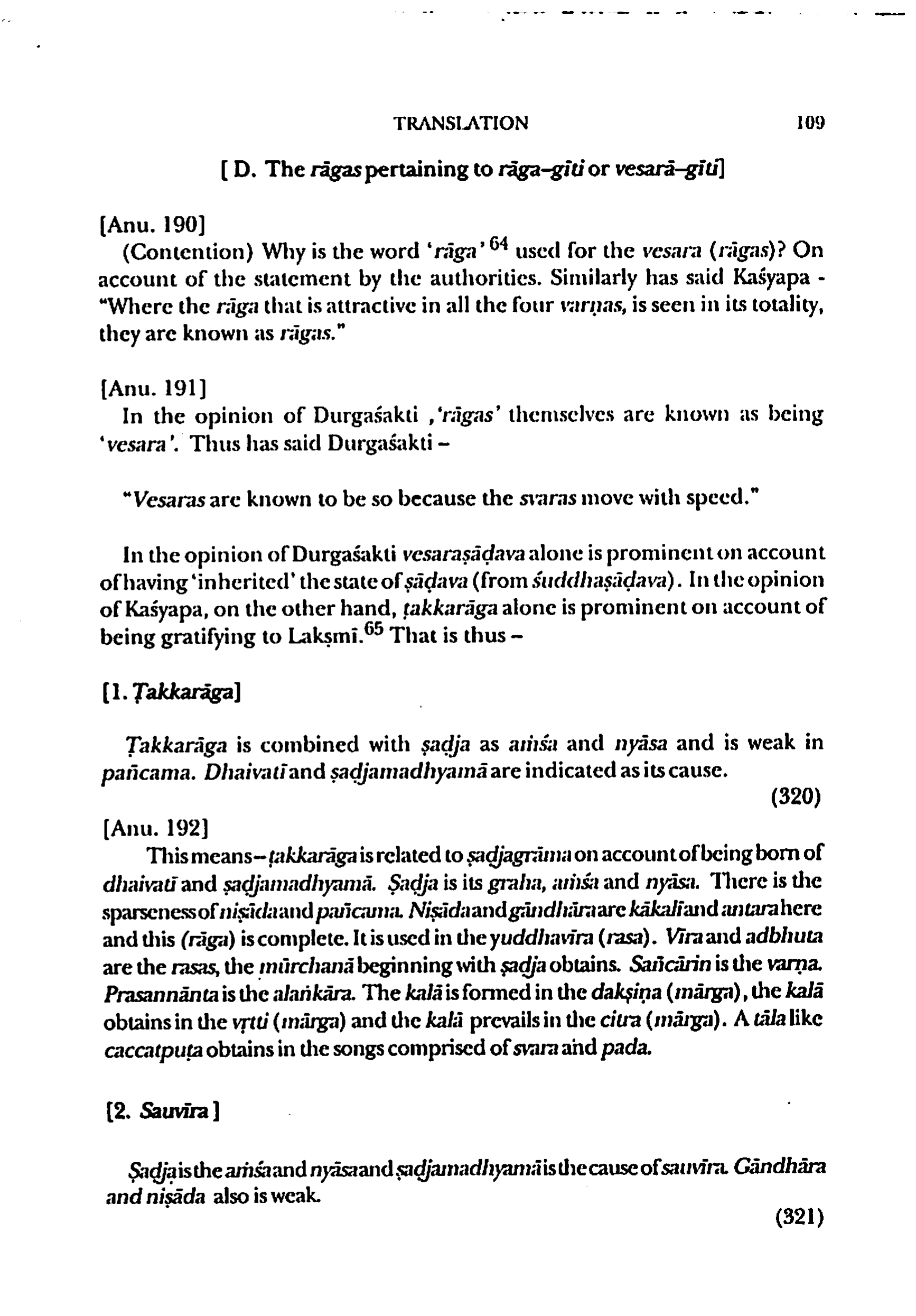
Caccatputa is a tāla used in songs comprised of svara and pada in takkarāga
"A tāla like
caccatputa obtains in the songs comprised of svara and pada."
. ..... ... ... .......................
r .
TRANSLATION
<sup>109</sup>
[D. The rāgas pertaining to rāga-gīti or vesarā-gīti]
[Anu. 190]
(Contention) Why is the word 'rāga' 64 used for the vesara (rāgas)? On
account of the statement by the authorities. Similarly has said Kaśyapa -
"Where the raga that is attractive in all the four varnas, is seen in its totality,
they are known as rāgas."
[Anu. <sup>191</sup>]
In the opinion of Durgaśakti , 'rāgas' themselves are known as being
'vesara'. Thus has said Durgaśakti -
"Vesaras are known to be so because the svaras move with speed."
In the opinion of Durgaśakti vesaraṣāḍava alone is prominent on account
of having 'inherited' the state of ṣāḍava (from śuddhaṣāḍava). In the opinion
of Kasyapa, on the other hand, takkarāga alone is prominent on account of
being gratifying to Laksmi.65 That is thus -
[1. Takkarāga]
Takkarāga is combined with şadja as aṁśa and nyāsa and is weak in
pañcama. Dhaivatī and ṣadjamadhyamā are indicated as its cause.
(320)
[Anu. 192]
This means—takkarāga is related to ṣaḍjagrāma on account of being born of
dhaivatī and ṣadjamadhyamā. Ṣaḍja is its graha, aniśa and nyāsa. There is the
sparseness of niṣāda and pañcama. Niṣāda and gāndhāra are kākalī and antara here
and this (rāga) is complete. It is used in the yuddhavīra (rasa). Vīra and adbhuta
are the rasas, the mūrchanā beginning with ṣaḍja obtains. Sañcārin is the varṇa.
Prasannānta is the alaṅkāra. The kalā is formed in the dakṣiṇa (mārga), the kalā
obtains in the vṛtti (mārga) and the kalā prevails in the citra (mārga). A tāla like
caccatputa obtains in the songs comprised of svara and pada.
[2. Sauvīra]
Şadjais the aṁśa and nyāsa and ṣadjamadhyamā is the cause of sauvīra. Gāndhāra
and niṣāda also is weak.
(321)
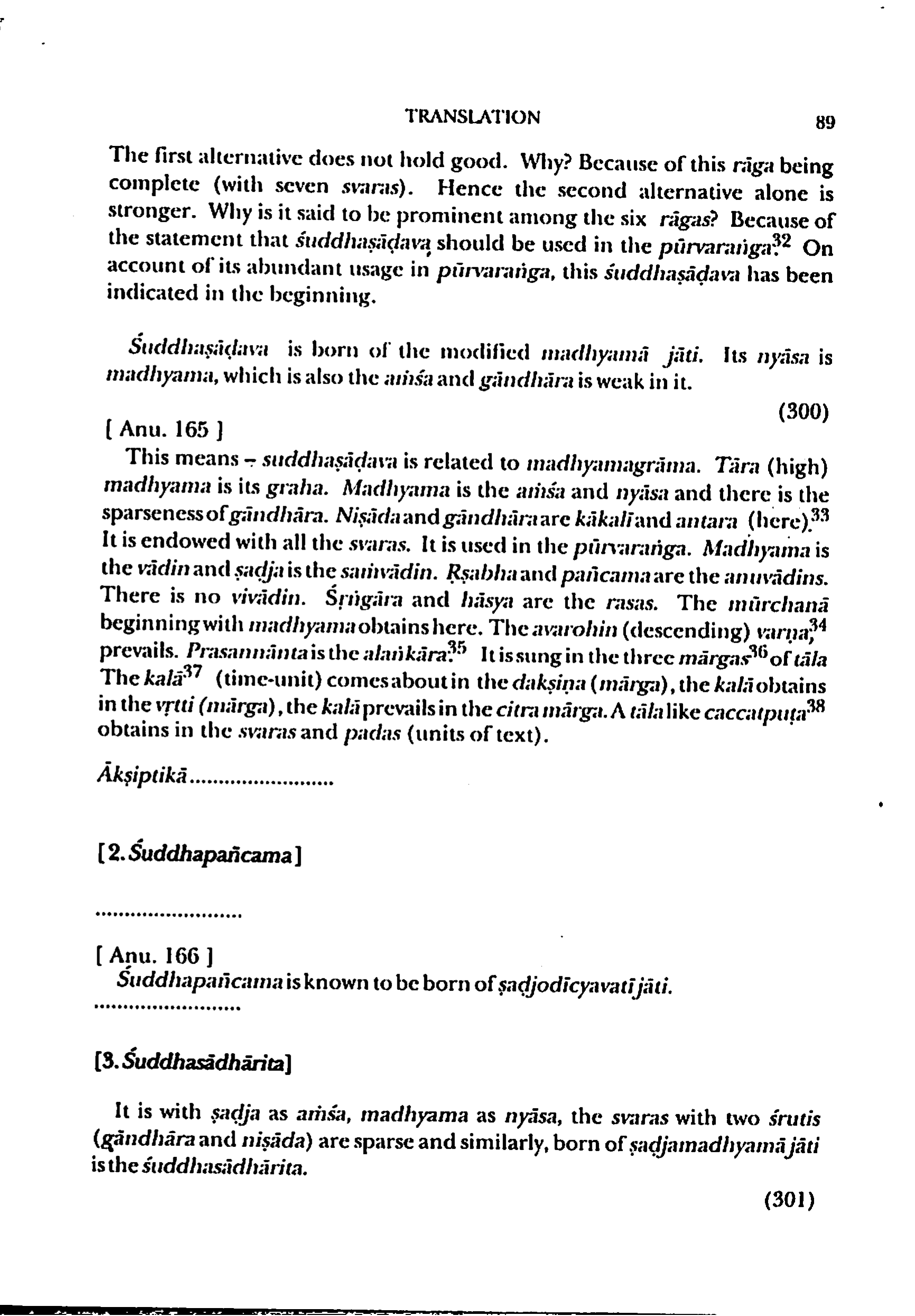
A tāla like caccatpuṭa obtains in the svaras and padas of śuddhaṣāḍava
"A tāla like caccatpuṭa
obtains in the svaras and padas (units of text)."
TRANSLATION
<sup>89</sup>
The first alternative does not hold good. Why? Because of this rāga being
complete (with seven svaras). Hence the second alternative alone is
stronger. Why is it said to be prominent among the six rāgas? Because of
the statement that śuddhaṣāḍava should be used in the pūrvaraiga. On
account of its abundant usage in pūrvaranga, this śuddhaṣāḍava has been
indicated in the beginning.
Suddhaṣāḍava is born of the modified madhyamā jāti.
Its nyāsa is
madhyama, which is also the aṁśa and gāndhāra is weak in it.
(300)
[ Anu. <sup>165</sup> ]
This means - suddhaṣāḍava is related to madhyamagrāma. Tāra (high)
madhyama is its graha. Madhyama is the aṁśa and nyāsa and there is the
sparseness of gāndhāra. Niṣāda and gāndhāra are kākalī and antara (here).33
It is endowed with all the svaras. It is used in the pūrvaranga. Madhyama is
the vādin and ṣaḍja is the samvādin. Ŗṣabha and pañcama are the anuvādins.
There is no vivādin. Śṛṅgāra and hāsya are the rasas. The mūrchanā
beginning with madhyama obtains here. The avarohin (descending) varņa,34
prevails. Prasannānta is the alaṅkāra. It is sung in the three mārgas 36 of tāla
The kalā<sup>37</sup> (time-unit) comes about in the dakṣiṇa (mārga), the kalā obtains
in the vṛtti (mārga), the kalā prevails in the citra mārga. A tāla like caccatpuṭa 38
obtains in the svaras and padas (units of text).
Ākṣiptikā.....
[2. Suddhapañcama]
<sup>*********</sup>
[ Anu. <sup>166</sup> ]
Šuddhapancama is known to be born of şadjodicyavatī jāti.
---------------------------------------
[3. Šuddhasādhārita]
It is with sadja as amsa, madhyama as nyāsa, the svaras with two śrutis
(gāndhāra and niṣāda) are sparse and similarly, born of ṣaḍjamadhyamā jāti
is the śuddhasādhārita.
(301)
A Section of the second section of the section of the section of the section of the section of the section of the section of the section of the section of the section of the section of the section of the section of the sec
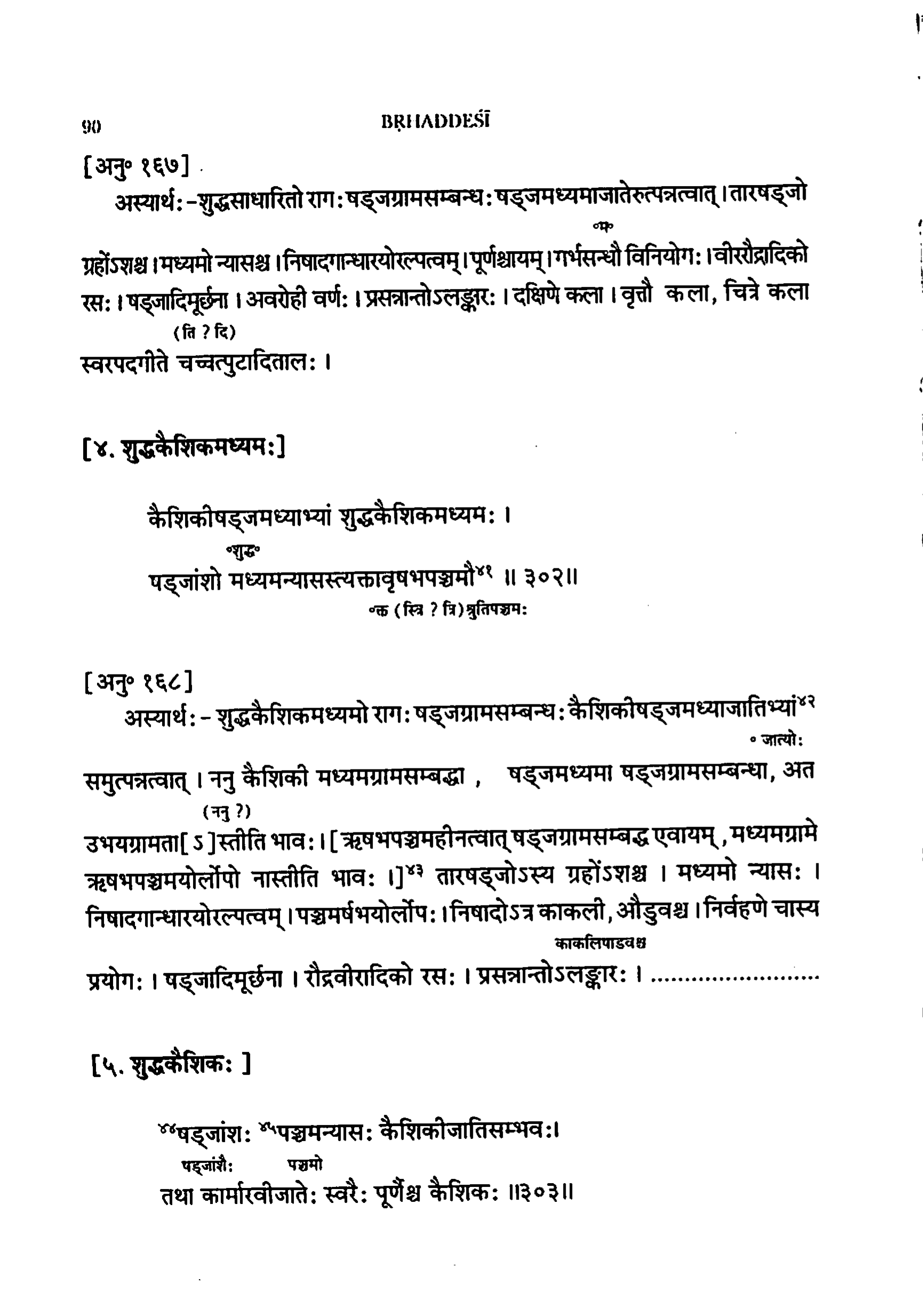
A tāla like caccatpuṭa obtains in a song comprised of svaras and padas in śuddhasādhrita rāga
"स्वरपदगीते चच्चत्पुटादितालः।"
BŖHADDEŚĪ
<sup>90</sup>
[अन्॰ <sup>१६७</sup>]
अस्यार्थः -शुद्धसाधारितो रागः षड्जग्रामसम्बन्धः षड्जमध्यमाज?ातेरुत्पत्रत्वात्। तारषड्ज?ो
ग्रहोंऽशश्च । मध्यमो न्यासश्च । निषादगान्धारयोरल्पत्वम् । पूर्णश्चायम् । गर्भसन्धौ विनियोगः । वीररौद्रादिको
रसः । षड्ज?ादिमूर्छना । अवरोही वर्णः । प्रसन्नान्तोऽलङ्कारः । दक्षिणे कला । वृत्तौ कला , चित्रे कला
(ति ? दि)
स्वरपदगीते चच्चत्पुटादितालः।
[४. शुद्धकैशिकमध्यमः]
कैशिकीषड्जमध्याभ्या शुद्धकैशिकमध्यमः।
॰शुद्ध॰
षड्ज?ांशो मध्यमन्यासस्त्यक्तावृषभपञ्चमौ४१ ॥ ३०२॥
॰क (स्त्रि ? त्रि) त्रुतिपञ्चमः
[अनु॰ <sup>१६८</sup>]
अस्यार्थः - शुद्धकैशिकमध्यमो रागः षड्जग्रामसम्बन्धः कैशिकीषड्जमध्याज?ातिभ्या<sup>४२</sup>
॰ ज?ात्योः
समुत्पन्नत्वात् । ननु कैशिको मध्यमग्रामसम्बद्धा , षड्जमध्यमा षड्जग्रामसम्बन्धा, अत
(ननु ?)
उभयग्रामता[ऽ]स्तीति भावः।[ऋषभपञ्चमहीनत्वात् षड्जग्रामसम्बद्ध एवायम् , मध्यमग्रामे
ऋषभपञ्चमयोर्लोपो नास्तीति भावः ।]<sup>४३</sup> तारषड्ज?ोऽस्य ग्रहोंऽशश्च । मध्यमो न्यासः ।
निषादगान्धारयोरल्पत्वम् । पञ्चमर्षभयोर्लोपः । निषादोऽत्र काकली, औडुवश्च । निर्वहणे चास्य
काकलिपाडवश
प्रयोगः । षड्ज?ादिमूर्छना । रौद्रवीरादिको रसः । प्रसन्नान्तोऽलङ्कारः । .....
[५. शुद्धकैशिकः ]
<sup>४४</sup>षड्ज?ांशः <sup>४५</sup>पञ्चमन्यासः कैशिकीज?ातिसम्भवः।
पड्ज?ांशैः
पञ्चमो
तथा कार्मारवीज?ातेः स्वरैः पूर्णेश्च कैशिकः ॥३०३॥
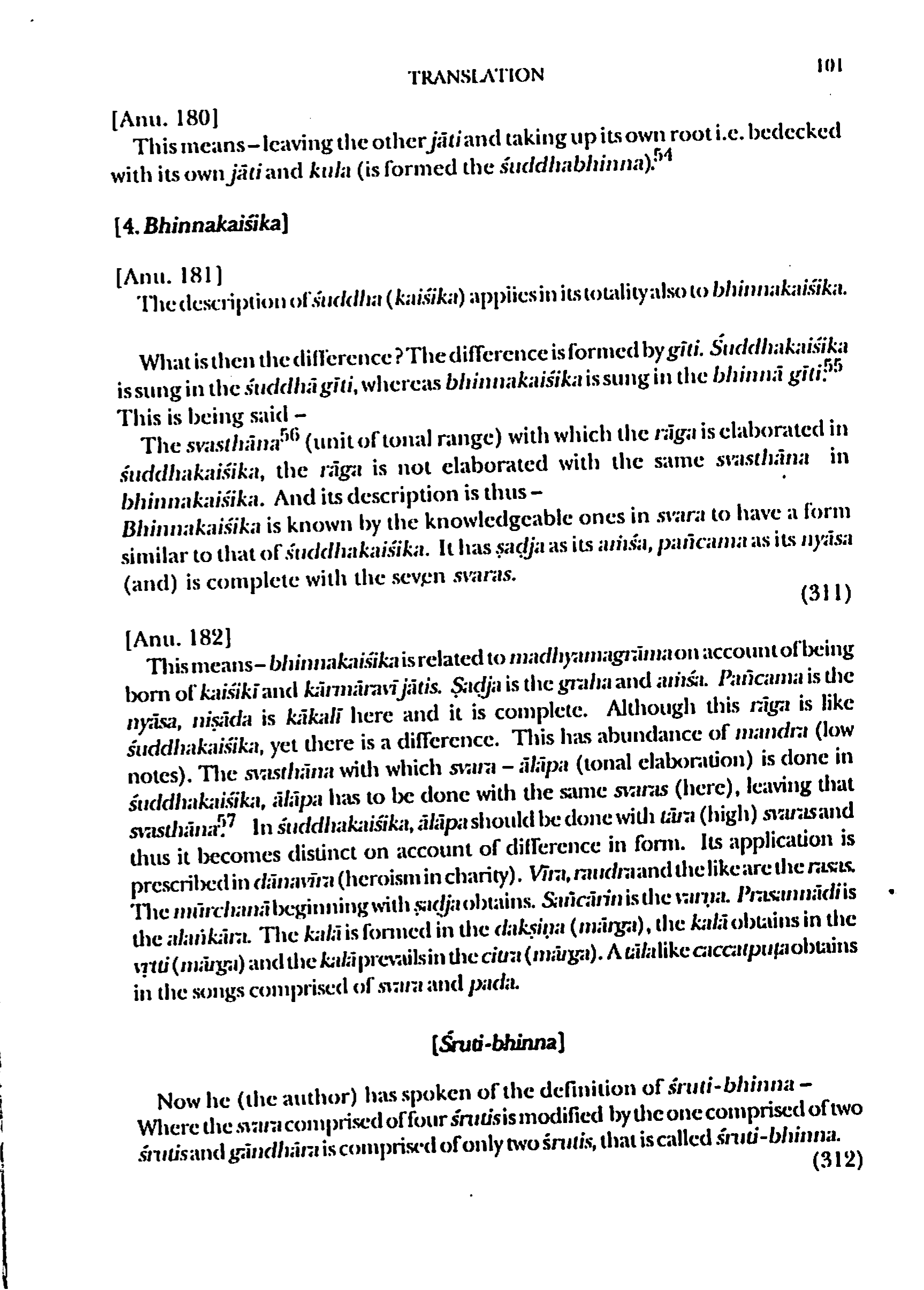
Caccatpuṭa functions as a tāla in songs comprised of svara and pada in bhinnakaiśika
"A tālalike caccatpuṭa obtains
in the songs comprised of svara and pada."
<sup>101</sup>
TRANSLATION
[Anu. <sup>180</sup>]
This means-leaving the other jāti and taking up its own root i.e. bedecked
with its own jāti and kula (is formed the śuddhabhinna).54
[4. Bhinnakaisika]
[Anu. <sup>181</sup>]
The description of śuddha (kaiśika) applies in its totality also to bhinnakaiśika.
What is then the difference? The difference is formed by gīti. Śuddhakaiśika
is sung in the \acute{s}uddh\~{a} g\~{i}ti, whereas bhinnakai\acute{s}ika is sung in the bhinn\~{a} g\~{i}ti.
This is being said -
The svasthāna^{56} (unit of tonal range) with which the rāga is elaborated in
śuddhakaiśika, the rāga is not elaborated with the same svasthāna in
bhinnakaisika. And its description is thus -
Bhinnakaiśika is known by the knowledgeable ones in svara to have a form
similar to that of śuddhakaiśika. It has ṣaḍja as its aṁśa, pañcama as its nyāsa
(and) is complete with the seven svaras.
(311)
[Anu. <sup>182</sup>]
This means - bhinnakaiśika is related to madhyamagrāma on account of being
born of kaiśikī and kārmāravī jātis. Şadja is the graha and aṁśa. Pañcama is the
nyāsa, niṣāda is kākalī here and it is complete. Although this rāga is like
śuddhakaiśika, yet there is a difference. This has abundance of mandra (low
notes). The svasthāna with which svara - ālāpa (tonal elaboration) is done in
śuddhakaiśika, ālāpa has to be done with the same svaras (here), leaving that
svasthāna<sup>57</sup> In śuddhakaiśika, ālāpa should be done with tāra (high) svaras and
thus it becomes distinct on account of difference in form. Its application is
prescribed in dānavīra (heroism in charity). Vīra, raudra and the like are the rasas.
The mūrchanā beginning with ṣaḍja obtains. Sañcārinis the varņa. Prasannādi is
the alaṅkāra. The kalā is formed in the dakṣiṇa (mārga), the kalā obtains in the
vṛtii (mārga) and the kalā prevails in the citra (mārga). A tālalike caccatpuṭa obtains
in the songs comprised of svara and pada.
(Śruti-bhinna)
Now he (the author) has spoken of the definition of śruti-bhinna -
Where the svara comprised of four śrutis is modified by the one comprised of two
śrutis and gāndhāra is comprised of only two śrutis, that is called śruti-bhinna.
(312)
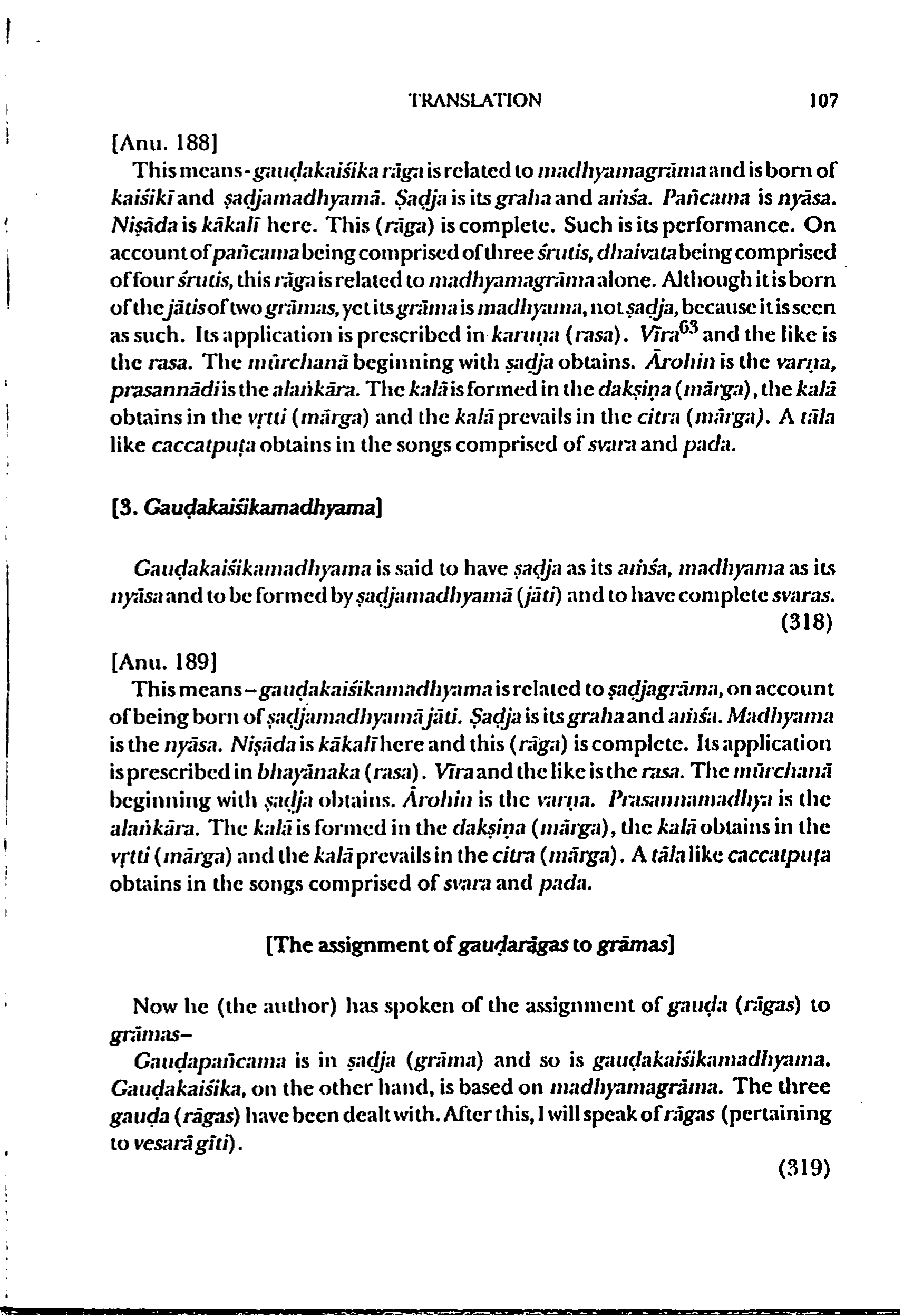
Caccatpuṭa is a tāla used in songs comprised of svara and pada
"A tāla like caccatputa obtains in the songs comprised of svara and pada."
TRANSLATION
<sup>107</sup>
[Anu. 188]
This means-gaudakaiśika rāga is related to madhyamagrāma and is born of
kaiśikī and şadjamadhyamā. Şadja is its graha and aṁśa. Pañcama is nyāsa.
Niṣāda is kākalī here. This (rāga) is complete. Such is its performance. On
account of pañcama being comprised of three śrutis, dhaivata being comprised
of four śrutis, this rāga is related to madhyamagrāma alone. Although it is born
of the jātis of two grāmas, yet its grāma is madhyama, not ṣaḍja, because it is seen
as such. Its application is prescribed in karuna (rasa). Vīra<sup>63</sup> and the like is
the rasa. The mūrchanā beginning with ṣaḍja obtains. Ārohin is the varņa,
prasannādi is the alaṅkāra. The kalā is formed in the dakṣiṇa (mārga), the kalā
obtains in the vṛtti (mārga) and the kalā prevails in the citra (mārga). A tāla
like caccatputa obtains in the songs comprised of svara and pada.
[3. Gaudakaisikamadhyama]
Gaudakaisikamadhyama is said to have şadja as its amsa, madhyama as its
nyāsa and to be formed by ṣaḍjamadhyamā (jāti) and to have complete svaras.
(318)
[Anu. 189]
This means – gaudakaišikamadhyama is related to şadjagrāma, on account
of being born of şadjamadhyamā jāti. Şadja is its graha and aṁśa. Madhyama
is the nyāsa. Niṣāda is kākalī here and this (rāga) is complete. Its application
is prescribed in bhayānaka (rasa). Vīra and the like is the rasa. The mūrchanā
beginning with sadja obtains. Arohin is the varna. Prasannamadhya is the
alaṅkāra. The kalā is formed in the dakṣiṇa (mārga), the kalā obtains in the
vṛtti (mārga) and the kalā prevails in the citra (mārga). A tāla like caccatpuṭa
obtains in the songs comprised of svara and pada.
[The assignment of gaudaragas to gramas]
Now he (the author) has spoken of the assignment of gauda (ragas) to
grāmas-
Gaudapañcama is in ṣaḍja (grāma) and so is gaudakaiśikamadhyama.
Gaudakaisika, on the other hand, is based on madhyamagrāma. The three
gauda (rāgas) have been dealt with. After this, I will speak of rāgas (pertaining
to vesarā gīti).
(319)
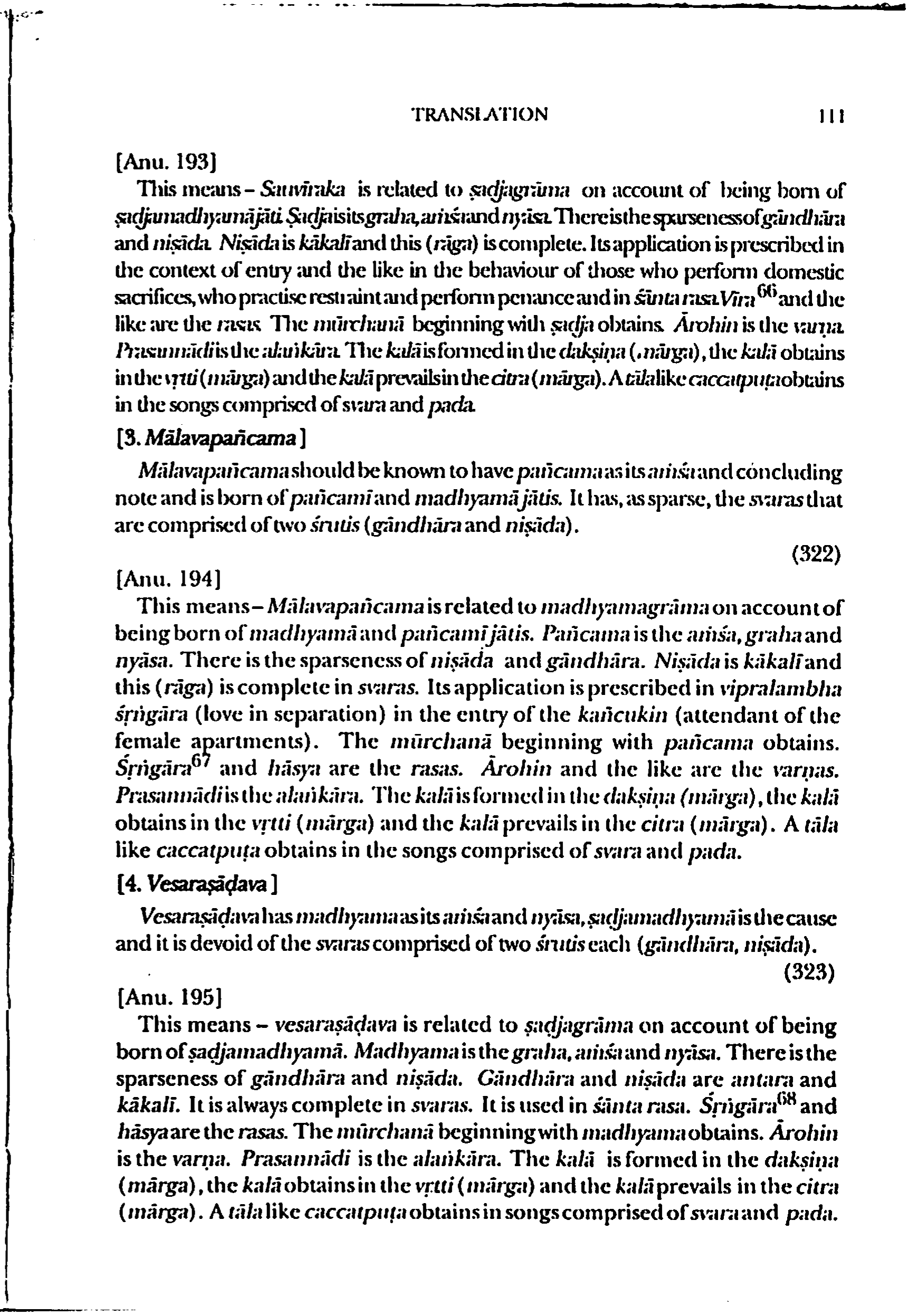
All three rāgas (Sauvīraka, Mālavapañcama, Vesaraṣāḍava) use a tāla like caccatpuṭa in songs comprised of svara and pada
"A tāla
like caccatpuṭa obtains in the songs comprised of svara and pada."
<sup>14</sup>.<sup>00</sup>
TRANSLATION
<sup>111</sup>
[Anu. 193]
This means - Sauvīraka is related to sadjagrāma on account of being born of
ṣaḍjamadhyamājāti Ṣaḍjaisitsgraha,amśandnyāsa. Thereisthe sparsenessof gāndhāra
and niṣāda. Niṣāda is kākalī and this (rāga) is complete. Its application is prescribed in
the context of entry and the like in the behaviour of those who perform domestic
sacrifices, who practise restraint and perform penance and in sinta rasa Vira 66 and the
like are the rasas. The mürchanā beginning with sadja obtains. Arohin is the varna.
Prasumādiis the alarikāra. The kalā is formed in the dakṣiṇa („nārga), the kalā obtains
in the vitti (mārga) and the kalā prevailsin the citra (mārga). A tālalike caccatputa obtains
in the songs comprised of svara and pada.
[3. Mālavapañcama]
Mālavapancamashould be known to have pancamaasits anistand concluding
note and is born of pañcami and madhyamā jātis. It has, as sparse, the svaras that
are comprised of two śrutis (gāndhāra and niṣāda).
(322)
[Anu. 194]
This means-Mālavapañcamais related to madhyamagrāma on account of
being born of madhyamā and pañcamī jātis. Pañcama is the aṁśa, graha and
nyāsa. There is the sparseness of niṣāda and gāndhāra. Niṣāda is kākalī and
this (rāga) is complete in svaras. Its application is prescribed in vipralambha
śṛṅgāra (love in separation) in the entry of the kañcukin (attendant of the
female apartments). The mūrchanā beginning with pañcama obtains.
Śringāra<sup>67</sup> and hāsya are the rasas. Ārohin and the like are the varņas.
Prasannādi is the alaṅkāra. The kalā is formed in the dakṣiṇa (mārga), the kalā
obtains in the vṛtti (mārga) and the kalā prevails in the citra (mārga). A tāla
like caccatputa obtains in the songs comprised of svara and pada.
[4. Vesarașādava]
Vesaraṣāḍavahas madhyamaas its amsaand nyāsa, ṣaḍjamadhyamā is the cause
and it is devoid of the svaras comprised of two śrutis each (gāndhāra, niṣāda).
(323)
[Anu. 195]
This means - vesaraṣāḍava is related to ṣaḍjagrāma on account of being
born of ṣaḍjamadhyamā. Madhyama is the graha, aṁśa and nyāsa. There is the
sparseness of gāndhāra and niṣāda. Gāndhāra and niṣāda are antara and
kākalī. It is always complete in svaras. It is used in sānta rasa. Šriigāra<sup>68</sup> and
hāsyaare the rasas. The mūrchanā beginning with madhyama obtains. Ārohin
is the varņa. Prasannādi is the alaṅkāra. The kalā is formed in the dakṣiṇa
(mārga), the kalā obtains in the vṛtti (mārga) and the kalā prevails in the citra
(mārga). A tāla like caccatpuṭa obtains in songs comprised of svara and pada.
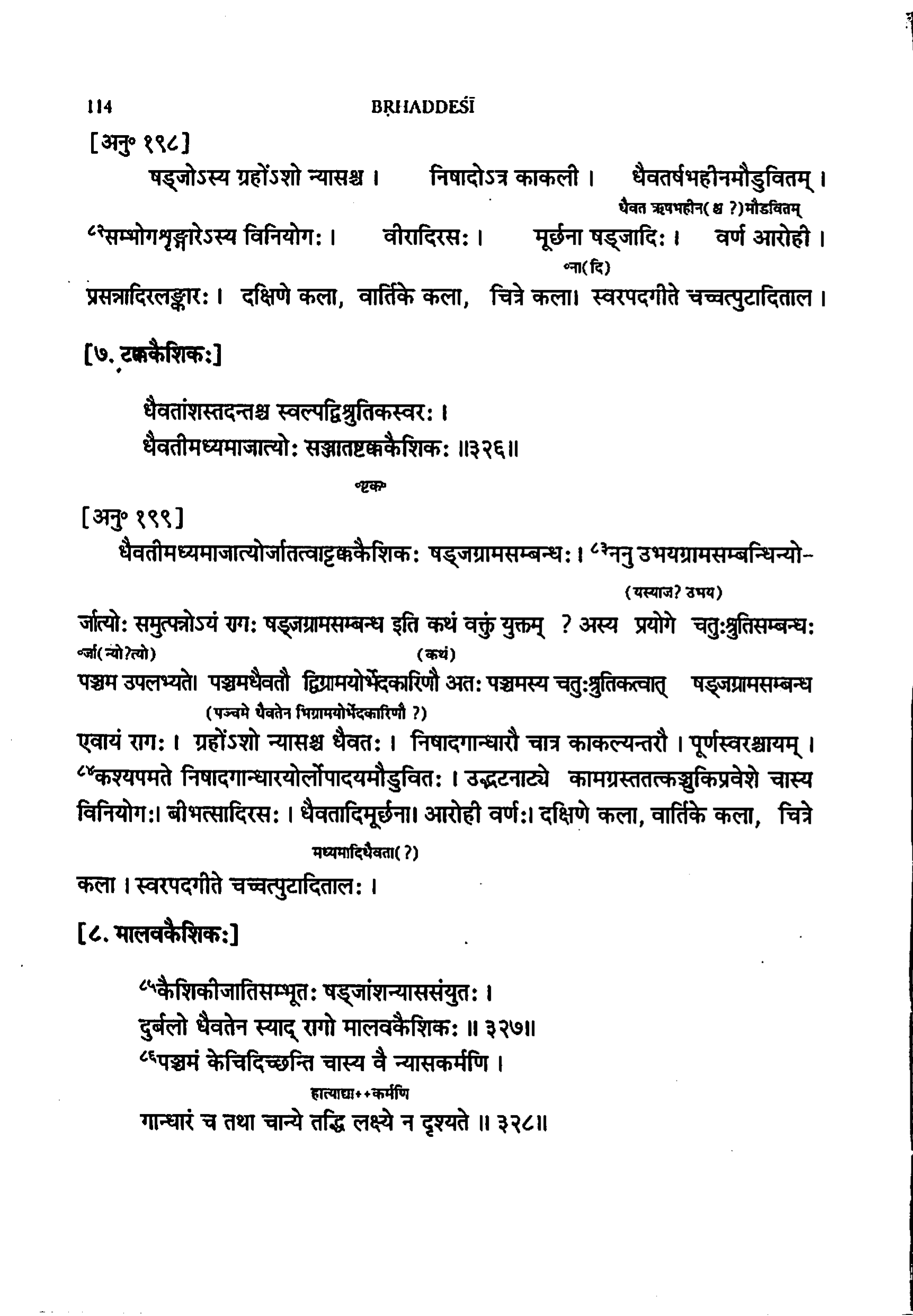
Caccatpuṭa is a tāla used in songs comprised of svara and pada for Ţakkakaiśika
"स्वरपदगीते चच्चत्पुटादितालः ।"
BRHADDEŚĪ
<sup>114</sup>
[अनु॰ १९८]
षड्ज?ोऽस्य ग्रहोंऽशो न्यासश्च । निषादोऽत्र काकली । धैवतर्षभहीनमौडुवितम् ।
धैवत ऋषभहीन( ध ?)मौडवितम्
<sup>८२</sup>सम्भोगशृङ्गारेऽस्य विनियोगः। वीरादिरसः। मूर्छना षड्ज?ादिः। वर्ण आरोही।
॰ना(दि)
प्रसन्नादिरलङ्कारः । दक्षिणे कला, वार्तिके कला, चित्रे कला। स्वरपदगीते चच्चत्पुटादिताल ।
[७. टक्ककेशिकः]
धैवतांशस्तदन्तश्च स्वल्पद्विश्रुतिकस्वरः ।
धैवतीमध्यमाज?ात्योः सञ्ज?ातष्टक्ककैशिकः ॥३२६॥
॰एक
[अनु॰ १९९]
धैवतीमध्यमाज?ात्योर्ज?ातत्वाट्टक्ककेशिकः षड्जग्रामसम्बन्धः। <sup>८३</sup>ननु उभयग्रामसम्बन्धिन्यो-
(यस्याज?? ठमय)
र्ज?ात्यो समुत्पन्नोऽयं गगः षड्जग्रामसम्बन्ध इति कथं वक्तु युक्तम् ? अस्य प्रयोगे चतुःश्रुतिसम्बन्धः
र्ज?ा(न्यो?त्यो)
(कथं)
पञ्चम उपलभ्यते। पञ्चमधैवतौ द्विग्रामयोर्भेदकारिणौ अतः पञ्चमस्य चतुःश्रुतिकत्वात् । षङ्जग्रामसम्बन्ध
(पञ्चमे पैवतेन भिग्रामयोर्भेदकारिणौ ?)
एवायं रागः। ग्रहोंऽशो न्यासश्च धैवतः। निषादगान्धारौ चात्र काकल्यन्तरौ। पूर्णस्वरश्चायम्।
<sup>८४</sup>कश्यपमते निषादगान्धारयोर्लोपादयमौडुवितः । उद्भटनाट्ये कामग्रस्ततत्कञ्चकिप्रवेशे चास्य
विनियोगः। बीभत्सादिरसः । धैवतादिमूर्छना। आरोही वर्णः। दक्षिणे कला, वार्तिके कला, चित्रे
मध्यमादिधैवता(?)
कला । स्वरपदगीते चच्चत्पुटादितालः ।
[८. मालवकैशिकः]
८५कैशिकीज?ातिसम्भूतः षड्ज?ांशन्याससंयुतः ।
दुर्बलो धैवतेन स्याद् रागो मालवकैशिकः ॥ ३२७॥
<sup>८६</sup>पञ्चमं केचिदिच्छन्ति चास्य वै न्यासकर्मणि ।
हात्याद्या + कर्मणि
गान्धारं च तथा चान्ये तद्धि लक्ष्ये न दृश्यते ॥ ३२८॥
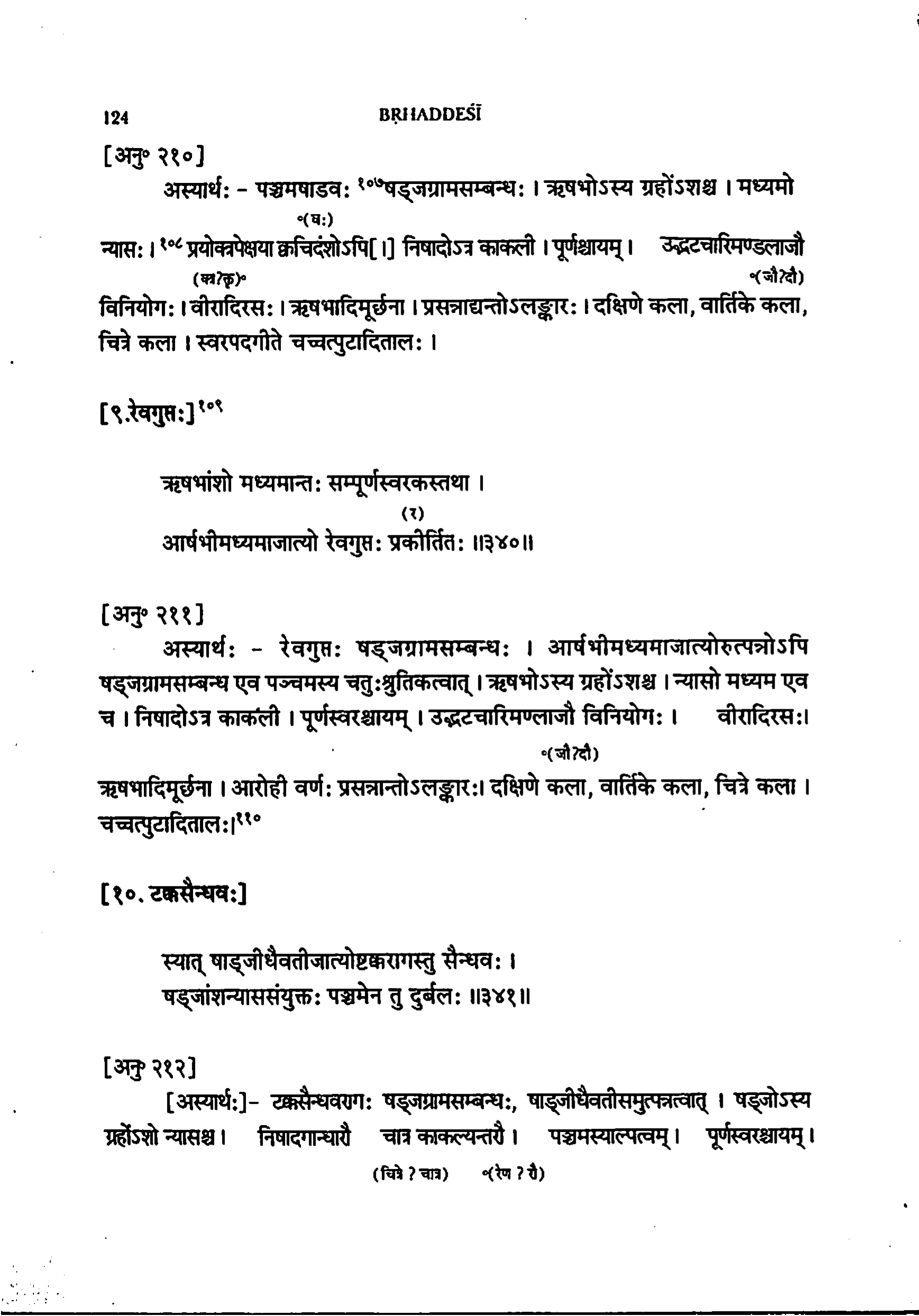
Caccatpuṭa is a tāla used in songs with svara and pada in pañcamaṣāḍava
"स्वरपदगीते चच्चत्पुटादितालः"
BRHADDEŚĨ
<sup>124</sup>
[अनु॰ २१०]
अस्यार्थः - पञ्चमषाडवः १०७षड्जग्रामसम्बन्धः । ऋषभोऽस्य ग्रहोंऽशश्च । मध्यमो
॰( ঘ:)
न्यासः । १०८ प्रयोक्त्रपेक्षया क्वचिदंशोऽपि[।] निषादोऽत्र काकली । पूर्णश्चायम् । उद्भटचारिमण्डलाज?ौ
॰(ज?ी?दी)
(स्र?कृ)॰
विनियोगः। वीरादिरसः। ऋषभादिमूर्छना। प्रसन्नाद्यन्तोऽलङ्कारः। दक्षिणे कला, वार्तिके कला,
चित्रे कला । स्वरपदगीते चच्चत्पुटादितालः ।
[९.रेवगुप्तः]<sup>१०९</sup>
ऋषभांशो मध्यमान्तः सम्पूर्णस्वरकस्तथा ।
(₹)
आर्षभीमध्यमाज?ात्यो रेवगुप्तः प्रकीर्तितः ॥३४०॥
[अन्॰ २११]
अस्यार्थः - रेवगुप्तः षड्जग्रामसम्बन्धः । आर्षभीमध्यमाज?ात्योरुत्पत्रोऽपि
षड्जग्रामसम्बन्ध एव पञ्चमस्य चतुःश्रुतिकत्वात् । ऋषभोऽस्य ग्रहोंऽशश्च । न्यासो मध्यम एव
च । निषादोऽत्र काक'ली । पूर्णस्वरश्चायम् । उद्भटचारिमण्लाज?ौ विनियोगः ।
वीरादिरसः।
॰(ज?ी?दी)
ऋषभादिमूर्छना । आरोही वर्णः प्रसन्नान्तोऽलङ्कारः। दक्षिणे कला, वार्तिके कला, चित्रे कला ।
चच्चत्पुटादितालः। ११०
[१०. टक्सैन्धवः]
स्यात् षाड्ज?ीधैवतीज?ात्योष्टकसगस्तु सैन्धवः।
षड्ज?ांशन्याससंयुक्तः पञ्चमेन तु दुर्बलः ॥३४१॥
[अनु २१२]
[अस्यार्थः]- टक्कसैन्धवरागः षड्जग्रामसम्बन्धः, षाड्ज?ीधैवतीसमुत्पत्रत्वात् । षड्ज?ोऽस्य
निषादगान्धारौ चात्र काकल्यन्तरौ । पञ्चमस्याल्पत्वम् । पूर्णस्वरश्चायम् ।
ग्रहोंऽशो न्यासश्च ।
॰(रेष ? चै)
(चित्रे ? चात्र)
<sup>210</sup>
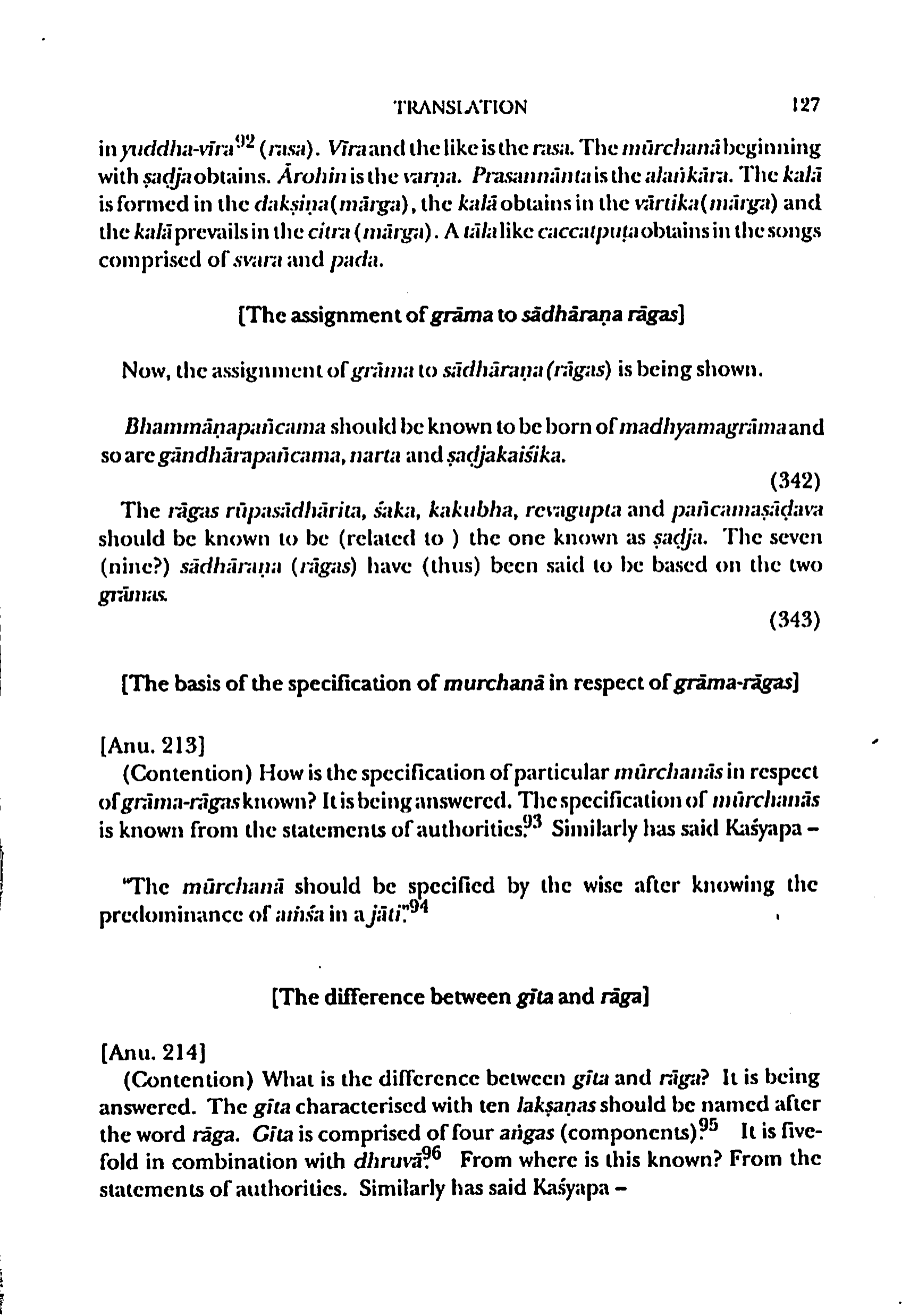
Caccatpuṭa is a type of tāla that obtains in songs comprised of svara and pada
"A tāla like caccatpuṭa obtains in the songs
comprised of svara and pada."
<sup>127</sup>
TRANSLATION
in yuddha-vīra 92 (rasa). Vīra and the like is the rasa. The mūrchanā beginning
with ṣaḍjaobtains. Ārohin is the varṇa. Prasannāntais the alaṅkāra. The kalā
is formed in the dakṣiṇa(mārga), the kalā obtains in the vārtika(mārga) and
the kalā prevails in the citra (mārga). A tāla like caccatpuṭa obtains in the songs
comprised of svara and pada.
[The assignment of grāma to sādhāraņa rāgas]
Now, the assignment of grāma to sādhāraņa (rāgas) is being shown.
Bhammāṇapañcama should be known to be born of madhyamagrāma and
so are gāndhārapañcama, narta and ṣaḍjakaiśika.
(342)
The rāgas rūpasādhārita, śaka, kakubha, revagupta and pañcamaṣāḍava
should be known to be (related to ) the one known as sadja. The seven
(nine?) sādhāraņa (rāgas) have (thus) been said to be based on the two
grämas.
(343)
[The basis of the specification of murchanā in respect of grāma-rāgas]
[Anu. 213]
(Contention) How is the specification of particular mūrchanās in respect
of grāma-rāgas known? It is being answered. The specification of mūrchanās
is known from the statements of authorities. Similarly has said Kasyapa -
"The mūrchanā should be specified by the wise after knowing the
predominance of amsa in a jāti."94
[The difference between gita and raga]
[Anu. 214]
(Contention) What is the difference between gita and raga? It is being
answered. The gita characterised with ten lakṣaṇas should be named after
the word rāga. Gīta is comprised of four angas (components).95 It is five-
fold in combination with dhruva96 From where is this known? From the
statements of authorities. Similarly has said Kasyapa -