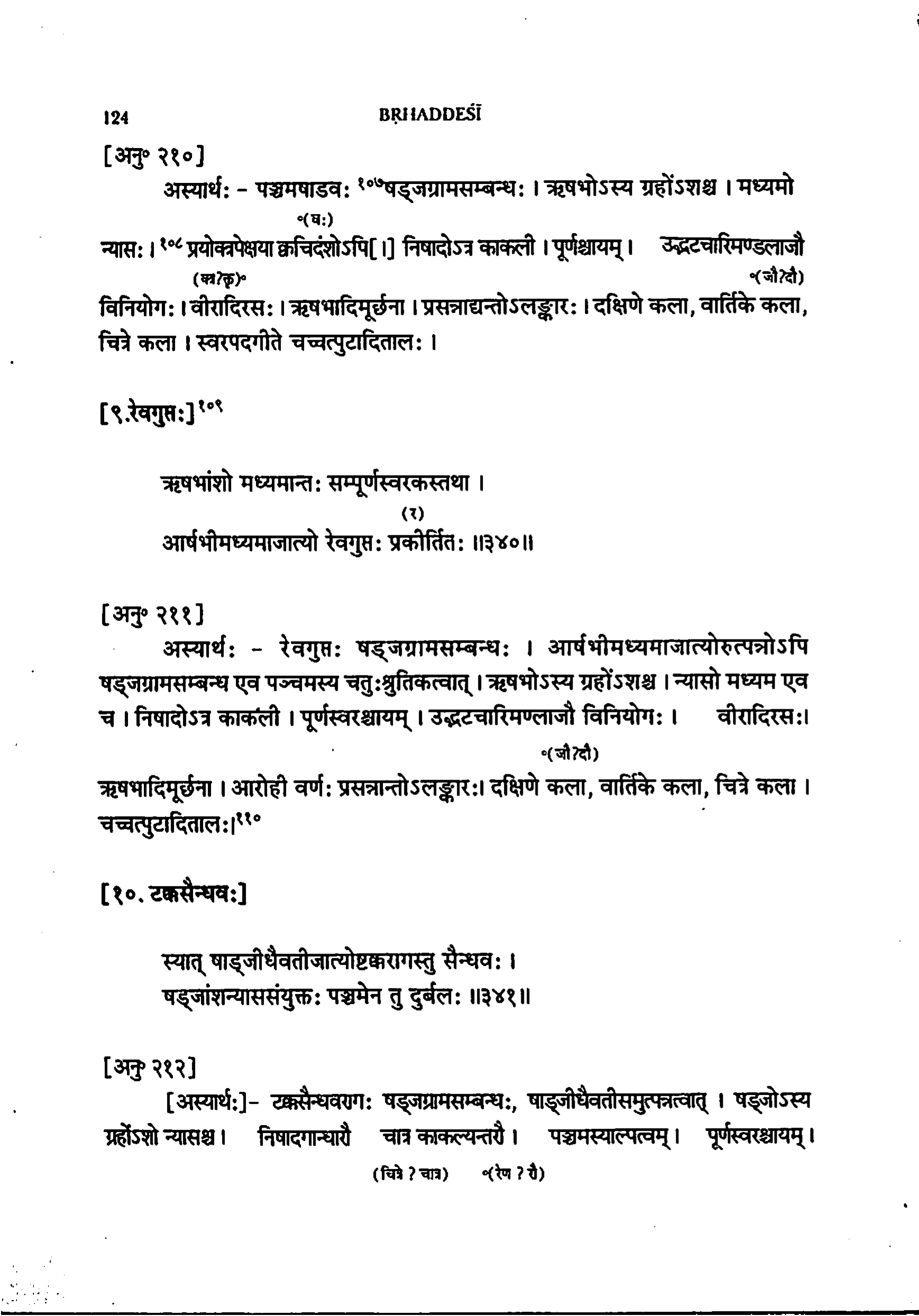
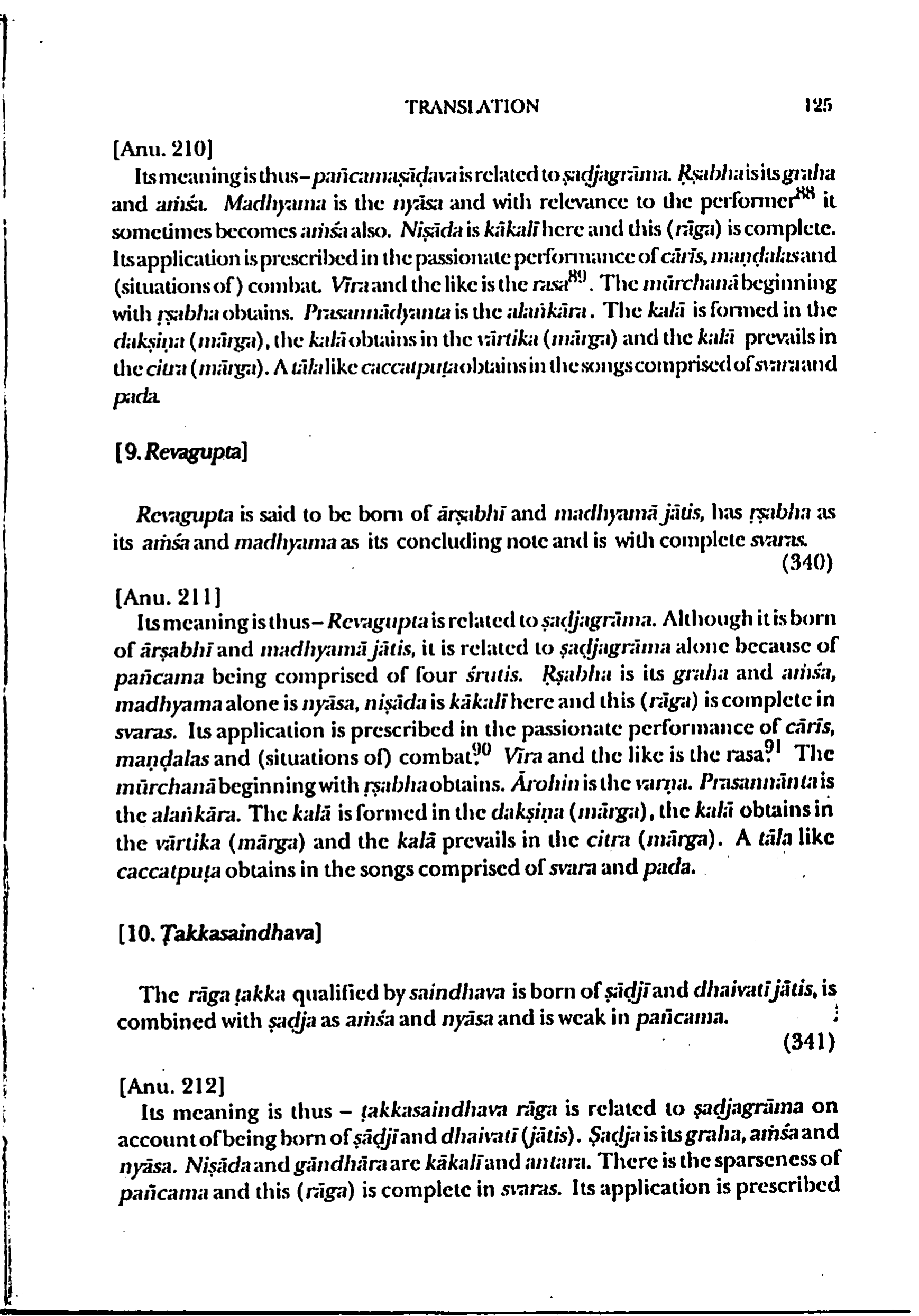
[Anu. 210]
Its meaning is thus –
pañcamaṣāḍavais related to ṣaḍjagrāma2. Ŗṣabhais its graha
and anisa.
Madhyama is the nyāsa and with relevance to the performer 88 it
sometimes becomes amśa also.
Niṣāda is kākalī here5 and this (rāga) is complete.
Its application is prescribed in the passionate performance of cārīs,
maṇḍalas and
(situations of ) combat. Vīra and the like is the rasa89.
The mūrchanā beginning
with ṛṣabha obtains6.
Prasannādyanta is the
alankāra.
The kalā is formed in the
dakṣiṇa (mārga), the kalā obtains in the vārtika (mārga) and the kalā prevails in
the citra (mārga)1.
A tāla like caccatpuṭa obtains in the songs comprised of svara and
pada8
Revagupta is said to be born of ārṣabhī and madhyamā jātis, has ṛṣabha as
its amsa and madhyama as its concluding note10 and is with complete svaras9.
(340)
[Anu. 211]
Its meaning is thus -
Revagupta is related to sadjagrāma3. Although it is born
of
ārṣabhī and madhyamā jātis, it is related to
ṣaḍjagrāma alone because of
pañcama being comprised of four śrutis. Rṣabha is its graha and amśa,
<math>
madhyama</math> alone is <math>ny\bar{a}sa</math>, <math>nis\bar{a}da</math> is <math>k\bar{a}kal\bar{t}</math> here and this (<math>r\bar{a}ga</math>) is complete in
svaras. Its application is prescribed in the passionate performance of cārīs,
mandalas and (situations of) combat. Vira and the like is the rasa. The
mūrchanā beginning with ṛṣabha obtains.
Ārohin is the varṇa11.
Prasannānta is
the
alankāra. The kalā is formed in the
dakṣiṇa (mārga), the kalā obtains in
the
vārtika (mārga) and the kalā prevails in the
citra (mārga). A tāla like
caccatputa obtains in the songs comprised of svara and pada.
The rāga takka qualified by saindhava is born of ṣāḍjī and dhaivatī jātis12, is
combined with sadja as amsa and nyāsa and is weak in pancama.
(341)
[Anu. 212]
Its meaning is thus -
takkasaindhava rāga is related to şadjagrāma4 on
account of being born of ṣāḍjī and
dhaivatī (jātis). Ṣaḍja is its graha, amśa and
nyāsa. Niṣāda and
gāndhāra are kākalī and antara.
There is the sparseness of
pañcama13 and this (rāga) is complete in svaras. Its application is prescribed