Source scans · vol_I_p039
recto · open full
scan recto
verso · open full
scan verso
Bṛhaddeśī · Volume I
pp. 60–61folio 039
Devanāgarī (Bṛhaddeśī)
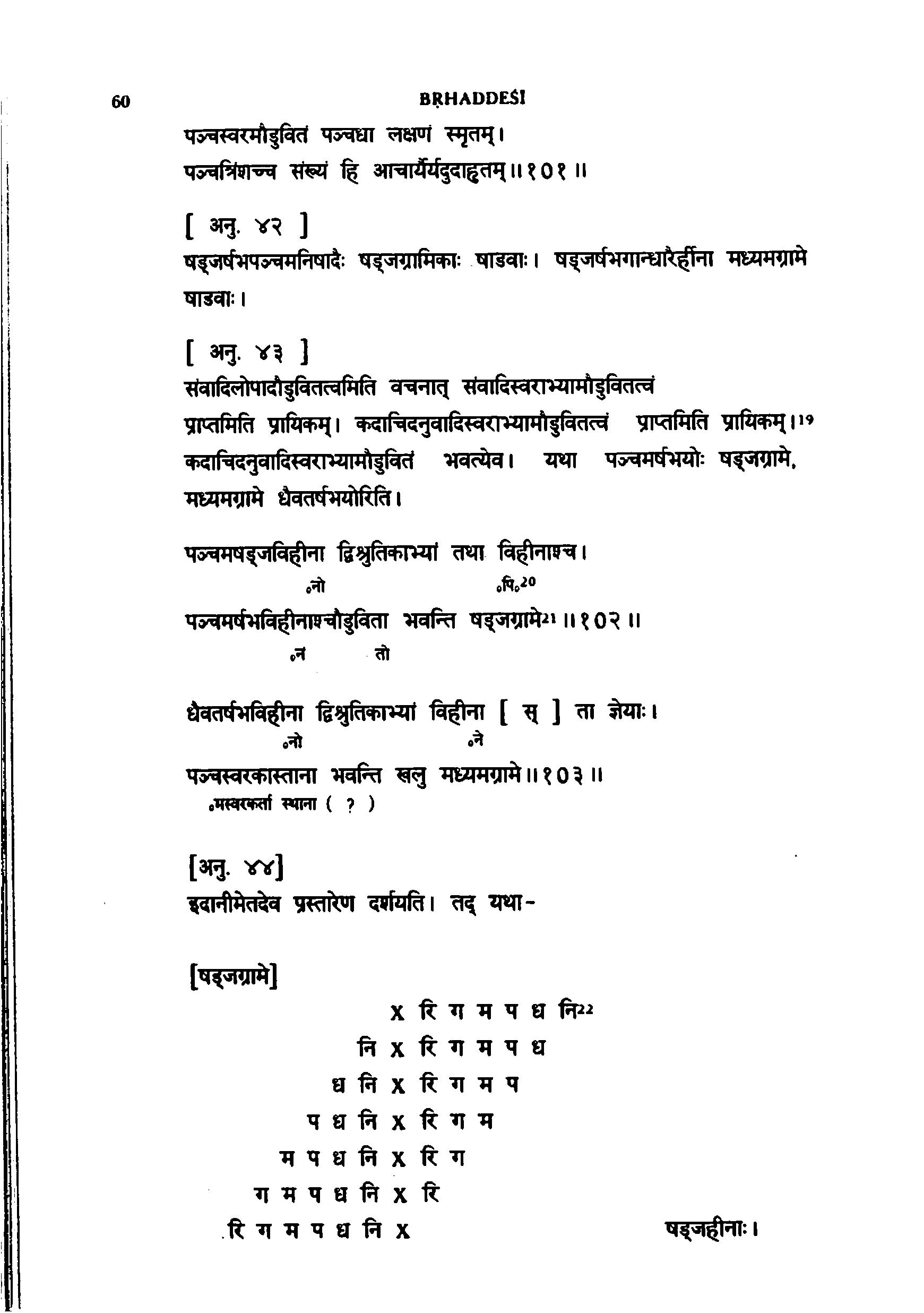
पञ्चस्वरमौडुवितं पञ्चधा लक्षणं स्मृतम्8
पञ्चित्रशच्च संख्यं हि आचार्यैर्यदुदाहृतम्।।१०१।।
[अनु. ४२]
षड्जर्षभपञ्चमनिषादैः षड्जग्रामिकाः षाडवाः। षड्जर्षभगान्धारैर्हीना मध्यमग्रामे
षाडवा4ः।
[अनु. ४३]
संवादिलोपादौडुवितत्विमिति वचनात्1 संवादिस्वराभ्यामौडुवितत्वं प्राप्तमिति प्रायिकम्। कदाचिदनुवादिस्वराभ्यामौडुवितत्वं प्राप्तमिति प्रायिकम्6। १९ कदाचिदनुवादिस्वराभ्यामौड्वितं भवत्येव2। यथा पञ्चमर्षभयोः षड्जग्रामे,
मध्यमग्रामे धैवतर्षभयोरिति।
पञ्चमषड्जविहीनाुनो द्विश्रुतिकाभ्यां10 तथा विहीनाम्च<del>्षि</del> 20
पञ्चमर्षभविहीनाश्चौडुवितातोुन₀नो भवन्ति षड्जग्रामे21्ने।।१०२।।
धैवतर्षभविहीना द्विश्रुतिकाभ्यां विहीना [ स् ] ता ज्ञेयाः।
पञ्चस्वरकास्ताना भवन्ति खलु मध्यमग्रामे ॥१०३॥ , मस्वरकर्ता स्थाना ( ? )
[अनु. ४४]
इदानीमेतदेव प्रस्तारेण दर्शयति। तद् यथा- X रिगमपधनि x रिगमपध नि22 धनि xपधनि X रिगम रिगमप म प गमपधनि रि नि रि ग ्रिगमपधनि
षड्जहानाः।
English — Sharma
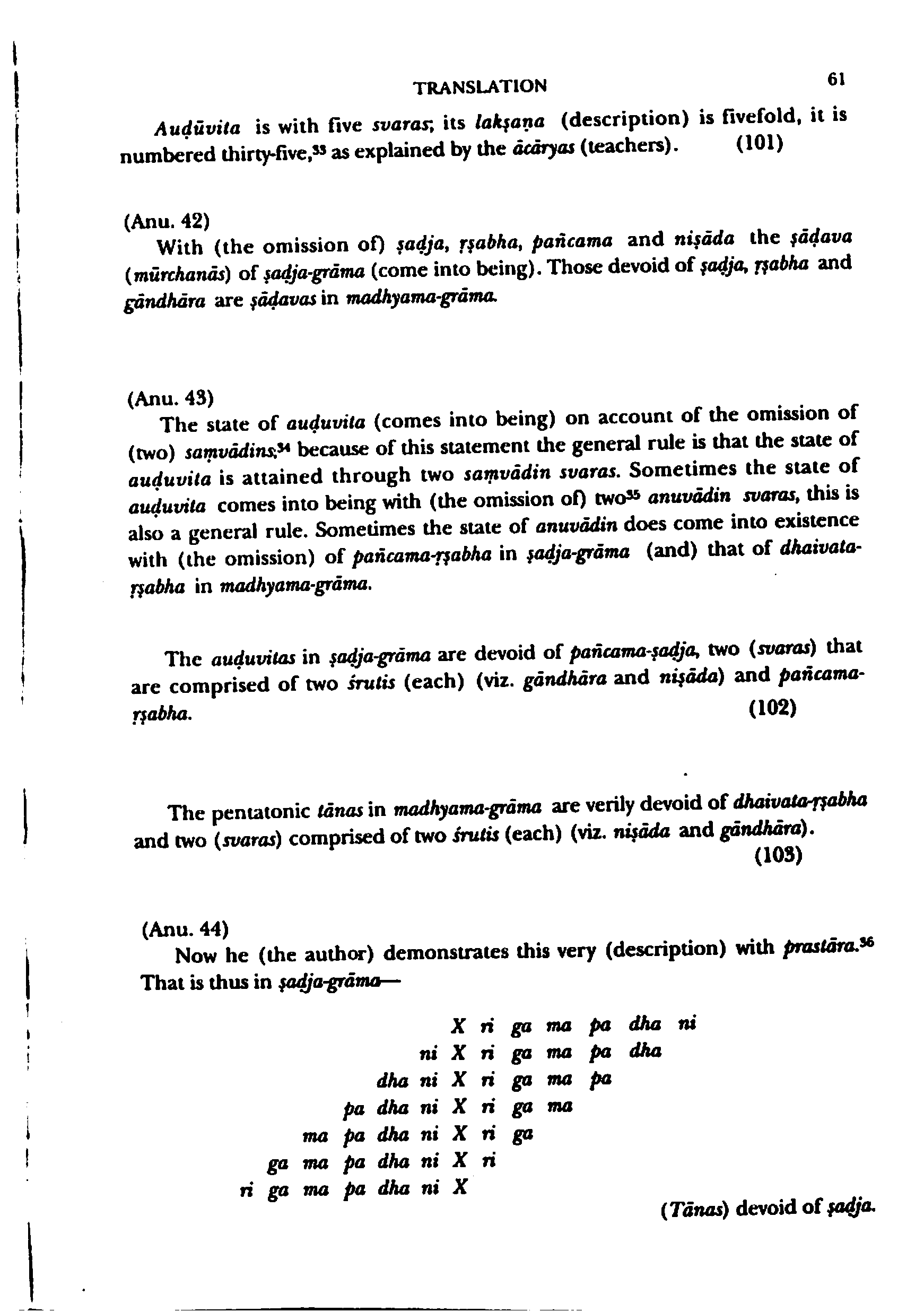
Audūvita is with five svaras; its lakṣaṇa (description) is fivefold8, it is numbered thirty-five,33 as explained by the ācāryas (teachers).
(101)
(Anu. 42) With (the omission of) șadja, rșabha, pañcama and nișāda the șādava (mūrchanās) of ṣadja-grāma (come into being). Those devoid of ṣadja, ṛṣabha and gandhara are şadavas in madhyama-grama. (Anu. 43) The state of auduvita (comes into being) on account of the omission of (two) samvadins1,34 because of this statement the general rule is that the state of auduvita is attained through two samvadin svaras. Sometimes the state of auduvita comes into being with (the omission of) two55 anuvādin svaras2, this is also a general rule.6 Sometimes the state of anuvadin does come into existence with (the omission) of pañcama-ṛṣabha in ṣadja-grāma (and) that of dhaivata- rşabha in madhyama-grāma. The auduvitas in şadja-grāma are devoid of pañcama-şadja, two (svaras) that are comprised of two śrutis (each) (viz. gandhāra and niṣāda)10 and pañcama-
(102)
rşabha. The pentatonic tānas in madhyama-grāma are verily devoid of dhaivata-ṛṣabha and two (svaras) comprised of two śrutis (each) (viz. niṣāda and gāndhāra).
(103)
(Anu. 44) Now he (the author) demonstrates this very (description) with prastara.36 That is thus in sadja-grāma9 X ri ga ma pa dha ni ni X ri ga ma pa dha dha ni X ri ga ma pa pa dha ni X ri ga ma ma pa dha ni X ri ga ga ma pa dha ni X ri ri ga ma pa dha ni X (Tānas) devoid of şadja.
1.[relation] The state of audūvita comes into being through the omission of two samvadin svarasसंवादिलोपादौडुवितत्विमिति वचनात्
2.[relation] Sometimes the state of audūvita comes into being with the omission of two anuvādin svarasकदाचिदनुवादिस्वराभ्यामौड्वितं भवत्येव
3.[relation] Ṣādava mūrchanās of ṣaḍja-grāma come into being through omission of ṣadja, ṛṣabha, pañcama and nișādaषड्जर्षभपञ्चमनिषादै षड्जग्रामिका षाडवा
4.[relation] Ṣādava mūrchanās in madhyama-grāma are devoid of ṣaḍja, ṛṣabha and gandharaषड्जर्षभगान्धारैर्हीना मध्यमग्रामे षाडवा
5.[relation] Mūrchanās of ṣaḍja-grāma are created by omitting specific svarasषड्जर्षभपञ्चमनिषादै षड्जग्रामिका षाडवा
6.[relation] Audūvita can be attained either through omission of samvadin svaras or anuvādin svaras, with the former being the general ruleसंवादिस्वराभ्यामौडुवितत्वं प्राप्तमिति प्रायिकम्। कदाचिदनुवादिस्वराभ्यामौडुवितत्वं प्राप्तमिति प्रायिकम्
7.[relation] Pañcama-ṛṣabha omitted in ṣaḍja-grāma corresponds to dhaivata-ṛṣabha omitted in madhyama-grāmaयथा पञ्चमर्षभयो षड्जग्रामे, मध्यमग्रामे धैवतर्षभयोरिति
8.[structural] The lakṣaṇa (description) of audūvita is fivefoldपञ्चस्वरमौडुवितं पञ्चधा लक्षणं स्मृतम्
9.[structural] The author demonstrates the description of audūvita with prastaraइदानीमेतदेव प्रस्तारेण दर्शयति। तद् यथा- [षड्जग्रामे]
10.[structural] Gandhāra and niṣāda are each comprised of two śrutisपञ्चमषड्जविहीना द्विश्रुतिकाभ्या
1.[relation]The state of audūvita comes into being through the omission of two samvadin svarasThe state of auduvita (comes into being) on account of the omission of (two) samvadins
2.[relation]Sometimes the state of audūvita comes into being with the omission of two anuvādin svarasSometimes the state of auduvita comes into being with (the omission of) two55 anuvādin svaras
3.[relation]Ṣādava mūrchanās of ṣaḍja-grāma come into being through omission of ṣadja, ṛṣabha, pañcama and nișādaWith (the omission of) șadja, rșabha, pañcama and nișāda the șādava (mūrchanās) of ṣaḍja-grāma (come into being).
4.[relation]Ṣādava mūrchanās in madhyama-grāma are devoid of ṣaḍja, ṛṣabha and gandharaThose devoid of ṣaḍja, ṛṣabha and gandhara are şadavas in madhyama-grama.
5.[relation]Mūrchanās of ṣaḍja-grāma are created by omitting specific svarasWith (the omission of) șadja, rșabha, pañcama and nișāda the șādava (mūrchanās) of ṣaḍja-grāma (come into being).
6.[relation]Audūvita can be attained either through omission of samvadin svaras or anuvādin svaras, with the former being the general rulethe general rule is that the state of auduvita is attained through two samvadin svaras. Sometimes the state of auduvita comes into being with (the omission of) two55 anuvādin svaras, this is also a general rule.
7.[relation]Pañcama-ṛṣabha omitted in ṣaḍja-grāma corresponds to dhaivata-ṛṣabha omitted in madhyama-grāmaSometimes the state of anuvadin does come into existence with (the omission) of pañcama-ṛṣabha in ṣaḍja-grāma (and) that of dhaivata- rşabha in madhyama-grama.
8.[structural]The lakṣaṇa (description) of audūvita is fivefoldAudūvita is with five svaras; its lakṣaṇa (description) is fivefold
9.[structural]The author demonstrates the description of audūvita with prastaraNow he (the author) demonstrates this very (description) with prastara.36 That is thus in sadja-grāma
10.[structural]Gandhāra and niṣāda are each comprised of two śrutistwo (svaras) that are comprised of two śrutis (each) (viz. gandhāra and niṣāda)