Source scans · vol_I_p038
recto · open full
scan recto
verso · open full
scan verso
Bṛhaddeśī · Volume I
pp. 58–59folio 038
Devanāgarī (Bṛhaddeśī)
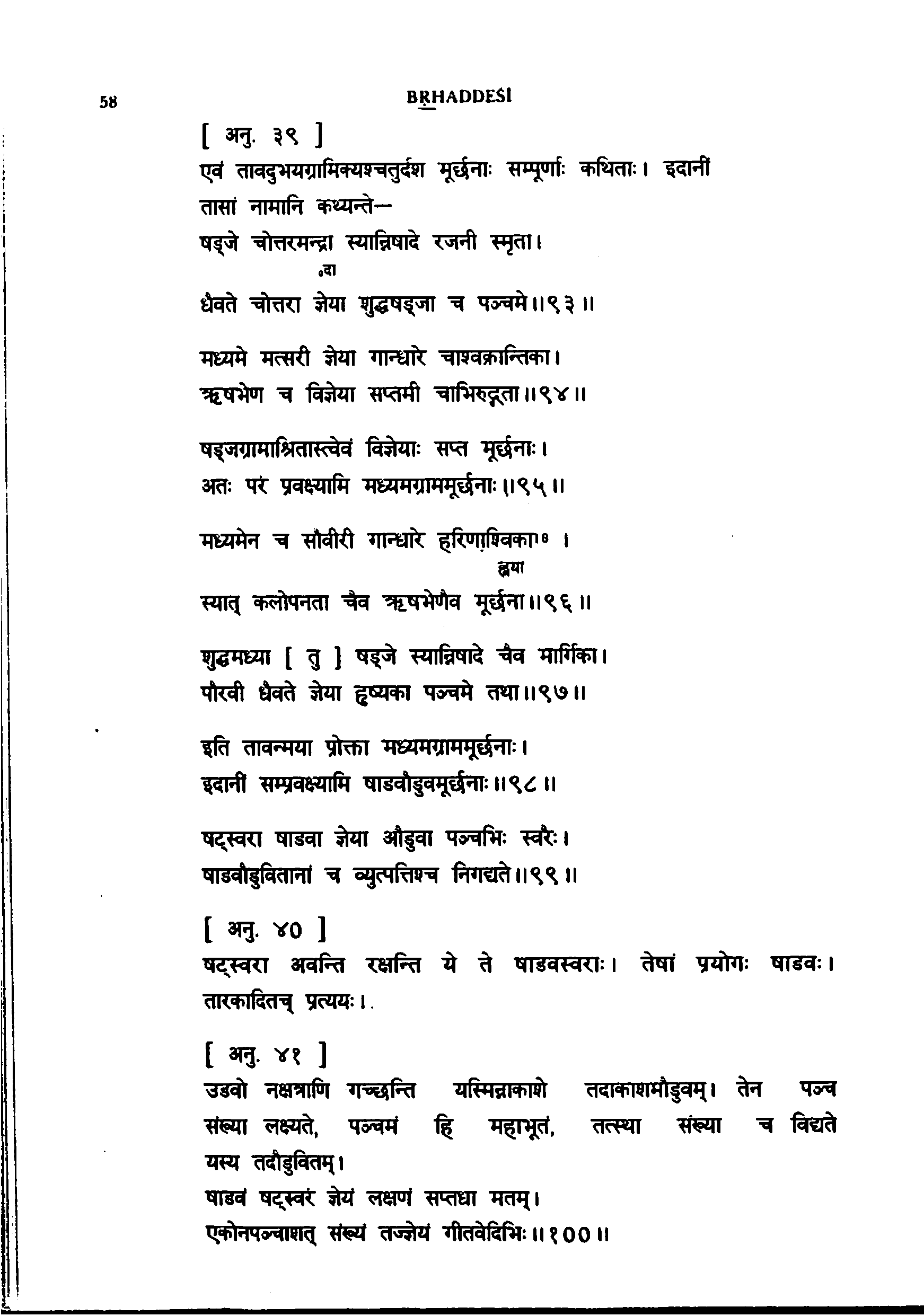
अनु. ३९ एवं तावदुभयग्रामिक्यश्चतुर्दश मूर्छनाः सम्पूर्णाः कथिताः। इदानीं तासां नामानि कथ्यन्ते—
षड्जे चोत्तरमन्द्रा•वा स्यान्6निषादे रजनी स्मृता7
धैवते चोत्तरा ज्ञेया शुद्धषड्जा च पञ्चमे।। ९३।।
मध्यमे मत्सरी ज्ञेया गान्धारे चाश्वक्रान्तिका।
ऋषभेण च विज्ञेया सप्तमी चाभिरुद्रता॥९४॥
षड्जग्रामाश्रितास्त्वेवं विज्ञेयाः सप्त मूर्छनाः।
अतः परं प्रवक्ष्यामि मध्यमग्राममूर्छनाः ॥९५॥
मध्यमेन च सौवीरी8 गान्धारे हरिणायिकाह्या
स्यात् कलोपनता चैव ऋषभेणैव मूर्छना।।९६।।
शुद्धमध्या [ तु ] षड्जे स्यान्निषादे चैव मार्गिका।
पौरवी धैवते ज्ञेया हृष्यका पञ्चमे तथा।।९७।।
इति तावन्मया प्रोक्ता मध्यमग्राममूर्छना4ः।
इदानी सम्प्रवक्ष्यामि षाडवौडुवमूर्छना5॥९८॥
षट्स्वरा षाडवा ज्ञेया औडुवा पञ्चिभः स्वरै2ः।
षाडवौडुवितानांअनु. ४० च व्युत्पत्तिश्च निगद्यते।।९९।।
षट्स्वरा अवन्ति रक्षन्ति ये ते षाडवस्वराः। तेषां प्रयोगः षाडवः।
तारकादितच् प्रत्ययः11
[अनु. ४१]
उडवो नक्षत्राणि गच्छन्ति यस्मिन्नाकाशे तदाकाशमौडुवम्। तेन पञ्च संख्यायस्य तदौडुवितम्। लक्ष्यते, पञ्चमं हि महाभूतं, तत्स्था संख्या च विद्यते
षाडवं षट्स्वरं ज्ञेयं लक्षणं सप्तधा मतम्।
एकोनपञ्चाशत् संख्यं तज्ज्ञेयं गीतवेदिभिः॥१००॥
English — Sharma
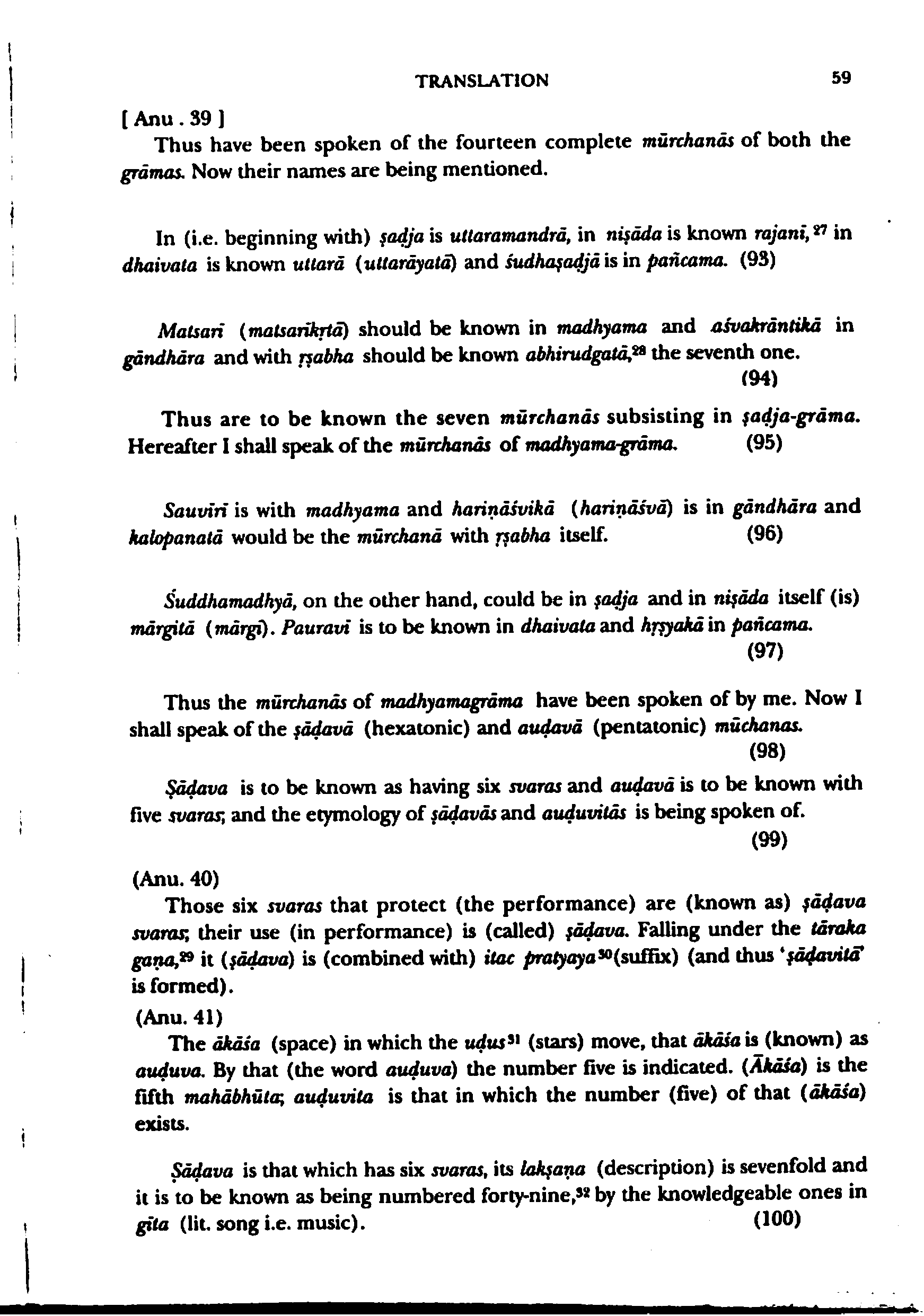
[Anu . 39]
Thus have been spoken of the fourteen complete murchanas of both the grāmas. Now their names are being mentioned. In (i.e. beginning with) şadja is uttaramandrā6, in niṣāda is known rajanī7, 27 in dhaivata is known uttarā (uttarāyatā) and śudhaşadjā is in pañcama. (93) Matsari (matsarikṛtā) should be known in madhyama and aśvakrāntikā in gāndhāra and with ṛṣabha should be known abhirudgatā,28 the seventh one.
(94)
Thus are to be known the seven mūrchanās subsisting in şadja-grāma.3 Hereafter I shall speak of the murchanas of madhyama-grama.
(95)
Sauvīrī is with madhyama8 and hariņāśvikā (hariņāśvā) is in gāndhāra and
(96)
kalopanatā would be the mūrchanā with ṛṣabha itself. Suddhamadhyā, on the other hand, could be in şadja and in niṣāda itself (is) mārgitā (mārgi). Pauravī is to be known in dhaivata and hṛṣyakā in pañcama. ł
(97)
Thus the mürchanās of madhyamagrāma have been spoken of by me.4 Now I shall speak of the şāḍavā (hexatonic) and auḍavā (pentatonic) mūchanas.5
(98)
Şāḍava is to be known as having six svaras1 and auḍavā is to be known with five svaras2; and the etymology of sadavas and auduvitas is being spoken of.
(99)
(Anu. 40) Those six svaras that protect (the performance) are (known as) sadava svaras; their use (in performance) is (called) sādava. Falling under the tāraka gaṇa,29 it (ṣāḍava) is (combined with) itac pratyaya 30 (suffix) (and thus ‘ṣāḍavitā’ is formed). (Anu. 41) The ākāśa (space) in which the udus 31 (stars) move, that ākāśa is (known) as auduva. By that (the word auduva) the number five is indicated. (<math>\bar{A}k\bar{a}\dot{s}a</math>) is the fifth mahābhūta; auduvita is that in which the number (five) of that (ākāśa) exists. Ṣāḍava is that which has six svaras, its lakṣaṇa (description) is sevenfold10 and it is to be known as being numbered forty-nine,52 by the knowledgeable ones in
(100)
gīta (lit. song i.e. music).
2.[definition] Auḍava is defined as a scale or framework containing five svaras (notes)औडुवा पञ्चिभः स्वरै
4.[enumeration] Seven mūrchanās of madhyama-grāma exist, each associated with a different svaraइति तावन्मया प्रोक्ता मध्यमग्राममूर्छना
5.[relation] Both şāḍava and auḍava mūrchanās are varieties of murchanas derived from the seven-note systemइदानी सम्प्रवक्ष्यामि षाडवौडुवमूर्छना
6.[relation] Uttaramandrā is a mūrchanā beginning with (or associated with) şadjaषड्ज? चोत्तरमन्द्रा स्यान्
7.[relation] Rajanī is a mūrchanā associated with the niṣāda svaraनिषादे रजनी स्मृता
8.[relation] Sauvīrī is a mūrchanā of madhyama-grāma associated with madhyama svaraमध्यमेन च सौवीरी
9.[relation] Ākāśa (space) is identified as the fifth mahābhūta (great element), which relates etymologically to the pentatonic (auḍava) frameworkपञ्चमं हि महाभूतं, तत्स्था संख्या च विद्यते यस्य तदौडुवितम्।
11.[structural] The itac pratyaya (grammatical suffix) is applied to şāḍava to form derivative termsतारकादितच् प्रत्ययः
1.[definition]Şāḍava is defined as a scale or framework containing six svaras (notes)Şāḍava is to be known as having six svaras
2.[definition]Auḍava is defined as a scale or framework containing five svaras (notes)auḍavā is to be known with five svaras
3.[enumeration]Seven mūrchanās subsist in (are derived from) şadja-grāma, each associated with a different svaraThus are to be known the seven mūrchanās subsisting in şadja-grāma.
4.[enumeration]Seven mūrchanās of madhyama-grāma exist, each associated with a different svaraThus the mürchanās of madhyamagrāma have been spoken of by me.
5.[relation]Both şāḍava and auḍava mūrchanās are varieties of murchanas derived from the seven-note systemNow I shall speak of the şāḍavā (hexatonic) and auḍavā (pentatonic) mūchanas.
6.[relation]Uttaramandrā is a mūrchanā beginning with (or associated with) şadjaIn (i.e. beginning with) şadja is uttaramandrā
7.[relation]Rajanī is a mūrchanā associated with the niṣāda svarain niṣāda is known rajanī
8.[relation]Sauvīrī is a mūrchanā of madhyama-grāma associated with madhyama svaraSauvīrī is with madhyama
9.[relation]Ākāśa (space) is identified as the fifth mahābhūta (great element), which relates etymologically to the pentatonic (auḍava) framework(Āk āśa) is the fifth mahābhūta; auduvita is that in which the number (five) of that (ākāśa) exists.
10.[structural]Şāḍava has a sevenfold lakṣaṇa (description or characterization)Ṣāḍava is that which has six svaras, its lakṣaṇa (description) is sevenfold
11.[structural]The itac pratyaya (grammatical suffix) is applied to şāḍava to form derivative termsFalling under the tāraka garṇa,29 it (ṣāḍava) is (combined with) itac pratyaya 30 (suffix)
12.[structural]Şāḍava is numerically valued at forty-nine by music scholarsit is to be known as being numbered forty-nine,52 by the knowledgeable ones in (gīta)