Source scans · vol_I_p053
recto · open full
scan recto
verso · open full
scan verso
Bṛhaddeśī · Volume I
pp. 88–89folio 053
Devanāgarī (Bṛhaddeśī)
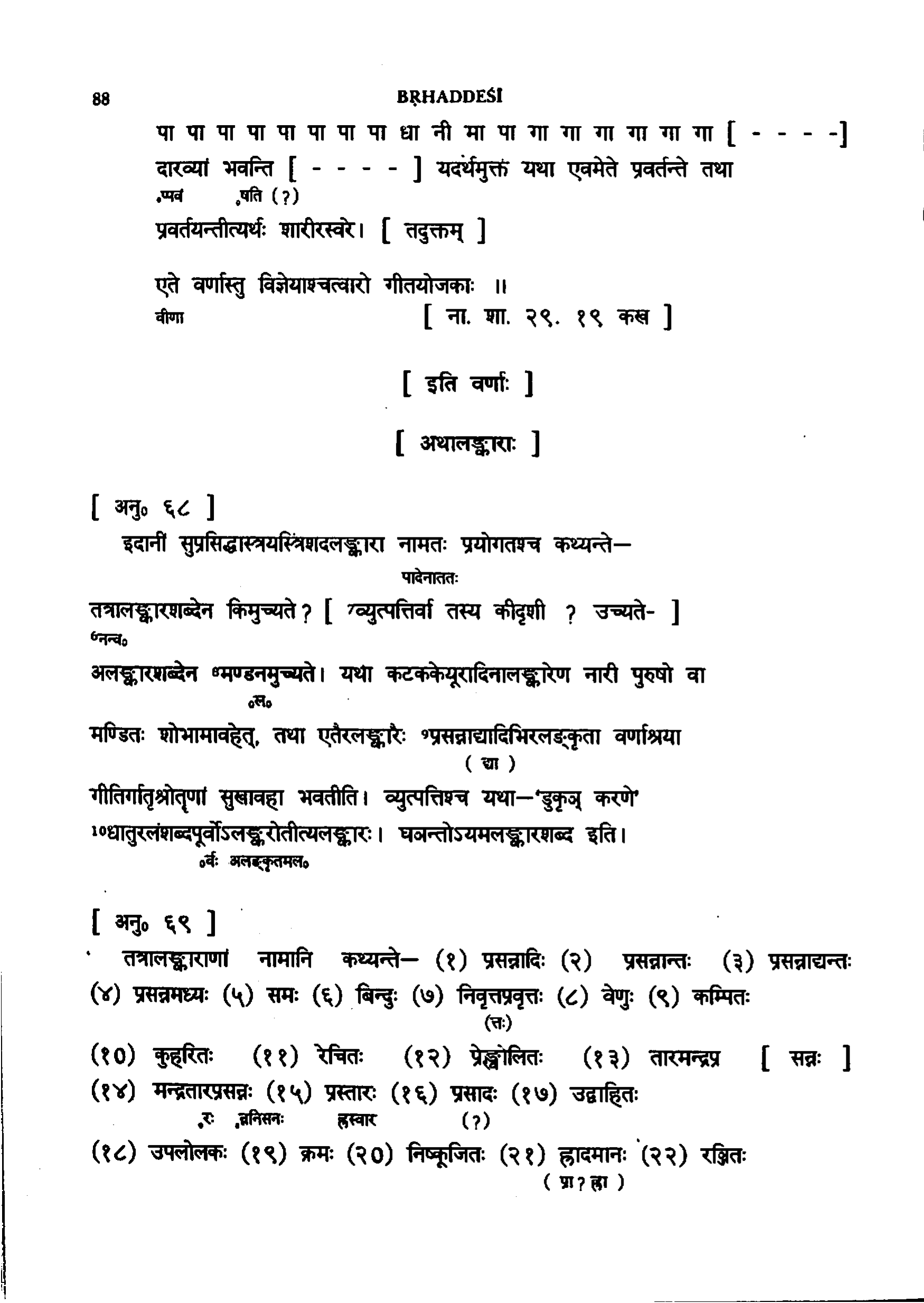
पापापापापापाधानीमापागागागागागा । [ - - - -] दारव्यां भवन्ति [ - - - - ] यदर्थमुक्तं यथा एवमेते प्रवर्तन्ते तथा ुषति•प्पर्व (?) प्रवर्तयन्तीत्यर्थः शारीरस्वरे। तदुक्तम् ]
एते वर्णास्तु विज्ञेयाश्चत्वारो गीतयोजकाः ॥
[ ना. मा. २९. १९ कख ]1 वीणा
[इति वर्णाः]
[अथालङ्काराः]
अनु₀ ६८ ] इदानीं<b>ध्नन्व</b>० सुप्रसिद्धास्त्रयस्त्रिशदलङ्कारापादेनाततः नामतः प्रयोगतश्च कथ्यन्ते—11 तत्रालङ्कारणब्देन किमुच्यते ? [ ग्व्युत्पत्तिर्वा तस्य कीदृशी ? उच्यते- ] अलङ्कारशब्देन ध्मण्डनमुच्यते। यथा कटककेयूरादिनालङ्कारेण नारी पुरुषो वा ৹ল৹ मण्डितः शोभामावहेत्, तथा एतैरलङ्कारैः श्रप्तम्नाद्यादिभिरलङ्कृता( द्या ) वर्णाश्रया गीतिर्गातृश्रोतृणां सुखावहा भवतीति। व्युत्पत्तिश्च यथा—‘डुकृञ् करणे’
10धातुरलंशब्दपूर्वोऽलङ्करोतीत्यलङ्कारः। घञन्तोऽयमलङ्कारशब्द इति।
•विः अलङ्कृतमल •
[अनु₀ ६९]
ं तत्रालङ्काराणां नामानि कथ्यन्ते— (१) प्रसन्नादिः (२) प्रसन्नान्तः (३) प्रसन्नाद्यन्तः (४) प्रसन्नमध्यः4 (५) समः (६) बिन्दुः (७) निवृत्तप्रवृत्तः9(तः) (८) वेणुः (९) कम्पितः5 (१०) कुहरितः (११) रेचितः (१२) प्रेङ्घोलितः (१३) तारमन्द्रप्र [
सन्नः ।
(१४) मन्द्रतारप्रसन्नः (१५) प्रस्तारः (१६) प्रसादः (१७) उद्वाहितः ्रः ,व्रनिसनः ह्रस्वार (?) (१८) उपलोलकः (१९) क्रमः (२०) निष्कृजितः (२१) ह्रादमानः (२२) रिञ्जतः (प्रा?ह्रा)
English — Sharma
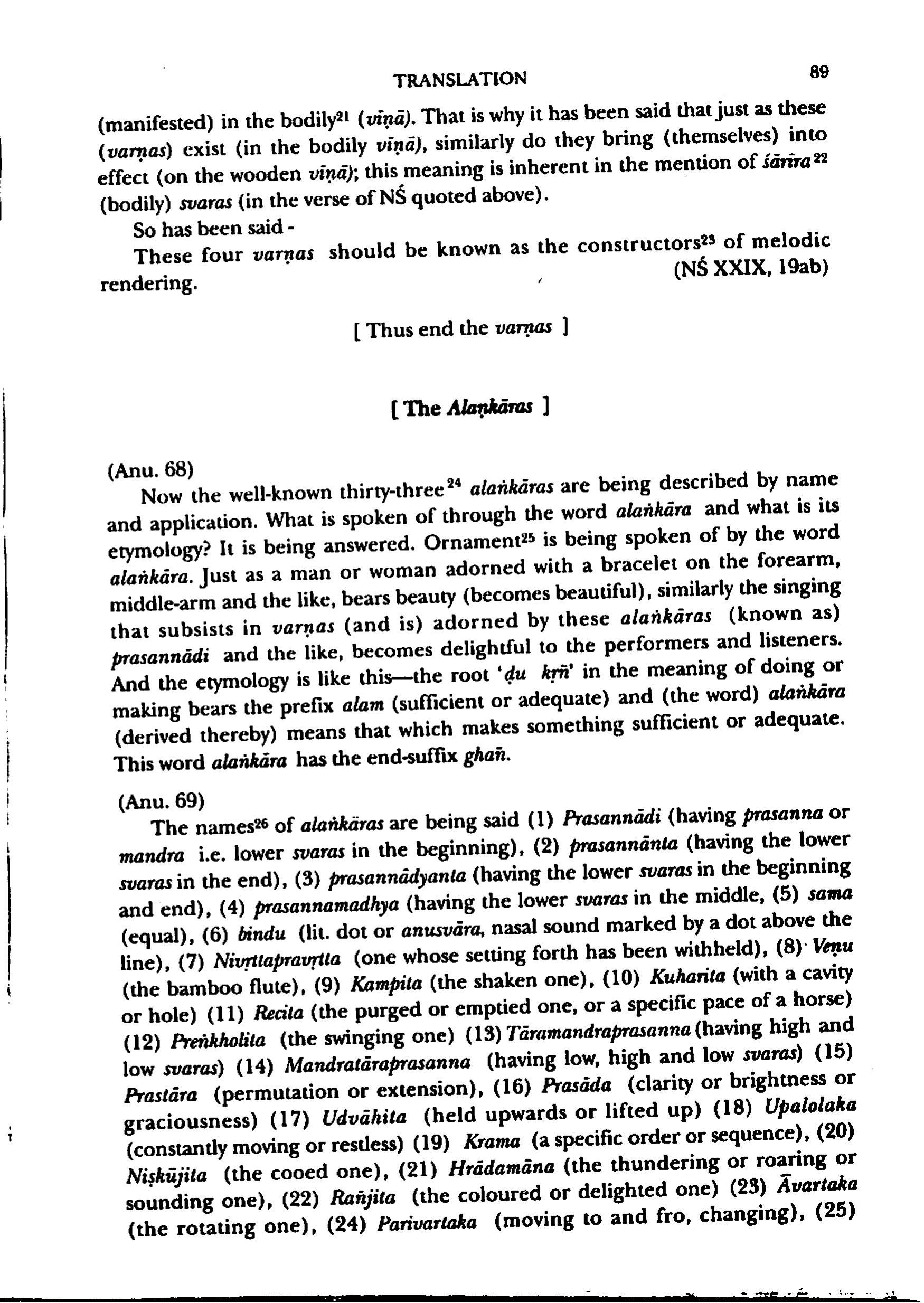
(manifested) in the bodily21 (<math>v\bar{i}n\bar{a}</math>). That is why it has been said that just as these (varṇas) exist (in the bodily <math>viṇ\bar{a}</math>), similarly do they bring (themselves) into effect (on the wooden <math>vin\bar{a}</math>); this meaning is inherent in the mention of <math>sanra^{22}</math> (bodily) svaras (in the verse of NS quoted above). So has been said - These four varnas should be known as the constructors23 of melodic (NŚ XXIX, 19ab) rendering.10
[Thus end the varnas]
[The Alankaras]
(Anu. 68) Now the well-known thirty-three 24 alankāras are being described by name and application. What is spoken of through the word alankara and what is its etymology? It is being answered. Ornament25 is being spoken of by the word alankāra. Just as a man or woman adorned with a bracelet on the forearm, middle-arm and the like, bears beauty (becomes beautiful), similarly the singing that subsists in varņas (and is) adorned by these alankāras12 (known as) prasannādi and the like, becomes delightful to the performers and listeners.2 And the etymology is like this—the root 'du krñ' in the meaning of doing or making bears the prefix alam (sufficient or adequate) and (the word) alankāra (derived thereby) means that which makes something sufficient or adequate. This word alankara has the end-suffix ghan. (Anu. 69) The names26 of alankāras are being said (1) Prasannādi (having prasanna or mandra i.e. lower svaras in the beginning)4, (2) prasannānta (having the lower svaras in the end), (3) prasannādyanta (having the lower svaras in the beginning and end), (4) prasannamadhya (having the lower svaras in the middle, (5) sama (equal), (6) bindu (lit. dot or anusvāra, nasal sound marked by a dot above the line), (7) Nivittapravitta (one whose setting forth has been withheld)9, (8) Veņu (the bamboo flute), (9) Kampita (the shaken one)5, (10) Kuharita (with a cavity or hole) (11) Recita (the purged or emptied one, or a specific pace of a horse) (12) Prenkholita (the swinging one) (13) Tāramandraprasanna (having high and low svaras) (14) Mandratāraprasanna (having low, high and low svaras) (15) Prastāra (permutation or extension)6, (16) Prasāda (clarity or brightness or graciousness)7 (17) Udvāhita (held upwards or lifted up) (18) Upalolaka (constantly moving or restless) (19) Krama (a specific order or sequence)8, (20) i Nișkūjita (the cooed one), (21) Hrādamāna (the thundering or roaring or sounding one), (22) Ranjita (the coloured or delighted one) (23) Avartaka (the rotating one), (24) Parivartaka (moving to and fro, changing), (25)
1.[attribution] The Nāṭyaśāstra (NŚ) is cited as a source for the doctrine that varṇas are the four constructors of melodic rendering[ ना. मा. २९. १९ कख ]
4.[definition] Prasannādi is an alankāra having lower svaras (prasanna/mandra) at the beginning(४) प्रसन्नमध्यः
5.[definition] Kampita is an alankāra meaning the shaken one(९) कम्पितः
6.[definition] Prastāra is an alankāra meaning permutation or extension(१५) प्रस्तारः
7.[definition] Prasāda is an alankāra meaning clarity, brightness, or graciousness(१६) प्रसादः
8.[definition] Krama is an alankāra meaning a specific order or sequence(१९) क्रमः
9.[definition] Nivittapravitta is an alankāra whose setting forth has been withheld(७) निवृत्तप्रवृत्तः
11.[enumeration] There are thirty-three well-known alankāras enumerated by name and applicationइदानी सुप्रसिद्धास्त्रयस्त्रिशदलङ्कारा नामतः प्रयोगतश्च कथ्यन्ते—
1.[attribution]The Nāṭyaśāstra (NŚ) is cited as a source for the doctrine that varṇas are the four constructors of melodic rendering(NŚ XXIX, 19ab)
2.[definition]Alankāras are ornaments that adorn singing subsisting in varṇas and make it delightful to performers and listenerssimilarly the singing that subsists in varņas (and is) adorned by these alankāras (known as) prasannādi and the like, becomes delightful to the performers and listeners.
3.[definition]The word alankāra derives from the root 'du krñ' (meaning doing/making) with the prefix 'alam' (sufficient/adequate), signifying that which makes something adequatethe root 'du krñ' in the meaning of doing or making bears the prefix alam (sufficient or adequate) and (the word) alaṅkāra (derived thereby) means that which makes something sufficient or adequate.
4.[definition]Prasannādi is an alankāra having lower svaras (prasanna/mandra) at the beginning(1) Prasannādi (having prasanna or mandra i.e. lower svaras in the beginning)
5.[definition]Kampita is an alankāra meaning the shaken one(9) Kampita (the shaken one)
6.[definition]Prastāra is an alankāra meaning permutation or extension(15) Prastāra (permutation or extension)
7.[definition]Prasāda is an alankāra meaning clarity, brightness, or graciousness(16) Prasāda (clarity or brightness or graciousness)
8.[definition]Krama is an alankāra meaning a specific order or sequence(19) Krama (a specific order or sequence)
9.[definition]Nivittapravitta is an alankāra whose setting forth has been withheld(7) Nivittapravitta (one whose setting forth has been withheld)
10.[definition]Varṇas are the four constructors of melodic rendering in singingThese four varnas should be known as the constructors23 of melodic (NŚ XXIX, 19ab) rendering.
11.[enumeration]There are thirty-three well-known alankāras enumerated by name and applicationNow the well-known thirty-three24 alankāras are being described by name and application.
12.[relation]Alankāras are applied to and adorn the varṇas in melodic singingthe singing that subsists in varņas (and is) adorned by these alankāras
13.[structural]The alankāra doctrine is organized with an etymological explanation establishing the semantic link between adorning and adequacyOrnament25 is being spoken of by the word alaṅkāra. Just as a man or woman adorned with a bracelet on the forearm, middle-arm and the like, bears beauty (becomes beautiful)