Source scans · vol_II_p030
recto · open full
scan recto
verso · open full
scan verso
Bṛhaddeśī · Volume II
pp. 9–43folio 030
Devanāgarī
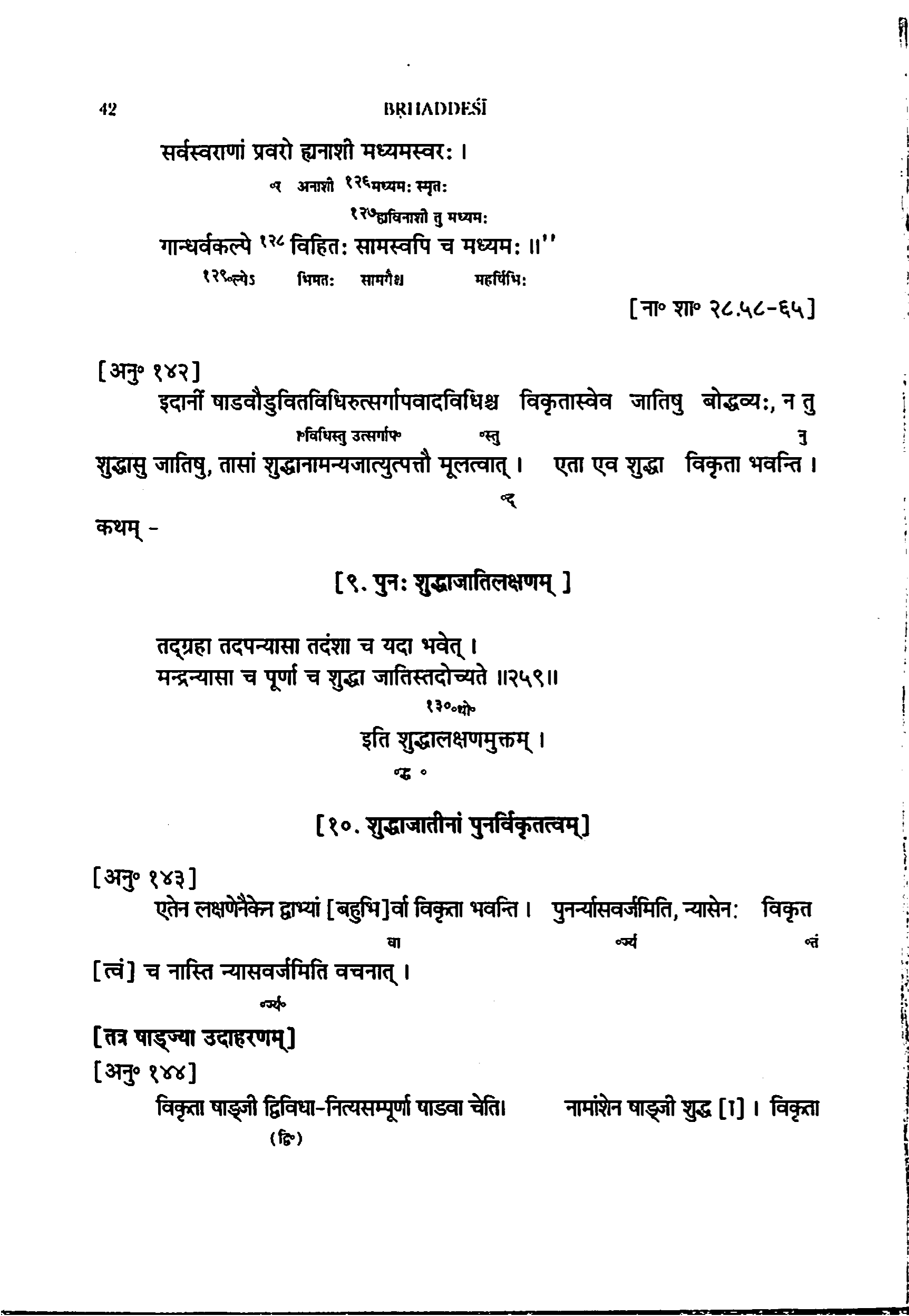
सर्वस्वराणां प्रवरो ह्यनाशी मध्यमस्वर:1
व्य अनाशी १२६मध्यम: स्मृत: १२७हाधिनाशी तु मध्यम: गान्धर्वकल्पे १२८ विहित: सामस्विप च मध्यम: ॥'' १२९०ल्येऽ सामगैश महर्षिभि:भिमत:
[ना॰ शा॰ २८.५८-६५]
[अनु॰ १४२]
इदानीं षाडवौडुवितविधिरुत्सर्गापवादविधिश्च<b>॰</b>विधस्तु उत्सर्गाफ॰स्तु विकृतास्वेव जातिषु बोद्धव्य:, न तु
शुद्धासु जातिषु, तासां शुद्धानामन्यजात्युत्पत्तौ मूलत्वात्5एता एव शुद्धा विकृता भवन्ति6
कथम् -
[९. पुन: शुद्धाजातिलक्षणम्]
तद्ग्रहा तदपन्यासा तदंशा च यदा भवेत्। मन्द्रन्यासा च पूर्णा च शुद्धा जातिस्तदोच्यते2१३००धी ॥२५९॥
इति शुद्धालक्षणमुक्तम्।
4 ° [१०.न्दर्भ शुद्धाजातीनांधा पुनर्विकृतत्वम्]•ज्यन्त
[अनु॰ १४३]
एतेन लक्षणेनैकेन द्वाभ्यां [बहुभि]वां विकृता भवन्ति । पुनर्न्यासवर्जमिति9, न्यासेन: विकृत
[त्वं] च नास्ति न्यासवर्जमिति वचनात् ।
[तत्र षाङ्ज्या उदाहरणम्]
[अनु॰ १४४]
विकृता षाङ्जी द्विविधा-नित्यसम्पूर्ण पाडवा चेति4
नामांशेन षाङ्जी शुद्ध3 [1] । विकृता (ক্টি) 78 LE
English — Sharma (translation)
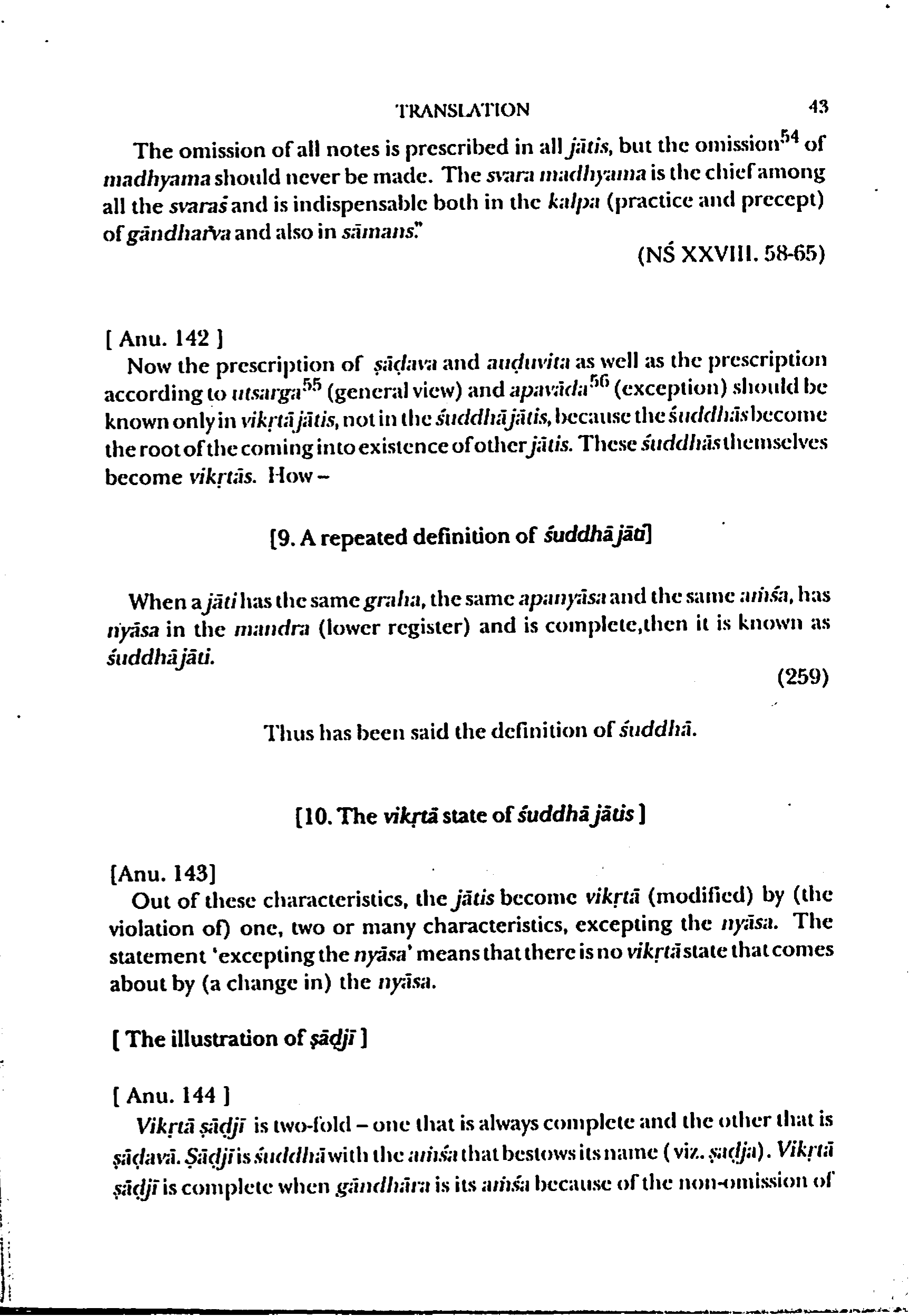
The omission of all notes is prescribed in all <math>j\bar{a}tis</math>, but the omission of madhyama should never be made. The svara madhyama is the chief among all the svaras and is indispensable both in the kalpa (practice and precept) of gāndharva and also in sāmans.1" (NŚ XXVIII. 58-65)
[Anu. 142]
Now the prescription of sadava and auduvita as well as the prescription according to utsarga55 (general view) and apavāda56 (exception) should be known only in vikṛtā jātis, not in the śuddhā jātis7, because the śuddhās become the root of the coming into existence of other jātis.5 These śuddhās themselves become vikṛtās.6 How-
[9. A repeated definition of śuddhā jāti]
When a jāti has the same graha, the same apanyāsa and the same aniśa, has nyāsa in the mandra (lower register) and is complete, then it is known as śuddhā jāti.2
(259)
Thus has been said the definition of śuddhā.
[Anu. 143]
Out of these characteristics, the jātis become vikṛtā (modified) by (the violation of) one, two or many characteristics, excepting the nyāsa.9 The statement 'excepting the nyāsa' means that there is no vikṛtā state that comes about by (a change in) the nyāsa.10
[The illustration of sadji]
[Anu. 144]
Vikṛtā ṣādjī is two-fold – one that is always complete and the other that is ṣāḍavā.4 Ṣāḍjī is śuddhā with the aṁśa that bestows its name (viz. ṣaḍja).3 Vikṛtā ṣāḍjī is complete when gāndhāra is its aṁśa because of the non-omission of8 ----
1.[attribution] The madhyama svara is the chief among all svaras and is indispensableसर्वस्वराणा प्रवरो ह्यनाशी मध्यमस्वरः
2.[definition] A śuddhā jāti is defined as having the same graha, apanyāsa, and aniśa, with nyāsa in the mandra and being completeतद्ग्रहा तदपन्यासा तदंशा च यदा भवेत्। मन्द्रन्यासा च पूर्णा च शुद्धा ज?ातिस्तदोच्यते
3.[definition] Ṣāḍjī is śuddhā with the aṁśa that bestows its nameनामांशेन षाङ्ज?ी शुद्ध
4.[enumeration] Vikṛtā ṣāḍjī has two varieties: one that is always complete and one that is ṣāḍavāविकृता षाङ्ज?ी द्विविधा-नित्यसम्पूर्ण पाडवा चेति
5.[relation] Śuddhā jātis are the root of the coming into existence of other jātisतासा शुद्धानामन्यजात्युत्पत्तौ मूलत्वात्
6.[relation] Śuddhā jātis themselves become vikṛtāsएता एव शुद्धा विकृता भवन्ति
9.[structural] Vikṛtā jātis are created by violation of one, two, or many characteristics of śuddhā jātis, excepting the nyāsaएतेन लक्षणेनैकेन द्वाभ्या [बहुभि]वा विकृता भवन्ति । पुनर्न्यासवर्जमिति
1.[attribution]The madhyama svara is the chief among all svaras and is indispensableThe svara madhyama is the chief among all the svaras and is indispensable both in the kalpa (practice and precept) of gāndharva and also in sāmans.
2.[definition]A śuddhā jāti is defined as having the same graha, apanyāsa, and aniśa, with nyāsa in the mandra and being completeWhen a jāti has the same graha, the same apanyāsa and the same aniśa, has nyāsa in the mandra (lower register) and is complete, then it is known as śuddhā jāti.
3.[definition]Ṣāḍjī is śuddhā with the aṁśa that bestows its nameṢāḍjī is śuddhā with the aṁśa that bestows its name (viz. ṣaḍja).
4.[enumeration]Vikṛtā ṣāḍjī has two varieties: one that is always complete and one that is ṣāḍavāVikṛtā ṣādjī is two-fold – one that is always complete and the other that is ṣāḍavā.
5.[relation]Śuddhā jātis are the root of the coming into existence of other jātisbecause the śuddhās become the root of the coming into existence of other jātis.
6.[relation]Śuddhā jātis themselves become vikṛtāsThese śuddhās themselves become vikṛtās.
7.[relation]The prescription of sadava and auduvita applies only to vikṛtā jātis, not to śuddhā jātisthe prescription of sadava and auduvita as well as the prescription according to utsarga (general view) and apavāda (exception) should be known only in vikṛtā jātis, not in the śuddhā jātis
8.[relation]Vikṛtā ṣāḍjī is complete when gāndhāra is its aṁśa because of the non-omission of that noteVikṛtā ṣāḍjī is complete when gāndhāra is its aṁśa because of the non-omission of
9.[structural]Vikṛtā jātis are created by violation of one, two, or many characteristics of śuddhā jātis, excepting the nyāsaOut of these characteristics, the jātis become vikṛtā (modified) by (the violation of) one, two or many characteristics, excepting the nyāsa.
10.[structural]There is no vikṛtā state that comes about by a change in the nyāsaThe statement 'excepting the nyāsa' means that there is no vikṛtā state that comes about by (a change in) the nyāsa.