Source scans · vol_II_p029
recto · open full
scan recto
verso · open full
scan verso
Bṛhaddeśī · Volume II
pp. 40–41folio 029
Devanāgarī
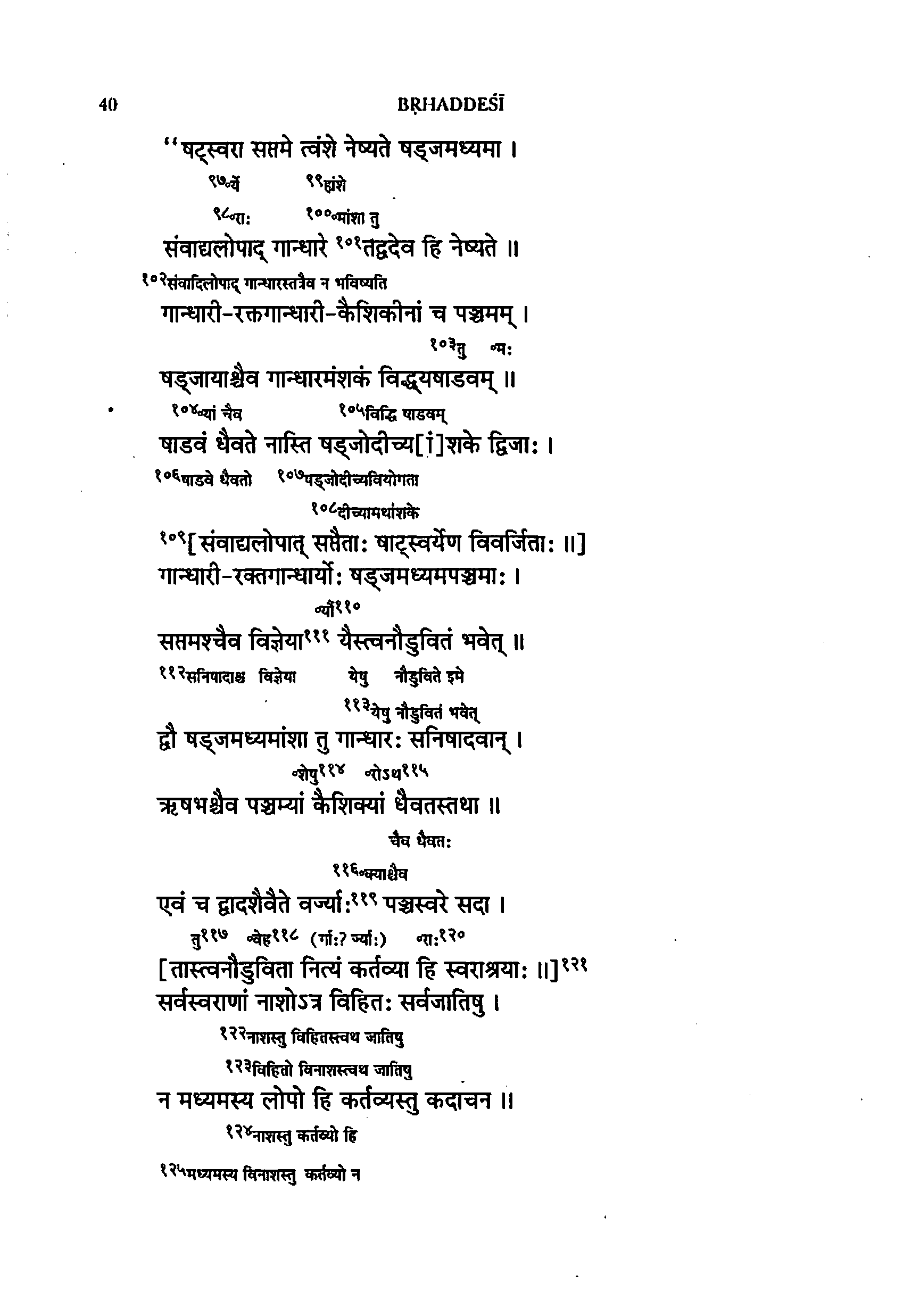
‘‘षट्स्वरा९७-र्य सप्तमे त्वंशे नेष्यते षड्जमध्यमा7
९९हांशे ९८०राः १०००मांशा त
संवाद्यलोपाद् गान्धारे १०१तद्वदेव हि नेष्यते ॥
९०२संवादिलोपाद् गान्धारस्तत्रैव न भविष्यति
गान्धारी-रक्तगान्धारी-कैशिकीनां च पञ्चमम्1098१०३त व्मः
षड्जायाश्चेव गान्धारमंशकं विद्ध्यषाडवम् ॥
१०४वां चैव १०५विद्धि षाडवम्
षाडवं धैवते नास्ति षड्जोदीच्य[ां]शके द्विजा:।
१०६षाडवे धैवतो १०७पड्जोदीच्यवियोगता १०८दीच्यामधांशके १०९[संवाद्यलोपात् सप्तैता: षाट्स्वर्येण विवर्जिता: ॥]
गान्धारी-रक्तगान्धार्यो:व्यौ११० षड्जमध्यमपञ्चमा:।
सप्तमश्चैव विज्ञेया १११ यैस्त्वनौडुवितं भवेत् ॥
११२सनिपादाश्च विज्ञेया येषु नौडुविते इमे ११३येषु नौडुवितं भवेत्
द्वौ षड्जमध्यमांशा तु गान्धार: सनिषादवान् ।
न्त्रोपुरेश्४ न्तोऽधरेर५
ऋषभश्चेव पञ्चम्यां कैशिक्यां११६॰क्याक्षैव धैवतस्तथाचैव धैवत:
एवं च द्वादशैवैते वर्ज्या:११९ पञ्चस्वरे सदा ।
तु११७ व्वेह११८ (र्गा:? ज्यां:) न्या:१२० [तास्त्वनौडुविता नित्यं कर्तव्या हि स्वराश्रया: ॥3] १२१
सर्वस्वराणां नाशोऽत्र विहितः सर्वजातिषु ।
१२२नाशस्तु विहितस्त्वथ जातिषु १२३विहितो विनाशस्त्वथ जातिषु
मध्यमस्य लोपो हि कर्तव्यस्तु कदाचन ॥
१२४नाशस्तु कर्तव्यो हि १२५मध्यमस्य विनाशस्तु कर्तव्यो न
English — Sharma (translation)
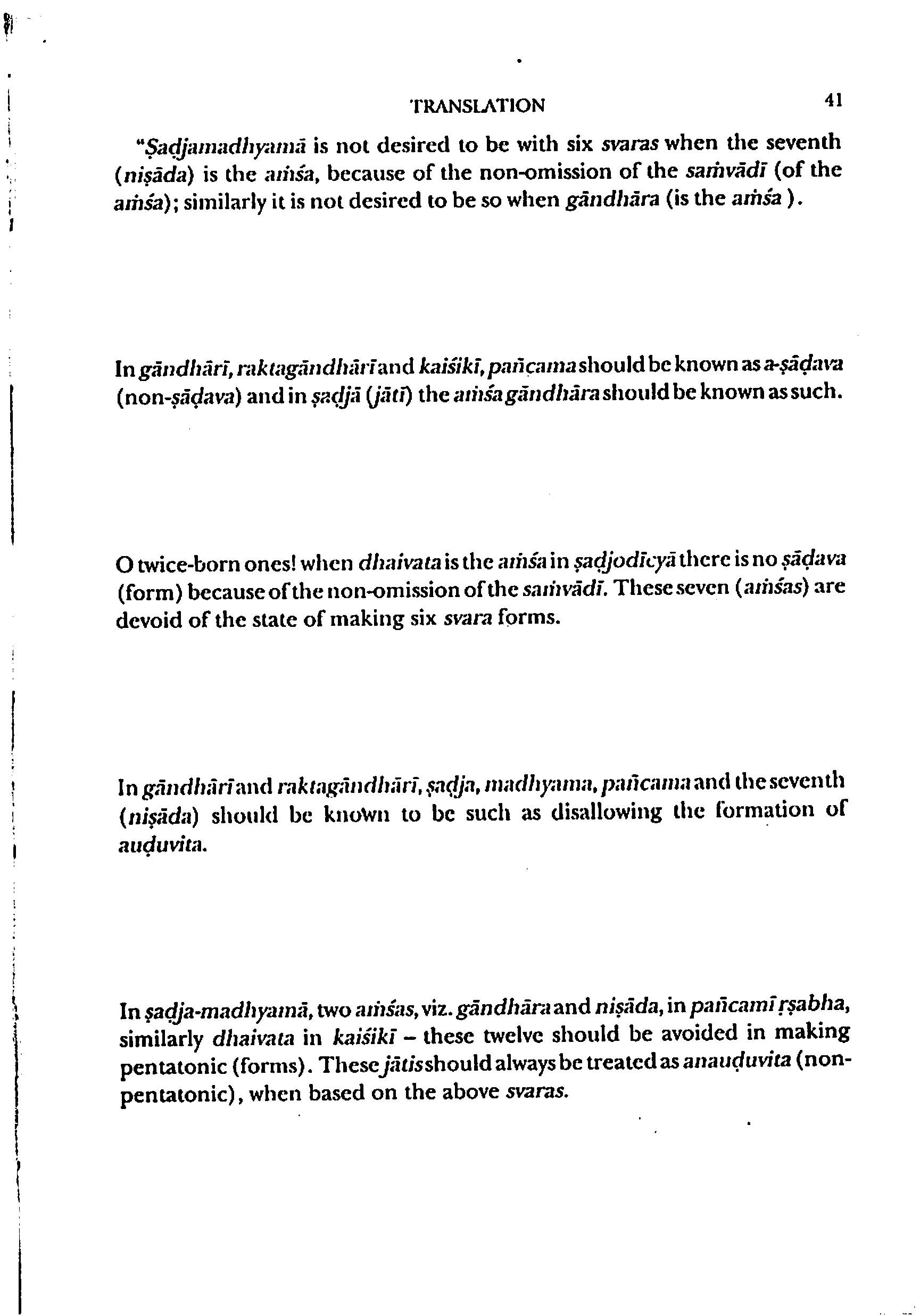
ş "Şadjamadhyamā is not desired to be with six svaras when the seventh (niṣāda) is the amśa, because of the non-omission of the samvādī (of the amsa); similarly it is not desired to be so when gandhara (is the amsa).4 In gāndhārī, raktagāndhārī and kaiśikī, pañcama should be known as a-ṣāḍava1098 (non-ṣāḍava) and in ṣaḍjā (jātī) the amśa gāndhāra should be known as such. O twice-born ones! when dhaivata is the amśa in ṣadjodīcyā there is no ṣāḍava (form) because of the non-omission of the samvādī. These seven (amśas) are devoid of the state of making six svara forms.5 In gāndhārī and raktagāndhārī, şadja, madhyama, pañcama and the seventh (niṣāda) should be known to be such as disallowing the formation of auduvita.2 In șadja-madhyamā, two amśas, viz. gāndhāra and niṣāda, in pañcamī ṛṣabha, similarly dhaivata in kaiśiki - these twelve should be avoided11 in making pentatonic (forms).6 These jātis should always be treated as anauduvita (non- pentatonic), when based on the above svaras.
3.[definition] Anauduvita (non-pentatonic) is the prescribed treatment for certain jātis when based on specific svarasतास्त्वनौडुविता नित्यं कर्तव्या हि स्वराश्रयाः ॥
7.[structural] The aṁśa (predominant note) determines structural constraints on the formation of modal variantsषट्स्वरा सप्तमे त्वंशे नेष्यते षड्जमध्यमा
8.[structural] In gāndhārī jātī, pañcama should be known as a-ṣāḍava (non-pentatonic)गान्धारी-रक्तगान्धारी-कैशिकीना च पञ्चमम्
9.[structural] In raktagāndhārī jātī, pañcama should be known as a-ṣāḍava (non-pentatonic)गान्धारी-रक्तगान्धारी-कैशिकीना च पञ्चमम्
10.[structural] In kaiśikī jātī, pañcama should be known as a-ṣāḍava (non-pentatonic)गान्धारी-रक्तगान्धारी-कैशिकीना च पञ्चमम्
1.[definition]ṣāḍava is a pentatonic form (six-note scale minus one); certain aṁśas and jātis cannot produce ṣāḍava formswhen dhaivata is the aṁśa in ṣadjodīcyā there is no ṣāḍava (form) because of the non-omission of the samvādī.
2.[definition]Auduvita is a pentatonic mode formation that is disallowed under certain conditionsIn gāndhārī and raktagāndhārī, şadja, madhyama, pañcama and the seventh (niṣāda) should be known to be such as disallowing the formation of auduvita.
3.[definition]Anauduvita (non-pentatonic) is the prescribed treatment for certain jātis when based on specific svarasThese jātis should always be treated as anauduvita (non-pentatonic), when based on the above svaras.
4.[relation]The non-omission of the samvādī (consonant note) prevents certain jātī forms from being ṣāḍavabecause of the non-omission of the samvādī (of the amsa); similarly it is not desired to be so when gandhara (is the amsa).
5.[relation]Seven specific aṁśas are devoid of ṣāḍava-forming capacity due to samvādī non-omissionThese seven (amśas) are devoid of the state of making six svara forms.
6.[relation]Twelve specific aṁśa-jātī combinations are prohibited in the formation of pentatonic scalesthese twelve should be avoided in making pentatonic (forms).
7.[structural]The aṁśa (predominant note) determines structural constraints on the formation of modal variantsŞadjamadhyamā is not desired to be with six svaras when the seventh (niṣāda) is the aṁśa
8.[structural]In gāndhārī jātī, pañcama should be known as a-ṣāḍava (non-pentatonic)In gāndhārī, raktagāndhārī and kaiśikī, pañcama should be known as a-ṣāḍava
9.[structural]In raktagāndhārī jātī, pañcama should be known as a-ṣāḍava (non-pentatonic)In gāndhārī, raktagāndhārī and kaiśikī, pañcama should be known as a-ṣāḍava
10.[structural]In kaiśikī jātī, pañcama should be known as a-ṣāḍava (non-pentatonic)In gāndhārī, raktagāndhārī and kaiśikī, pañcama should be known as a-ṣāḍava
11.[structural]In pañcamī jātī, ṛṣabha as aṁśa should be avoided when forming pentatonic (five-note) scalesIn șadja-madhyamā, two amśas, viz. gāndhāra and niṣāda, in pañcamī ṛṣabha, similarly dhaivata in kaiśiki - these twelve should be avoided