Source scans · vol_II_p044
recto · open full
scan recto
verso · open full
scan verso
Bṛhaddeśī · Volume II
pp. 70–71folio 044
Devanāgarī
shifted sequence table
gāndhārapañcamī prastāra (suite) — Fin du prastāra de gāndhārapañcamī (rāgiṇī), lignes 11-16, suivi du colophon ‖ [iti] gāndhārapañcamī ‖
Pattern: ? · omitted:
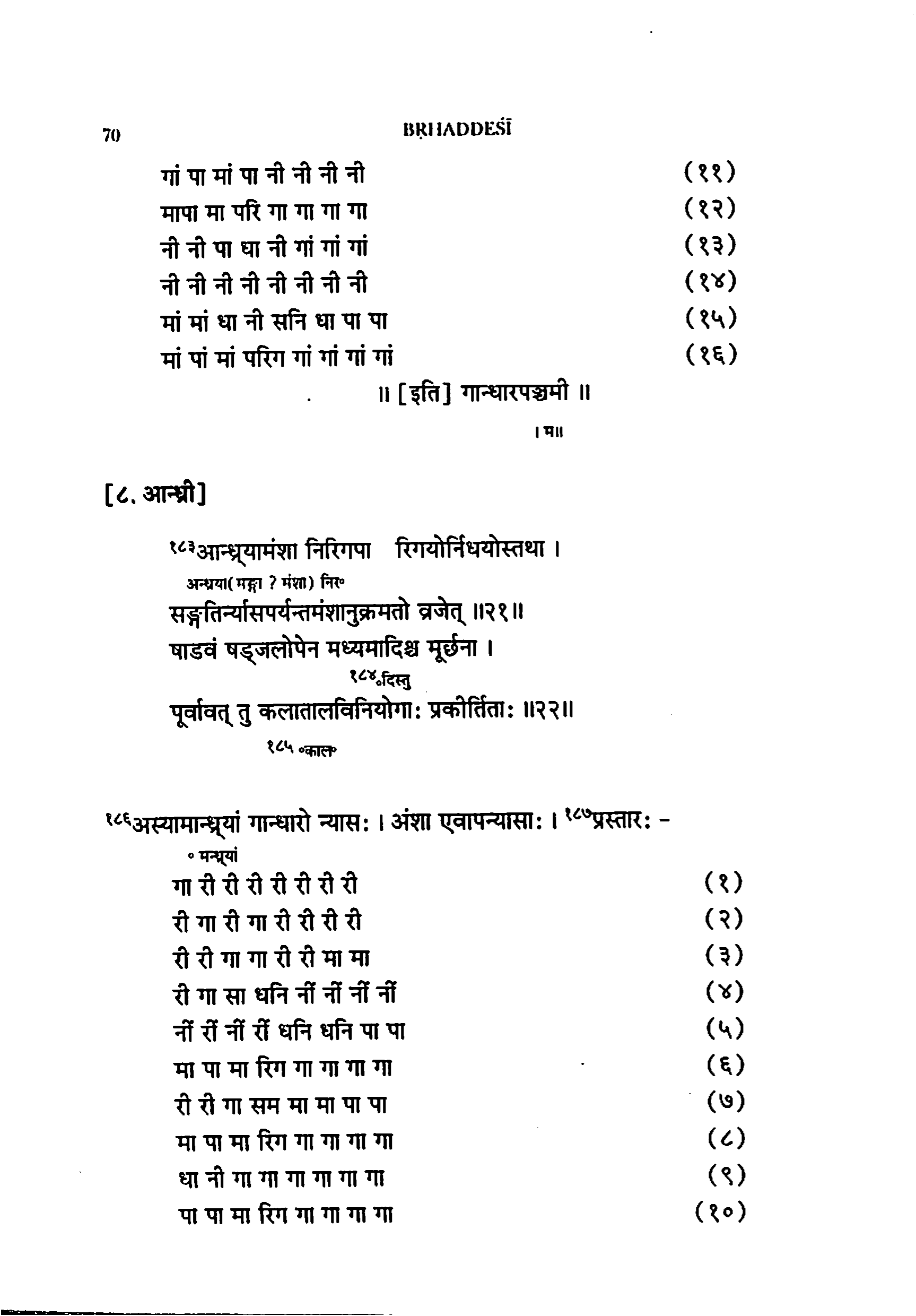
gāṃ · pā · māṃ · pā · nī · nī · nī · nī
mā · pā · mā · pari · gā · gā · gā · gā
nī · nī · pā · dhā · nī · gāṃ · gāṃ · gāṃ
nī · nī · nī · nī · nī · nī · nī · nī
māṃ · māṃ · dhā · nī · sani · dhā · pā · pā
māṃ · pāṃ · māṃ · parig · gāṃ · gāṃ · gāṃ · gāṃ
— (११)–(१६)
[८, आन्ध्री]। म॥
१८३ आन्ध्र्यामंशा निरिगपा रिगयोर्निधयोस्तथा6
अन्ध्रया(मङ्गा ? मंशा) निरू सङ्गतिन्यासपर्यन्तमंशानुक्रमतो व्रजेत्3 ॥२१॥
षाडवं षड्जलोपेन9 मध्यमादिश्च१८४ दिस्तु मूर्छना2
पूर्वावत् तु कलातालविनियोगाः१८५ ॰काल॰ प्रकीर्तिताः ॥२२॥
The same of the same of the same of the same of the same of the same of the same of the same of the same of the same of the same of the same of the same of the same of the same of the same of the same of the same of the sa
English — Sharma (translation)
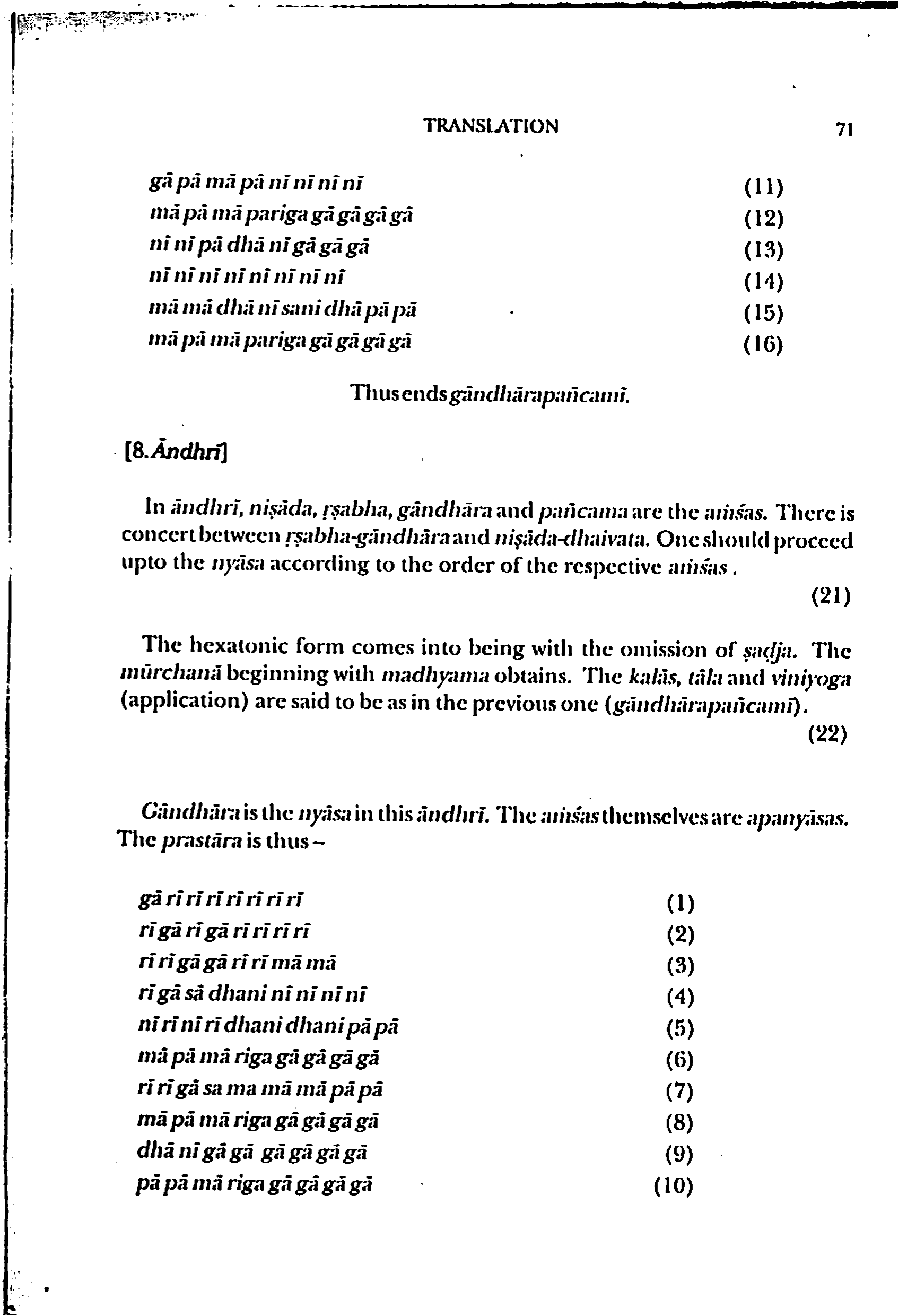
gā pā mā pā nī nī nī nī
(11)
mă pă mă pariga gā gā gā gā
(12)
ni ni pā dhā ni gā gā gā
(13)
nî nî nî nî nî nî nî nî
(14)
mã mã dhã nĩ sani dhã pã pã
(15)
mā pā mā pariga gā gā gā gā
(16)
Thusends gāndhārapancami.
[8. Āndhrī]
In āndhrī, niṣāda, ṛṣabha, gāndhāra and pañcama are the aniśas. There is concert between ṛṣabha-gāndhāra and niṣāda-dhaivata.6 One should proceed upto the nyāsa according to the order of the respective amsas.3
(21)
The hexatonic form comes into being with the omission of sadja.9 The mūrchanā beginning with madhyama obtains.2 The kalās, tāla and viniyoga (application) are said to be as in the previous one (gāndhārapañcamī).5
(22)
Gāndhāra is the nyāsa in this āndhrī.8 The amsas themselves are apanyāsas.4 The prastāra is thus – gārirīrīrīrīrīrī
(1)
rī gā rī gā rī rī rī rī
(2)
rī rī gā gā rī rī mā mā
(3)
rī gā sā dhani nī nī nī nī
(4)
ni ri ni ri dhani dhani pā pā
(5)
mā pā mā riga gā gā gā gā
(6)
rī rī gā sa ma mā mā pā pā (7) mā pā mā riga gā gā gā gā
(8)
dhā nī gā gā gā gā gā gā
(9)
pā pā mā riga gā gā gā gā
(10)
2.[relation] Mūrchanā beginning with madhyama arises in the hexatonic form of āndhrīषाडवं षड्जलोपेन मध्यमादिश्च मूर्छना
3.[relation] One should proceed through the order of amsas up to sangati-nyāsa according to their respective sequenceसङ्गतिन्यासपर्यन्तमंशानुक्रमतो व्रजेत्
4.[relation] The amsas of āndhrī themselves serve as apanyāsasअंशा एवापन्यासाः
5.[relation] Āndhrī shares the same kalās, tāla and viniyoga as gāndhārapañcamīपूर्वावत् तु कलातालविनियोगा प्रकीर्तिता
6.[relation] There is a concert relationship between ṛṣabha-gāndhāra and niṣāda-dhaivata in āndhrīरिगयोर्निधयोस्तथा
7.[structural]Gāndhārapañcamī is a rāga form that ends with the notation marking its conclusion॥ [इति] गान्धारपञ्चमी
8.[structural] Āndhrī has gāndhāra as its nyāsaअस्यामान्ध्र्या गान्धारो न्यासः
9.[structural] Hexatonic (ṣāḍava) form is created by omitting sadjaषाडवं षड्जलोपेन
10.[structural] Prastāra is a systematic elaboration or exposition presented in musical notationप्रस्तारः
1.[enumeration]Āndhrī is a rāga type that has nisāda, ṛṣabha, gāndhāra and pañcama as its aniśasIn āndhrī, niṣāda, ṛṣabha, gāndhāra and pañcama are the aniśas.
2.[relation]Mūrchanā beginning with madhyama arises in the hexatonic form of āndhrīThe hexatonic form comes into being with the omission of sadja. The mūrchanā beginning with madhyama obtains.
3.[relation]One should proceed through the order of amsas up to sangati-nyāsa according to their respective sequenceOne should proceed upto the nyāsa according to the order of the respective amsas.
4.[relation]The amsas of āndhrī themselves serve as apanyāsasThe amsas themselves are apanyāsas.
5.[relation]Āndhrī shares the same kalās, tāla and viniyoga as gāndhārapañcamīThe kalās, tāla and viniyoga (application) are said to be as in the previous one (gāndhārapañcamī).
6.[relation]There is a concert relationship between ṛṣabha-gāndhāra and niṣāda-dhaivata in āndhrīThere is concert between ṛṣabha-gāndhāra and niṣāda-dhaivata.
8.[structural]Āndhrī has gāndhāra as its nyāsaGāndhāra is the nyāsa in this āndhrī.
9.[structural]Hexatonic (ṣāḍava) form is created by omitting sadjaThe hexatonic form comes into being with the omission of sadja.
10.[structural]Prastāra is a systematic elaboration or exposition presented in musical notationThe prastāra is thus – gārirīrīrīrīrīrī