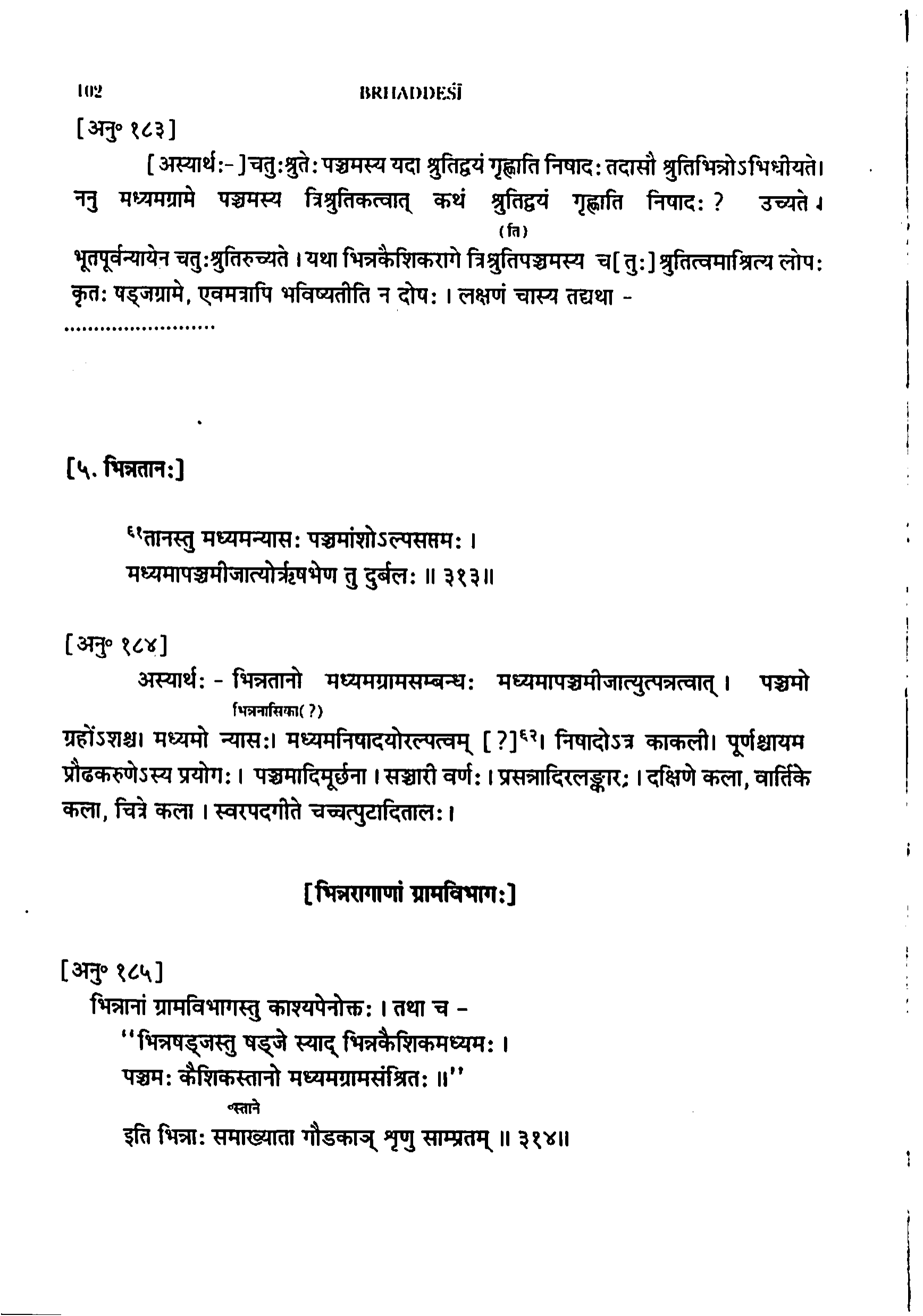
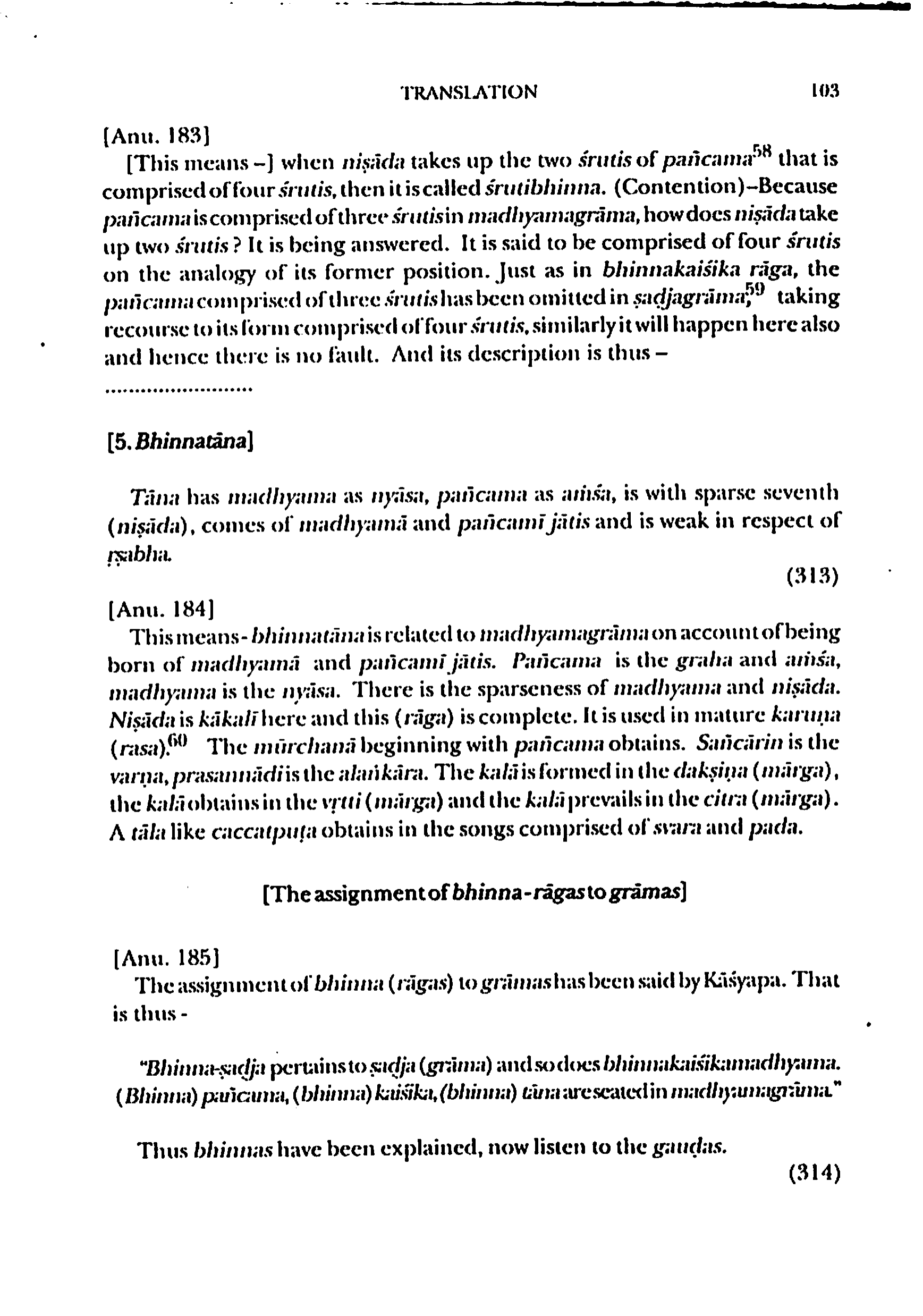
[Anu. 183]
[This means -] when niṣāda takes up the two śrutis of
pañcama58 that is
comprised of four śrutis, then it is called
śrutibhinna. (Contention)-Because
pañcamais comprised of three śrutisin
madhyamagrāma, how does niṣāda take
up two śrutis? It is being answered. It is said to be comprised of four śrutis
on the analogy of its former position. Just as in
bhinnakaiśika rāga, the
pañcama comprised of three śrutis has been omitted in
şadjagrāma, 59 taking
recourse to its form comprised of four śrutis, similarly it will happen here also
and hence there is no fault. And its description is thus -
. . . . . . . . . . . . . . . . . . . .
Tāna has
madhyama as nyāsa,
pañcama as amsa,
is with sparse seventh
(niṣāda), comes of madhyamā and pañcamī jātis and is weak in respect of
rsabha10.
(313)
[Anu. 184]
This means-
bhinnatāna is related to madhyamagrāma on account of being
born of madhyamā and pañcamī jātis3.
Pañcama is the graha and amśa,
madhyama is the nyāsa. There is the sparseness of
madhyama and niṣāda.
Niṣāda is kākalī here5 and this (rāga) is complete. It is used in mature karuņa
(rasa).60
The mūrchanā beginning with pañcama obtains6.
Sañcārin is the
varņa,
prasannādi is the alarikāra7. The kalā is formed in the
dakṣiṇa (mārga),
the <math>kal\bar{a}</math> obtains in the <math>v_itti</math> (<math>m\bar{a}rga</math>) and the <math>kal\bar{a}</math> prevails in the <math>citra</math> (<math>m\bar{a}rga</math>).
A tāla like caccatpuţa obtains in the songs comprised of svara and pada.
[The assignment of bhinna-rāgas to grāmas]
[Anu. 185]
The assignment of bhinna (rāgas) to grāmas has been said by Kāsyapa1. That
is thus -
"Bhinna-ṣaḍja pertains to ṣaḍja (grāma) and so does bhinnakaiśikamadhyama.
(Bhinna) pañcama, (bhinna) kaiśika, (bhinna) tāna are seated in madhyamagrāma4."
Thus bhinnas have been explained, now listen to the gaudas.
(314)