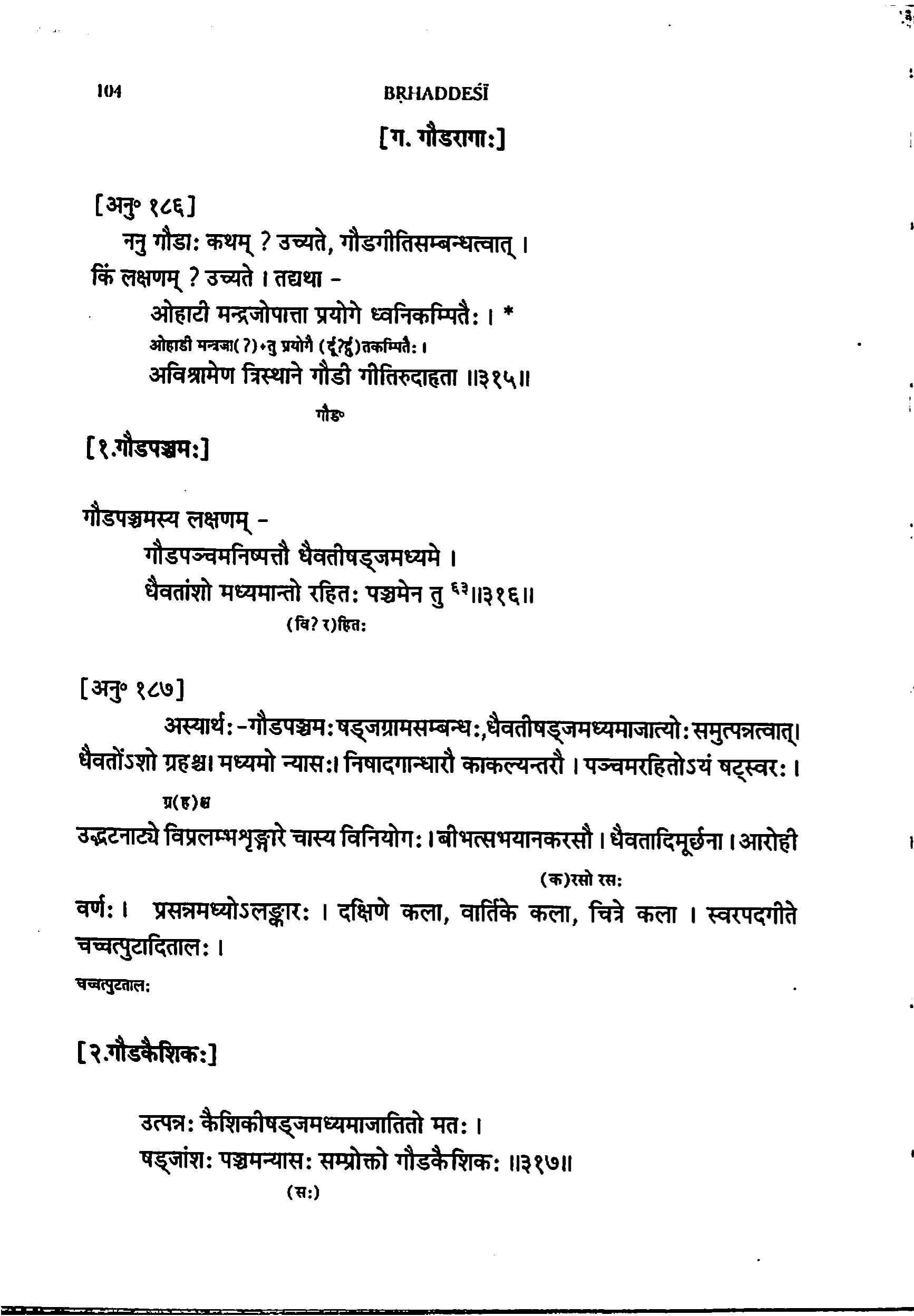
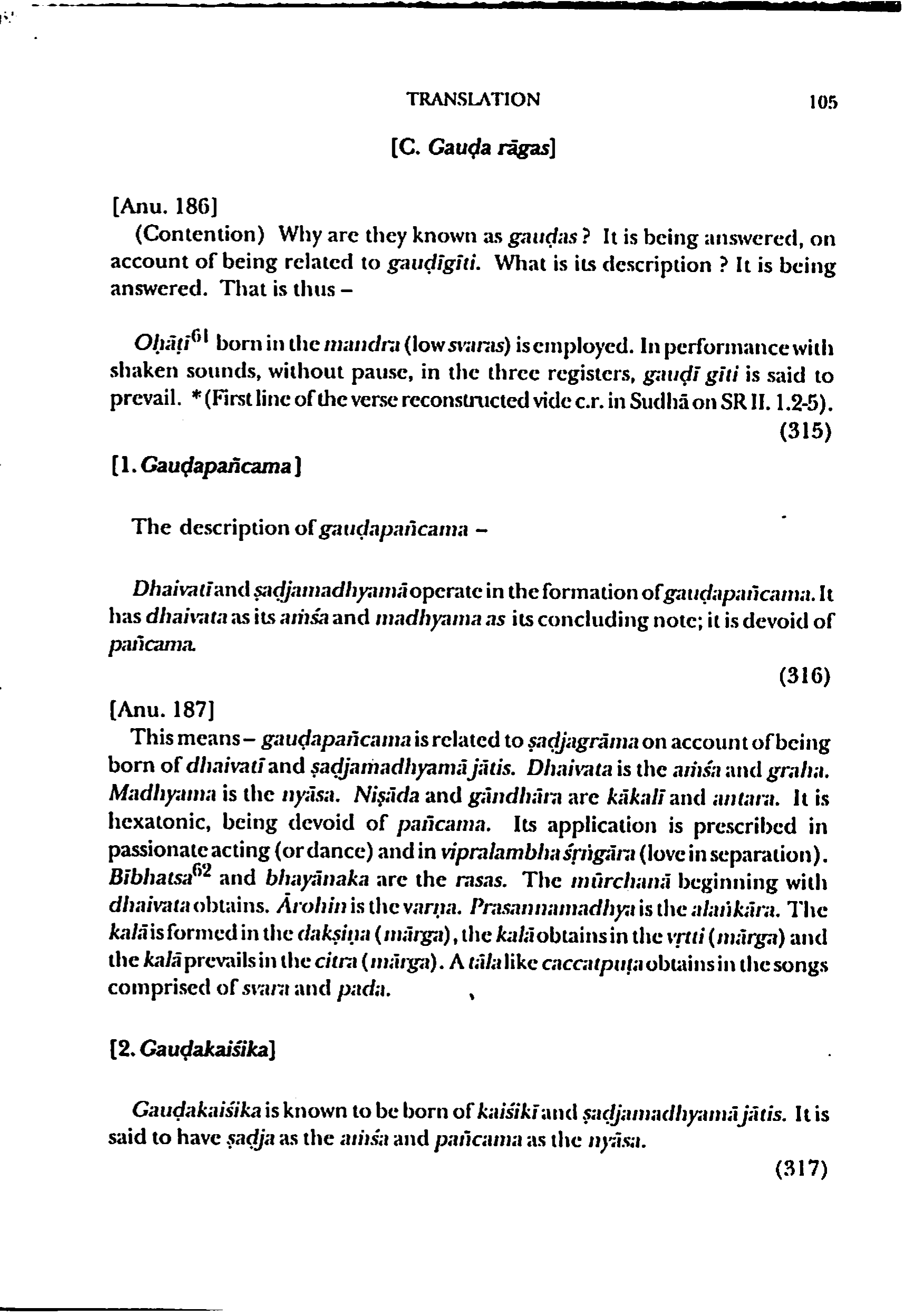
[Anu. 186]
(Contention)
Why are they known as gaudas? It is being answered, on
account of being related to gaudigiti.2 What is its description? It is being
answered. That is thus -
Oḥāṭi
61 born in the mandra (low svaras) is employed. In performance with
shaken sounds, without pause, in the three registers, gaudī gīti is said to
prevail. *(First line of the verse reconstructed vide c.r. in Sudhā on SR II. 1.2-5).
(315)
The description of
gaudapañcama -
Dhaivatī and
ṣadjamadhyamā operate in the formation of gauḍapañcama. It
has
dhaivata as its amśa and
madhyama as its concluding note; it is devoid of
pañcama.
(316)
[Anu. 187]
This means - gaudapañcama is related to sadjagrāma on account of being
born of dhaivatī and şadjamadhyamā jātis.3 Dhaivata is the aniśa and graha.
Madhyama is the nyāsa. Niṣāda and
gāndhāra are kākalī and antara.
It is
hexatonic, being devoid of pañcama.8 Its application is prescribed in
passionate acting (or dance) and in vipralambha śringāra (love in separation).4
Bībhatsa62 and bhayānaka are the rasas.5 The mūrchanā beginning with
dhaivata obtains.10 Ārohin is the varņa.
Prasannamadhya is the
alankāra. The
kalāis formed in the
dakṣiṇa (mārga), the kalā obtains in the
vṛtti (mārga) and
the kalā prevails in the
citra (mārga). A tāla like
caccatpuța obtains in the songs
comprised of svara and pada.
Gauḍakaiśika is known to be born of kaiśikī and ṣaḍjamadhyamā jātis.6 It is
said to have şadja as the amśa and
pañcama as the nyāsa.
(317)