Source scans · vol_II_p132
recto · open full
scan recto
verso · open full
scan verso
Bṛhaddeśī · Volume II
pp. 49–247folio 132
Devanāgarī
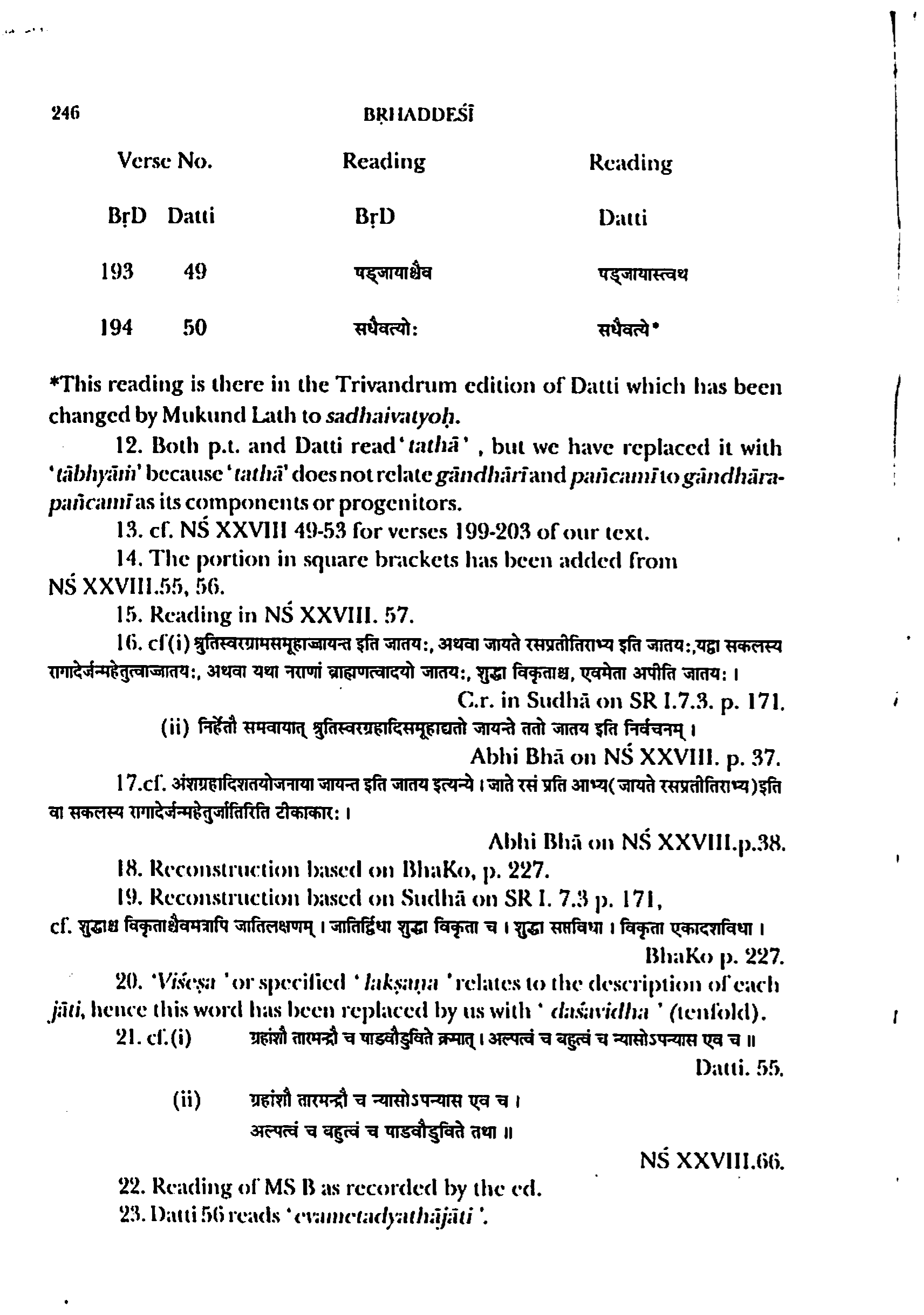
BRHADDEŚĪ Verse No. Reading Reading BrD Datti BŗD Datti पड्जायाधैव पड्जायास्त्वथ सधैवत्यो: सधैवत्ये * *This reading is there in the Trivandrum edition of Datti which has been changed by Mukund Lath to sadhaivatyoh. 12. Both p.t. and Datti read'tatha', but we have replaced it with 'tābhyām' because 'tathā' does not relate gāndhārī and pañcamī to gāndhāra- pañcami as its components or progenitors. 13. cf. NŚ XXVIII 49-53 for verses 199-203 of our text. 14. The portion in square brackets has been added from NŚ XXVIII.55, 56. 15. Reading in NŚ XXVIII. 57. l 6. cf(i) श्रुतिस्वरग्रामसमूहाज्जायन्त इति जातय:, अथवा जायते रसप्रतीतिराभ्य इति जातय:,यद्वा सकलस्य
रागादेर्जन्महेतुत्वाज्जातयः, अथवा यथा नराणां ब्राह्मणत्वादयो जातयः, शुद्धा विकृताश्च, एवमेता अपीति जातयः।
C.r. in Sudhā on SR 1.7.3. p. 171. ŧ
(ii) निर्हेतौ समवायात् श्रुतिस्वरग्रहादिसमूहाद्यतो जायन्ते ततो जातय इति निर्वचनम् ।
Abhi Bhā on NŚ XXVIII. p. 37. 17.cf. अंशग्रहादिशतयोजनाया जायन्त इति जातय इत्यन्ये । जाते रसं प्रति आभ्य(जायते रसप्रतीतिराभ्य)इति
वा सकलस्य रागादेर्जन्महेतुर्जातिरिति टीकाकार:।
Abhi Bhā on NŠ XXVIII.p.38. 18. Reconstruction based on BhaKo, p. 227. Reconstruction based on Sudhā on SR I. 7.3 p. 171,
cf. शुद्धाश्च विकृताश्चैवमत्रापि जातिलक्षणम् । जातिर्द्धिधा शुद्धा विकृता च । शुद्धा सप्तविधा । विकृता एकादशविधा ।
BhaKo p. 227. 20. 'Viścṣa' or specified 'lakṣaṇa' relates to the description of each jāti, hence this word has been replaced by us with ‘ daśavidha ’ (tenfold) .
ग्रहांशी तारमन्द्री च पाडवीडुविते क्रमात् । अल्पत्वं च बहुत्वं च न्यासोऽपन्यास एव च ॥
21. cf.(i) Datti. 55,
ग्रहांशी तारमन्द्री च न्यासोऽपन्यास एव च ।
(ii)
अल्पत्वं च बहुत्वं च पाडवौडुविते तथा ॥
NŠ XXVIII.66. 22. Reading of MS B as recorded by the ed. 23. Datti 56 reads *evametadyathājāti *.
English — Sharma
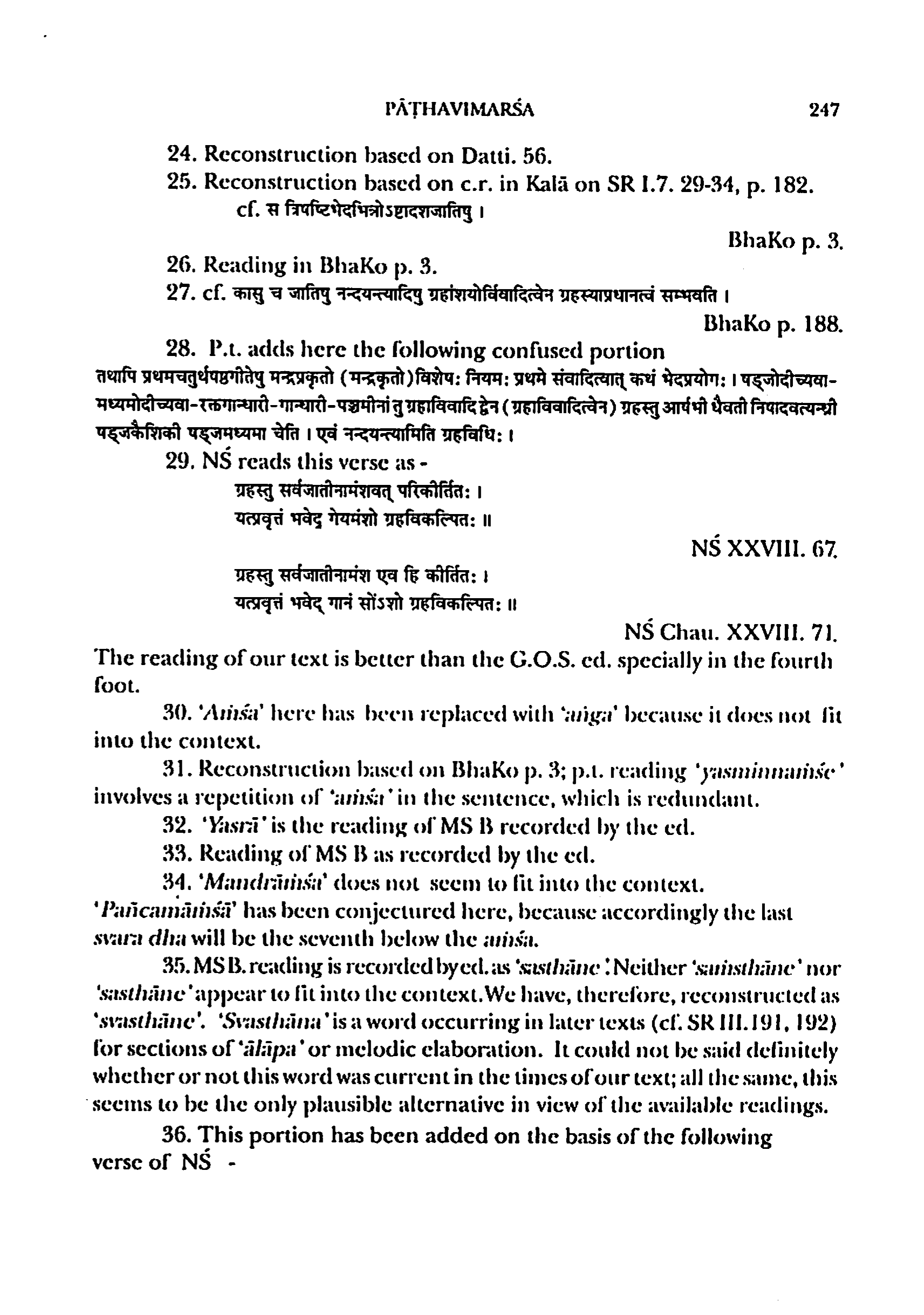
24. Reconstruction based on Datti. 56. 25. Reconstruction based on c.r. in Kalā on SR I.7. 29-34, p. 182.
cf. स त्रिपष्टिभेदभित्रोऽष्टादशजातिषु ।
BhaKo p. 3. 26. Reading in BhaKo p. 3.
27. cf. कासु च जातिषु नन्दयन्त्यादिषु ग्रहांशयोर्विवादित्वेन ग्रहस्याप्रधानत्वं सम्भवति ।
BhaKo p. 188. 28. P.t. adds here the following confused portion तथापि प्रथमचतुर्थपष्टगीतेषु मन्द्रप्रकृतो (मन्द्रकृतो)विशेषः नियमः प्रथमे संवादित्वात् कथं भेदप्रयोगः । षङ्जोदीच्यवा- मध्यमोदीच्यवा-रक्तगान्धारी-गान्धारी-पञ्चमीनां तु ग्रहाविवादि द्वेन ( ग्रहाविवादित्वेन) ग्रहस्तु आर्षभी धैवती निपादवत्यन्त्री
पड्जकैशिकी पड्जमध्यमा चेति । एवं नन्दयन्त्यामिति ग्रहविधि:।
29. NŠ reads this verse as -
ग्रहस्तु सर्वजातीनामंशवत् परिकीर्तित:।
यत्प्रवृत्तं भवेदु गेयमंशो ग्रहविकल्पित:॥
NŠ XXVIII. 67.
ग्रहस्तु सर्वजातीनामंश एव हि कीर्तित: ।
यत्प्रवृत्तं भवेद् गानं सोंऽशो ग्रहविकल्पित:5
NŠ Chau. XXVIII. 71. The reading of our text is better than the G.O.S. ed. specially in the fourth foot. 30. 'Amśa' here has been replaced with 'anga' because it does not fit into the context. 31. Reconstruction based on BhaKo p. 3; p.t. reading 'yasminnamśe' involves a repetition of 'amśa' in the sentence, which is redundant. 32. 'Yasrā' is the reading of MS B recorded by the ed. 33. Reading of MS B as recorded by the ed. 34. 'Mandrāinsa' does not seem to fit into the context. 'Pañcamāmśā' has been conjectured here, because accordingly the last svara dha will be the seventh below the amśa. 35. MSB. reading is recorded by ed. as 'sasthāne'. Neither 'sainsthāne' nor 'sasthāne' appear to fit into the context. We have, therefore, reconstructed as 'svasthāne'. 'Svasthāna' is a word occurring in later texts (cf. SR III.191, 192) for sections of 'alapa' or melodic elaboration. It could not be said definitely whether or not this word was current in the times of our text; all the same, this seems to be the only plausible alternative in view of the available readings. 36. This portion has been added on the basis of the following verse of NS -
2.[citation]grahāṁśī is listed as a characteristic feature in the description of jātiग्रहांशी तारमन्द्री च न्यासोऽपन्यास एव च ।
4.[citation]BhaKo provides classification of jāti as composed of sixty-three varieties distributed among eighteen jātiस त्रिपष्टिभेदभित्रोऽष्टादशजातिषु । BhaKo p. 3.
5.[definition]grahavikalpita refers to a section of melody determined by the grahāṁśa (primary note)यत्प्रवृत्तं भवेद् गानं सोंऽशो ग्रहविकल्पितः
7.[enumeration]jāti (melodic type) is classified into two categories: śuddha (pure) and vikṛta (modified)ज़ातिर्द्धिधा शुद्धा विकृता च
10.[structural]śuddha jāti comprises seven varieties while vikṛta jāti comprises eleven varietiesशुद्धा सप्तविधा । विकृता एकादशविधा ।
11.[structural]The division into sixty-three varieties (tripakṣibheda) is distributed across eighteen jātiस त्रिपष्टिभेदभित्रोऽष्टादशजातिषु ।
1.[attribution]Mukund Lath made textual emendations to the Trivandrum edition of DattiReading in the Trivandrum edition of Datti which has been changed by Mukund Lath to sadhaivatyoh.
3.[citation]NŚ (Nāṭya Śāstra) verses 199-203 of Brihaddesi correspond to NŚ XXVIII 49-53cf. NŚ XXVIII 49-53 for verses 199-203 of our text.
4.[citation] BhaKo provides classification of jāti as composed of sixty-three varieties distributed among eighteen jāticf. स त्रिपष्टिभेदभित्रोऽष्टादशजातिषु । BhaKo p. 3.
5.[definition] grahavikalpita refers to a section of melody determined by the grahāṁśa (primary note)यत्प्रवृत्तं भवेद् गानं सोंऽशो ग्रहविकल्पितः
6.[definition]svasthāna is a word occurring in later texts for sections of alapa or melodic elaboration'Svasthāna' is a word occurring in later texts (cf. SR III.191, 192) for sections of 'alapa' or melodic elaboration.
8.[relation]gāndhārī and pañcamī relate to gāndhāra-pañcami as its components or progenitors'tathā' does not relate gāndhārī and pañcamī to gāndhāra- pañcami as its components or progenitors.
9.[relation]anga has been used instead of aṁśa in certain contexts where aṁśa does not fit'Aṁśa' here has been replaced with 'anga' because it does not fit into the context.
11.[structural] The division into sixty-three varieties (tripakṣibheda) is distributed across eighteen jāticf. स त्रिपष्टिभेदभित्रोऽष्टादशजातिषु ।