Source scans · vol_II_p145
recto · open full
scan recto
verso · open full
scan verso
Bṛhaddeśī · Volume II
pp. 272–273folio 145
Devanāgarī (Bṛhaddeśī)
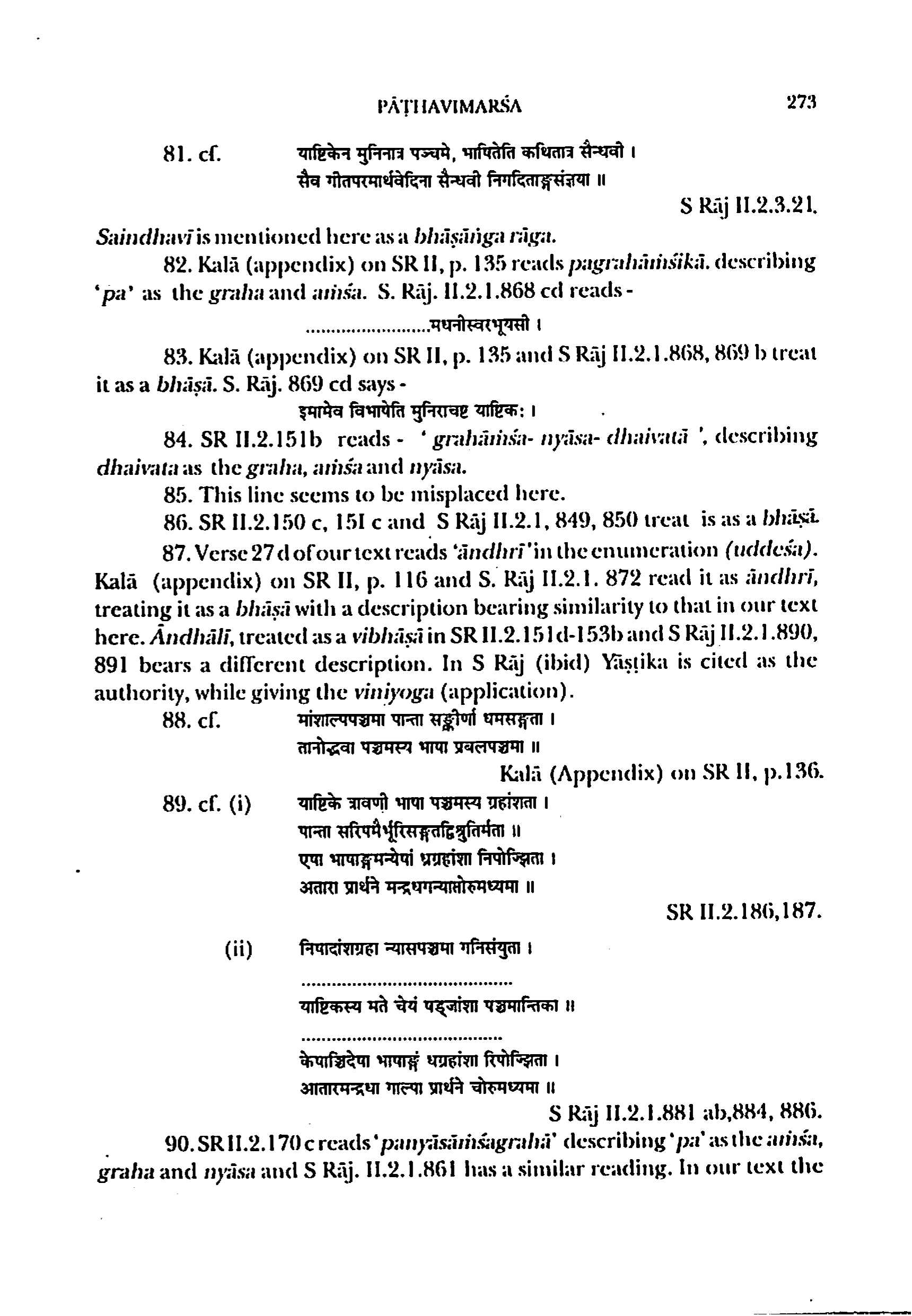
तारगान्धाररुचिरा मन्द्रधैवतभूषिता ।
नियोज?्येयं रसे हास्ये गमकैः समलङ्कृता10
उत्सवे च सदा तज्ज?्ञैः छेवाटी प्रेक्सकोद्भवा7
याष्टिकः पुनराचष्टे पूर्णामेता समस्वराम् ॥
S Raj II.2.1.932-9344. 71. cf.(i)
षड्ज?ाद्या मध्यमान्तांशा हिन्दोला षड्जमध्यमा9
भाषा निरिविहीना स्यात् समयोर्गमयोर्युता ॥
Kalā (appendix) in SR II, p.1375.
पङ्ज?ांशग्रहणन्यासा धैवतर्पभदुर्बला11
(ii)
निषादर्षभहीनत्वादौडुवा गपसङ्गता ।
पड्जमध्यमसंवादा पड्जमध्येति कीर्तिता ॥
S Rāj II.2.1. 942 c,943. 72. cf. Kalā(appendix) on SR II, p.137, reading bahupadhanisā and rṣabhālpā and S. Rāj II.2.1.945 d, reading pañcamabhūyasī, describing the abundance of pañcama.
धन्योश्च धपयोर्युक्ता सङ्गत्या प्रेक्षणे भवेत् ।
73. cf. S Rāj II.2.1. 945 cf. 74. P. t. adds here -
अतःपरं प्रवक्ष्यामि पञ्चमपाडवे भाषाः।
This line is out of place, the metre is also broken. 75. Kalā (appendix) on SR II, p. 135 reads 'samayoryutā', describing a concert between sadja-madhyama.
....गान्धारर्षभवर्ज?िता ॥
76. cf.
सम्पूर्णा चास्ति भाषेयं याष्ट्रिकाचार्यसम्मते6
S Rāj II.2.1.829 d and 830 cd. 77. cf.(i)
शुद्धपञ्चमभाषा स्याद् भावनी पग्रहान्तिमा ।
रिहोना मन्द्रसा मापन्यासा समनिभूयसी ॥
Kalā (appendix) on SR II, p.135. (ii)
गान्धारांशग्रहा षड्जग्रामगामिसमस्वरा ।
पन्यासा स्वल्पनिस्वानपञ्चमा पूर्णसुस्वरा ॥
सपमध्यमसङ्गत्योपचिता भावनी स्मृता ॥
S Rāj 11.2.1. 874. 78. Read as bāṅgālī in ibid 877. Another bhāṣā bearing the same name, but with a different description, is included in ibid 836, 837, under the same rāga, viz. śuddhapañcama. '79. Kalā (appendix) on SR II, p. 135, gives ‘dha’ (dhaivata) as the nyāsa (dhāntā) and reads the name as māngalī. 80. Ibid reads ' ripasanivādini', prescribing a concert between 'ri-pa'. The state of the state of the state of the state of the state of the state of the state of the state of the state of the state of the state of the state of the state of the state of the state of the state of the state of t in it is a second of the . . .....................................
English — Sharma
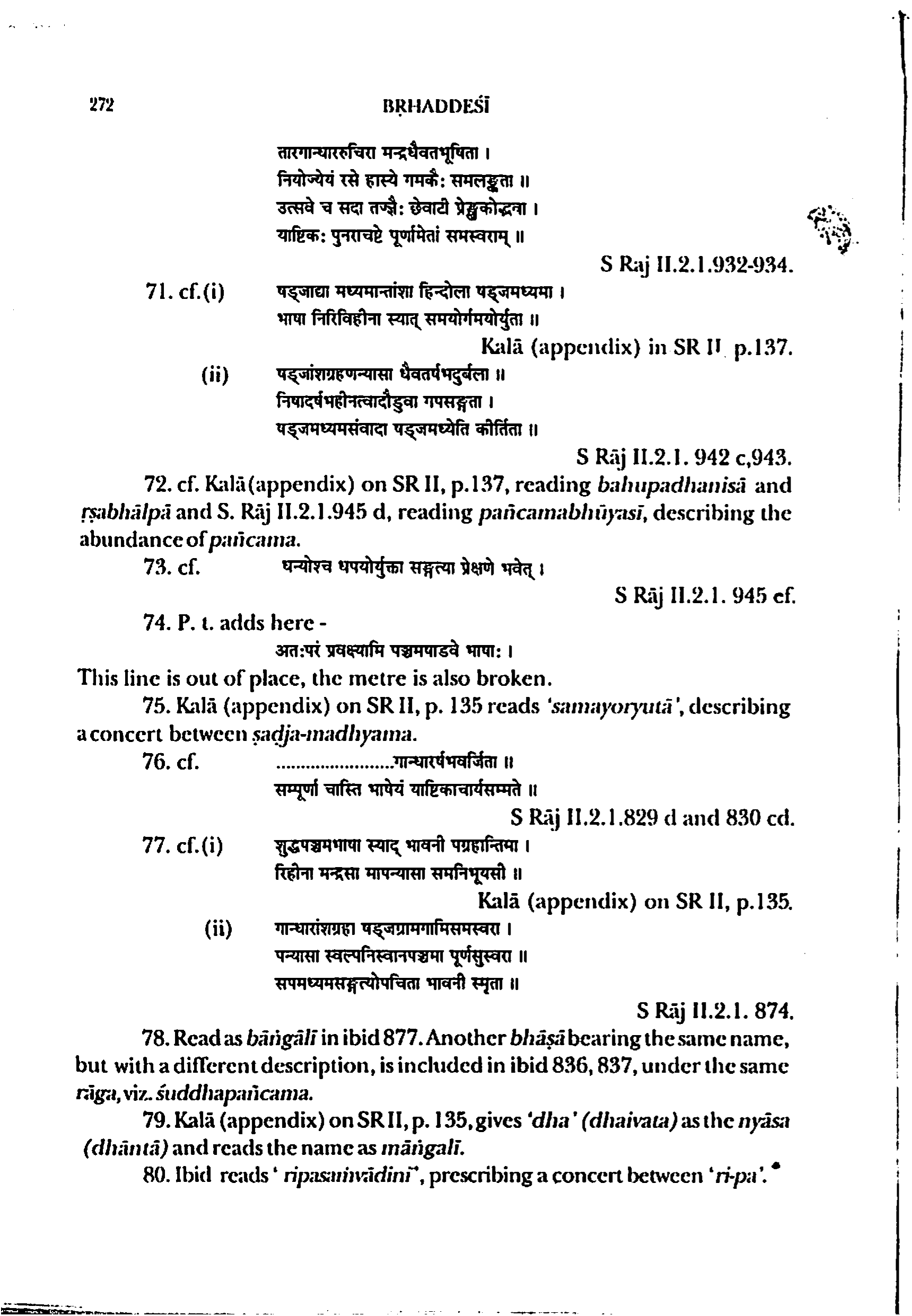
याष्ट्रिकेन मुनिनात्र पञ्चमे, भाषितेति कथितात्र सैन्धवी1
81. cf.
सैव गीतपरमार्थवेदिना सैन्धवी निगदिताङ्गसंज्ञया ॥
S Rāj II.2.3.21, Saindhavī is mentioned here as a bhāṣāṅga rāga. 82. Kalā (appendix) on SR II, p. 135 reads pagrahāmšikā. describing 'pa' as the graha and amśa. S. Rāj. 11.2.1.868 cd reads -
.....मधनोस्वरभूयसी ।
83. Kalā (appendix) on SR II, p. 135 and S Rāj II.2.1.868, 869 b treat it as a bhāṣā. S. Rāj. 869 cd says -
इमामेव विभाषेति मुनिराचष्ट याष्टिक:।
84. SR II.2.151b reads - 'grahāniśa- nyāsa- dhaivatā ', describing dhaivata as the graha, amsa and nyāsa. 85. This line seems to be misplaced here. 86. SR II.2.150 c, 15I c and S Rāj II.2.1, 849, 850 treat is as a bhāṣā. 87. Verse 27 d of our text reads 'āndhrī' in the enumeration (uddeśa). Kalā (appendix) on SR II, p. 116 and S. Rāj II.2.1. 872 read it as āndhrī, treating it as a bhāṣā with a description bearing similarity to that in our text here. Andhālī, treated as a vibhāṣā in SR II.2.151d-153b and S Rāj II.2.1.890, 891 bears a different description. In S Rāj (ibid) Yāṣṭika is cited as the authority, while giving the viniyoga (application).
मांशाल्पपञ्चमा पान्ता सङ्कीर्णा धमसङ्गता ।
88. cf.
तानोद्भवा पञ्चमस्य भाषा प्रवलपञ्चमा ॥
Kalā (Appendix) on SR II, p.136.
याष्ट्रिके त्रावणी भाषा पञ्चमस्य ग्रहांशता ।
89. cf. (i)
पान्ता सरिपमैर्भूरिसङ्गतद्विश्रुतिर्मता ॥
एषा भाषाङ्गमन्येषां भ्रग्रहांशा निपोन्झिता ।
अतारा प्रार्थने मन्द्रधगन्यातोरुमध्यमा ॥
SR II.2.186,187.
निषादांशग्रहा न्यासपञ्चमा गनिसंयुता ।
(ii)
याष्टिकस्य मते चेयं पड्जांशा पञ्चमान्तिका ॥
केपाञ्चिदेषा भाषाङ्गं धग्रहांशा रिपोन्झिता ।
आतारमन्द्रधा गाल्पा प्रार्थने चोरुमध्यमा ॥
S Rāj II.2.1.881 ab,884, 886. 90. SR 11.2.170 c reads 'panyāsāmśagrahā' describing 'pa' as the amśa, graha and nyāsa and S Rāj. H.2.1.861 has a similar reading. In our text the
1.[attribution]Saindhavī is mentioned as a bhāṣāṅga rāga by Yastika in the context of panchamaयाष्ट्रिकेन मुनिनात्र पञ्चमे, भाषितेति कथितात्र सैन्धवी
3.[citation] Brihaddesi is the source text from which these musical descriptions are extractedBRHADDEŚI
4.[citation] S Raj (Sangita Rajas) is cited as a comparative source for musical concepts and alternative readingsS Raj II.2.1.932-934
5.[citation] Kalā is cited as an appendix source providing alternative readings and interpretations of musical conceptsKalā (appendix) in SR II, p.137
6.[definition]Bhashanga is a category of raga that can be complete (sampurna) according to Yastika's authorityसम्पूर्णा चास्ति भाषेयं याष्ट्रिकाचार्यसम्मते
7.[definition]Chevati is a raga produced from the perspective of spectators (preksa-udbhava)छेवाटी प्रेक्सकोद्भवा
9.[structural]Hindola is a raga characterized by the swaras sadja and madhyamaषड्ज?ाद्या मध्यमान्तांशा हिन्दोला षड्जमध्यमा
10.[structural]Gamaka is used as an ornamental technique in the performance of ragasगमकैः समलङ्कृता
11.[structural]Bhashanga ragas employ specific swaras as graha (opening note), amsa (predominant note), and nyasa (resting note)पङ्ज?ांशग्रहणन्यासा धैवतर्पभदुर्बला
12.[structural]Gamaka serves a decorative function (sambhrita) in raga performanceगमकैः समलङ्कृता
1.[attribution] Saindhavī is mentioned as a bhāṣāṅga rāga by Yastika in the context of panchamaयाष्ट्रिकेन मुनिनात्र पञ्चमे, भाषितेति कथितात्र सैन्धवी
2.[attribution]Yastika is cited as an authoritative source for descriptions and applications of ragasIn S Rāj (ibid) Yāṣṭika is cited as the authority
3.[citation]Brihaddesi is the source text from which these musical descriptions are extractedBRHADDEŚI
4.[citation]S Raj (Sangita Rajas) is cited as a comparative source for musical concepts and alternative readingsS Raj II.2.1.932-934
5.[citation]Kalā is cited as an appendix source providing alternative readings and interpretations of musical conceptsKalā (appendix) in SR II, p.137
8.[relation]Vibhāṣā represents a variant classification of ragas distinct from bhāṣāṅga ragasAndhālī, treated as a vibhāṣā in SR II.2.151d-153b