Source scans · vol_II_p144
recto · open full
scan recto
verso · open full
scan verso
Bṛhaddeśī · Volume II
pp. 270–271folio 144
Devanāgarī (Bṛhaddeśī)
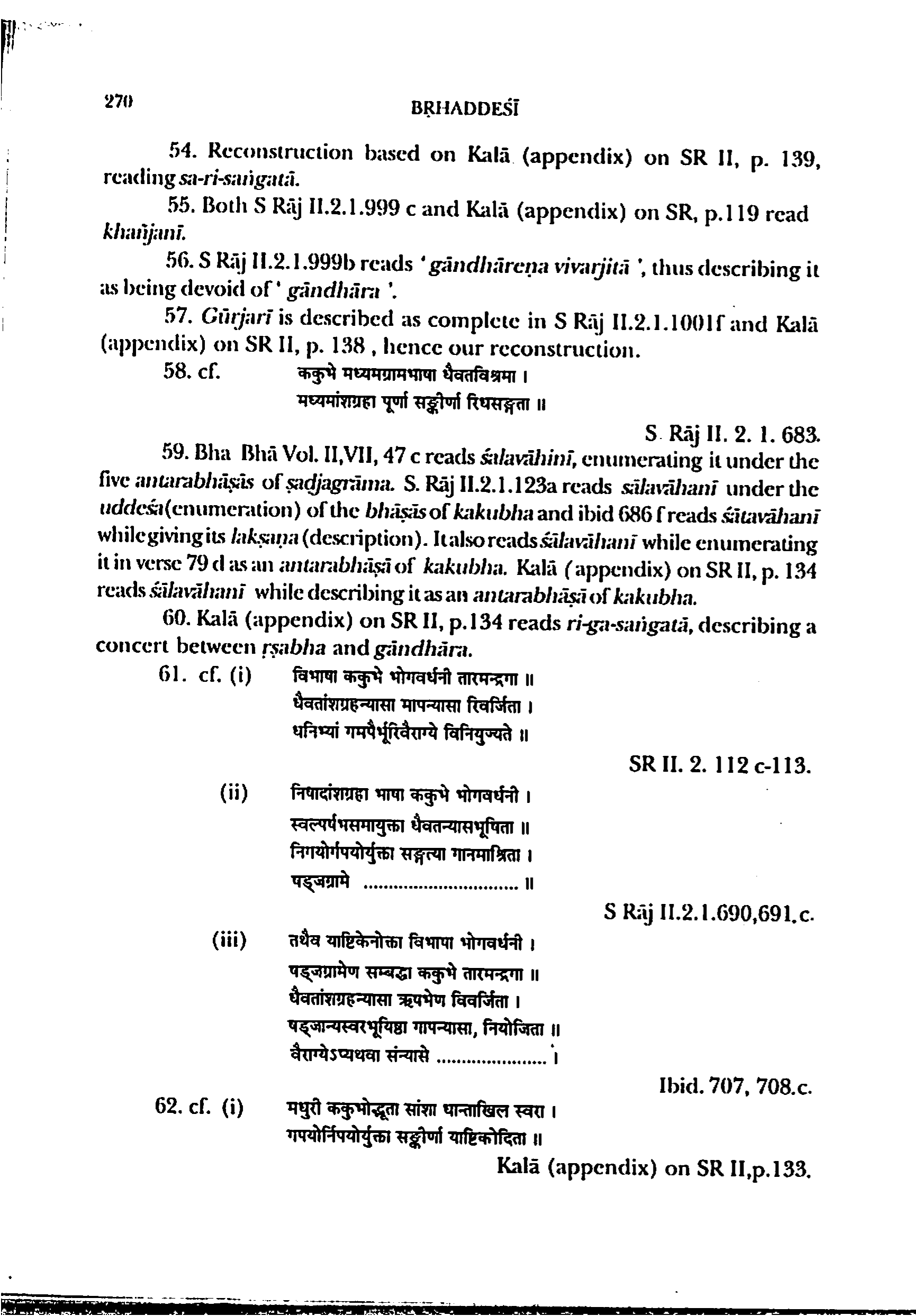
2"-WH - - * 54. Reconstruction based on Kalā (appendix) on SR II, p. 139, reading sa-ri-sangatā. 55. Both S Rāj II.2.1.999 c and Kalā (appendix) on SR, p.119 read khañjanī. 56. S Rāj II.2.1.999b reads 'gāndhāreņa vivarjitā', thus describing it as being devoid of 'gāndhāra'. 57. Gūrjarī is described as complete in S Rāj II.2.1.1001f and Kalā (appendix) on SR II, p. 138, hence our reconstruction.
ककुभे मध्यमग्रामभाषा धैवतविश्रमा।
58. cf.
मध्यमांशग्रहा पूर्णा सङ्कीर्णा रिधसङ्गता ॥
S. Rāj II. 2. 1. 683. 59. Bha Bhā Vol. II,VII, 47 c reads śalavāhinī, enumerating it under the five antarabhāṣās of ṣadjagrāma. S. Rāj II.2.1.123a reads sālavāhanī under the uddeśa(enumeration) of the bhāṣās of kakubha and ibid 686 f reads śātavāhanī while giving its lakṣaṇa (description). It also reads śālavāhanī while enumerating it in verse 79 d as an antarabhāṣā of kakubha. Kalā (appendix) on SR II, p. 134 reads śālavāhanī while describing it as an antarabhāṣā of kakubha. 60. Kalā (appendix) on SR II, p.134 reads ri-ga-sangatā, describing a concert between rṣabha and gāndhāra.
विभाषा ककुभे भोगवर्धनी तारमन्द्रगा ॥
61. cf. (i)
धैवतांशग्रहन्यासा मापन्यासा रिवर्जिता ।
धनिभ्यां गमपैभृंरिवैराग्ये विनियुज्यते ॥
SR II. 2. 112 c-113. (ii)
निषादांशग्रहा भाषा ककुभे भोगवर्धनी ।
स्वल्पर्पभसमायुक्ता धैवतन्यासभूपिता ॥
निगयोर्गपयोर्युक्ता सङ्गत्याषड्जग्रामे .....॥ गानमाश्रिता ।
S Rāj II.2.1.690,691.c.
तथैव याष्टिकेनोक्ता विभाषा भोगवर्धनी ।
(iii)
पङ्जग्रामेण सम्बद्धा ककुभे तारमन्द्रगा ॥
धैवतांशग्रहन्यासा ऋषभेण विवर्जिता ।
षड्जान्यस्वरभूयिष्ठा गापन्यासा, नियोजिता ॥
वैराग्येऽप्यथवा संन्यासे .....ं।
Ibid. 707, 708.c.
मधुरी ककुभोद्भूता सांशा धान्ताखिल स्वरा।
62. cf. (i)
गपयोर्निपयोर्युका सङ्कीर्णा याष्ट्रिकोदिता ॥
Kalā (appendix) on SR II,p.133. Carl man Carlo man a March and · 西西州市,1920年11日,1920年,1920年,1920年,1920年,1920年,1920年,1920年,1920年,1920年,1920年,1920年,1920年,1920年,1920年,1920年,1920年 2012/09/09 8:44 -0.0 . . . . . . . . . . . . . . . . . . . .
English — Sharma
(ii)
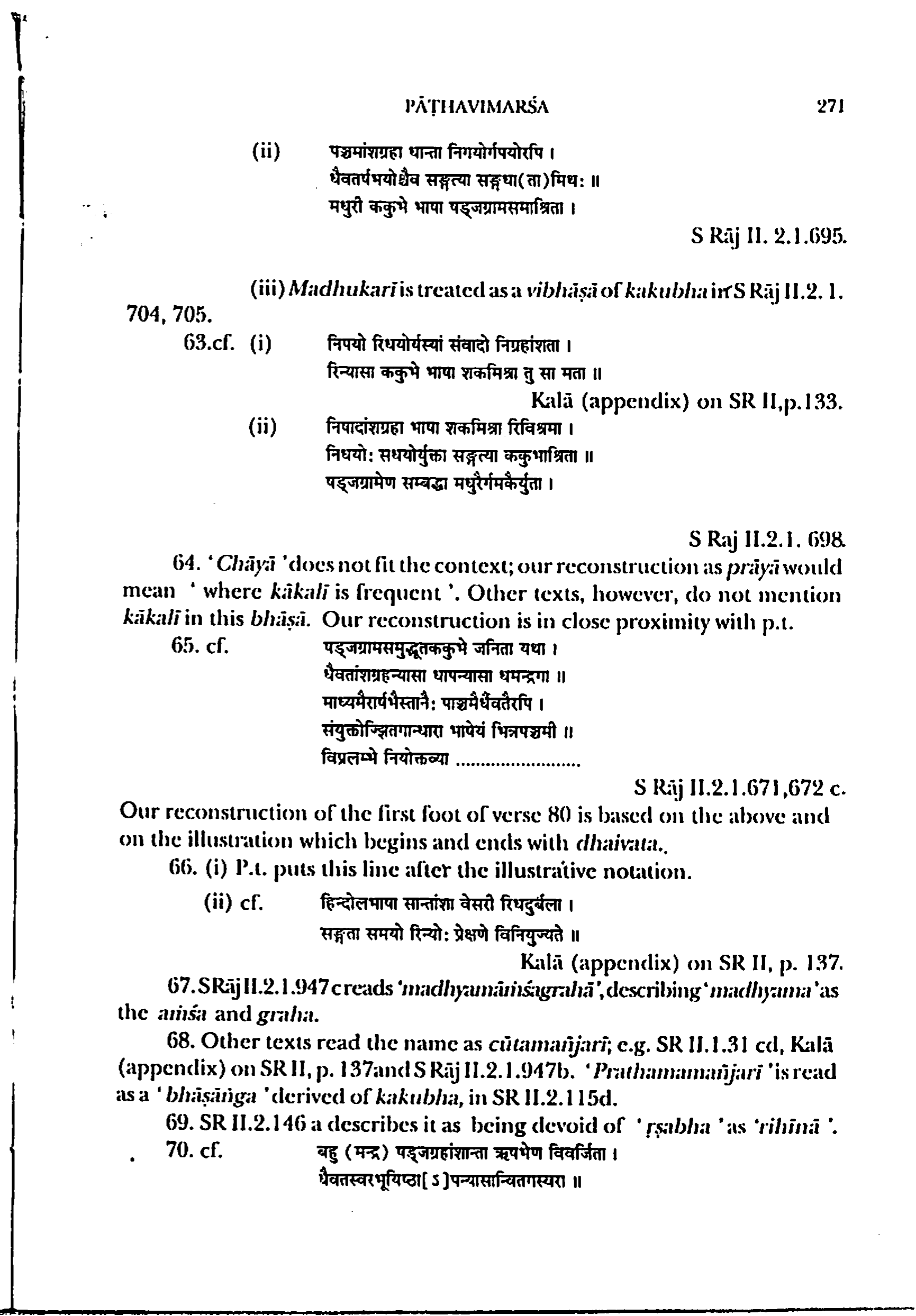
पञ्चमांशग्रहा धान्ता निगयोर्गपयोर्गप ।
धैवतर्पभयोधैव सङ्गत्या सङ्गधा(ता)मिथ:॥
मधुरी ककुभे भाषा षड्जग्रामसमाश्रिता ।
S Rāj II. 2.1.695. (iii) Madhukarī is treated as a vibhāṣā of kakubha ircS Rāj II.2. 1. 704, 705.83
निपयो रिधयोर्यस्यां संवादो निग्रहांशता ।
63.cf. (i)
रिन्यासा ककुभे भाषा शकमिश्रा तु सा मता ॥
Kalā (appendix) on SR II,p.133. (ii)
निपादांशग्रहा भाषा शकमिश्रा रिविश्रमा ।
निधयो: सधयोर्युक्ता सङ्गत्या ककुभाश्रिता ॥
पङ्जग्रामेण सम्बद्धा मधुरैर्गमकैर्युता ।
S Raj II.2.1, 698. 64. 'Chāyā 'does not fit the context; our reconstruction as prāyā would mean 'where kākalī is frequent'. Other texts, however, do not mention kākalī in this bhāṣā. Our reconstruction is in close proximity with p.t. 65. cf.
पङ्जग्रामसमुद्भतककुभे जनिता यथा।
धैवतांशग्रहन्यासा धापन्यासा धमन्द्रगा ॥
माध्यमैरार्पभैस्तानै: पाञ्चमैधैवतैर्पि ।
संयुक्तोन्झितगान्धारा भाषेयं भित्रपञ्चमी
विप्रलम्भे नियोक्तव्या ..... S Rāj II.2.1.671,672 c. Our reconstruction of the first foot of verse 80 is based on the above and on the illustration which begins and ends with dhaivata. 66. (i) P.t. puts this line after the illustrative notation.
(ii) cf. हिन्दोलभाषा सान्तांशा वेसरी रिधदुर्बला ।
सङ्गता समयो रिन्यो: प्रेक्षणे विनियुज्यते ॥
Kalā (appendix) on SR II, p. 137. 67. SRāj II. 2.1.947 creads 'madhyamāmśagrahā', describing 'madhyama' as the aniśa and graha. 68. Other texts read the name as cūtamañjarī; e.g. SR II.1.31 cd, Kalā (appendix) on SR II, p. 137and S Rāj II.2.1.947b. 'Prathamamañjarī 'is read as a 'bhāṣāṅga 'derived of kakubha, in SR II.2.115d. 69. SR II.2.146 a describes it as being devoid of 'rṣabha'as 'rihīnā'. 70. cf.
बहु (मन्द्र) पङ्जग्रहांशान्ता ऋपभेण विवर्जिता ।
धैवतस्वरभृयिष्ठा[ऽ]पन्यासान्यितगस्यरा ॥
1.[attribution]S Rāj is a treatise that provides variant readings and descriptions of bhāṣās and their characteristicsBoth S Rāj II.2.1.999 c and Kalā (appendix) on SR, p.119 read khañjanī.
2.[attribution]Kalā is a commentary or appendix work that provides alternative readings and descriptions of musical modesReconstruction based on Kalā (appendix) on SR II, p. 139, reading sa-ri-sangatā.
3.[attribution]Madhukarī is a vibhāṣā belonging to the kakubha categoryMadhukarī is treated as a vibhāṣā of kakubha ircS Rāj II.2. 1. 704, 705.
4.[definition]lakṣaṇa represents the descriptive characteristics or defining features of musical modeswhile giving its lakṣaṇa (description)
5.[definition]uddeśa refers to enumeration or listing of bhāṣās under specific categoriesS. Rāj II.2.1.123a reads sālavāhanī under the uddeśa(enumeration) of the bhāṣās of kakubha
6.[definition]bhāṣāṅga is a component or derived element of bhāṣās originating from grāmas'Prathamamañjarī 'is read as a 'bhāṣāṅga 'derived of kakubha
7.[relation]cūtamañjarī is an alternative name for a musical mode also known as PrathamamañjarīOther texts read the name as cūtamañjarī; e.g. SR II.1.31 cd, Kalā (appendix) on SR II, p. 137and S Rāj II.2.1.947b.
8.[structural]vibhāṣā is a category of musical modes that can be derived from or related to grāma such as kakubhaMadhukarī is treated as a vibhāṣā of kakubha ircS Rāj II.2. 1. 704, 705.
9.[structural]antarabhāṣās are subcategories of bhāṣās enumerated under specific grāmas like ṣadjagrāma and kakubhaenumerating it under the five antarabhāṣās of ṣadjagrāma
10.[structural]kakubha is a grāma from which multiple bhāṣās and vibhāṣās are derived or relatedGūrjarī is described as complete in S Rāj II.2.1.1001f
11.[structural]gāndhāra is a svara (note) that can be present or absent in specific bhāṣāsdescribing it as being devoid of 'gāndhāra'
12.[structural]graha is a structural property of musical modes, functioning as a defining or holding pointSRāj II. 2.1.947 creads 'madhyamāmśagrahā', describing 'madhyama' as the aniśa and graha.
13.[structural]aniśa is a structural property of musical modes, working in conjunction with grahaSRāj II. 2.1.947 creads 'madhyamāmśagrahā', describing 'madhyama' as the aniśa and graha.
14.[structural]ṣadjagrāma is a grāma category under which multiple antarabhāṣās are enumeratedenumerating it under the five antarabhāṣās of ṣadjagrāma