Source scans · vol_II_p146
recto · open full
scan recto
verso · open full
scan verso
Bṛhaddeśī · Volume II
pp. 274–275folio 146
Devanāgarī (Bṛhaddeśī)
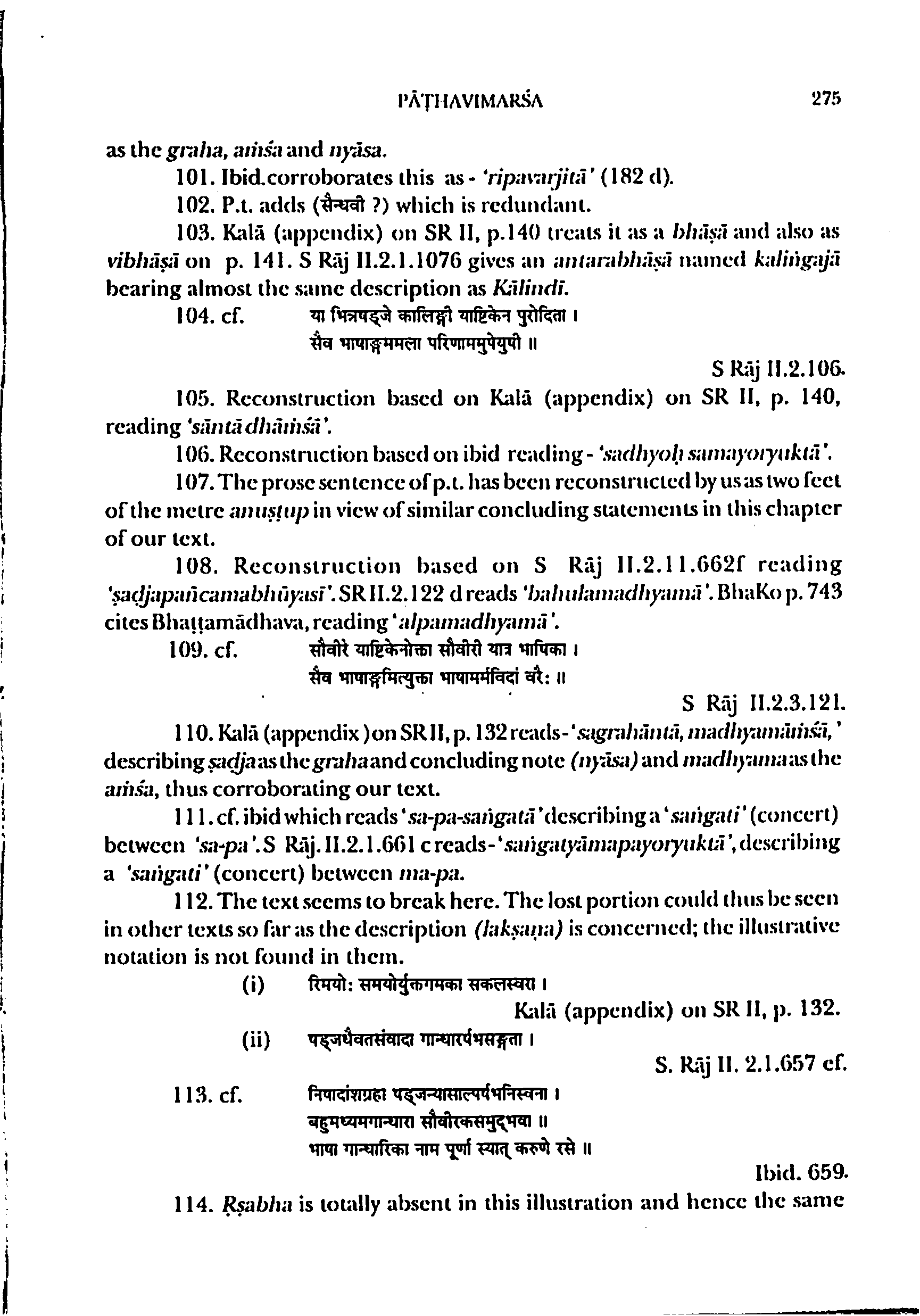
1 + 2 kg - 4 kg illustration treats pañcamaand not ‘madhyama’ as the graha,aṁśa and nyāsa. 91. SR II.2.170 d and S Rāj II.2.1.864 ab notice that some authorities treat it as a bhāṣāṅga; the latter also says in 864 cd that Yāṣṭika held it to be a vibhāsā. 92. Kalā (appendix) on SR II, p. 140 and S Rāj II.2.1.1038a read the name as śuddhā, hence our reconstruction.
घांशग्रहान्ता मृदुलधैवता रिपवर्ज?िता ।
93. cf. (i)
पवर्ज?िता वा सगयोः सम्बन्धा भित्रषड्जजा ॥
सापन्यासा मन्द्रसगधा शुद्धा दीर्घपञ्चमा ॥
Kalā (appendix) on SR II, p. 121.
शुद्धा भाषा भित्रषड्ज? ग्रहांशन्यासधैवता ।
(ii)
गापन्यासा धभूयिष्ठा रिहीना मृदुषङ्ज?िका ॥
धतारा पश्चमेनापि रहिता याष्ट्रिके मते ॥
S Rāj 11.2.1.1038. 94. P. t. adds here 'dākṣiṇātyā' which is out of place. 95. S. Rāj II.2.1.1046 and Kalā (appendix) on SR II, p. 140 treat it as a bhāṣā. 96. Although p.t. says that this bhāṣā is hexatonic, the illustration presents it as complete. 97. 'Şadjasambhavā' would mean born of ' bhinnaṣaḍja'. cl. तथैव दाक्षिणात्यास्ति भिन्नपड्ज? धमन्द्रिका ।10
षड्जतारस्वरा धांशग्रहन्यासा निदोलिता ॥
नियोक्तव्या च सन्तापे प्रियस्य स्मरणेऽपि च ।
विभाषेति पुनर्भाषामिमामाचष्ट याष्ट्रिकः॥
S Rāj II 2. 1. 1045, 1046. 98. S Rāj II.2.1.1053, and Kalā (appendix) on SR II, p. 141 treat Śrīkaṇṭhī as a bhāṣā, the text of the former runs as follows-
धैवतांशग्रहन्यासा त्यक्तपा धैवतास्पिका ।
गतारा मन्द्रधा चापन्यासेनर्षभभूषिता ॥
श्रीकण्ठी भित्रपङ्ज?ोत्था भवेदुत्कण्ठिते जने ।
याष्टिकः पुनराचष्ट रिलोपात् पाडवामिमाम् ॥
99. S Rāj II.2.1.1069 c reads - 'dhaivatāmsagrahanyāsā', describing dhaivata as the graha, aṁśa and nyāsa. 100. SR 11.2. 182 b reads-‘nyāsāniśagraha-dhaivatā’ , describing dhaivata G~
English — Sharma
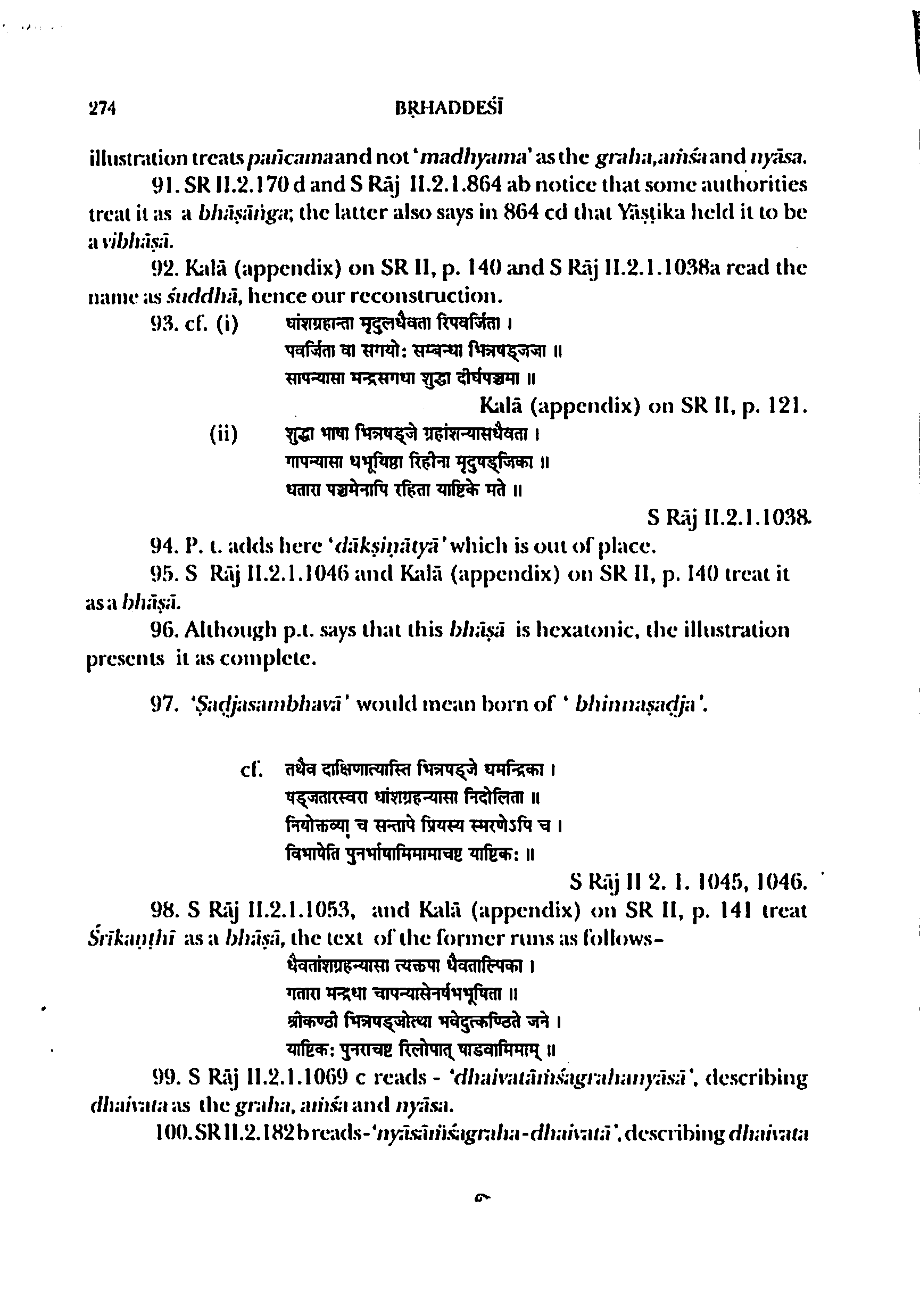
as the graha, amśa and nyāsa. 101. Ibid.corroborates this as - 'ripavarjitā' (182 d). 102. P.t. adds (सैन्धवी ?) which is redundant. 103. Kalā (appendix) on SR II, p.140 treats it as a bhāṣā and also as vibhāṣā on p. 141. S Rāj II.2.1.1076 gives an antarabhāṣā named kaliṅgajā bearing almost the same description as Kālindī.
या भित्रपड्जे कालिङ्गी याष्ट्रिकेन पुरोदिता ।
104. cf.
सैव भाषाङ्गममला परिणाममुपेयुपी ॥
S Rāj II.2.106. 105. Reconstruction based on Kalā (appendix) on SR II, p. 140, reading 'sāntā dhāmśā'. 106. Reconstruction based on ibid-reading - ‘sadhyoḥ samayoryuktā’. 107. The prose sentence of p.t. has been reconstructed by us as two feet of the metre anustup in view of similar concluding statements in this chapter of our text. 108. Reconstruction based on S Raj II.2.11.662f reading 'ṣadjapañcamabhūyasī'. SR II.2.122 d reads 'bahulamadhyamā'. BhaKo p. 743 cites Bhattamādhava, reading 'alpamadhyamā'.
सौवीरे याष्ट्रिकेनोक्ता सौवीरी यात्र भाषिका ।
109. cf.
सैव भाषाङ्गमित्युक्ता भाषामर्मविदां वरै: ॥
S Rāj II.2.3.121. 110. Kalā (appendix ) on SR II, p. 132 reads-‘sagrahāntā, madhyamāinsā,’ describing şadjaas the graha and concluding note (nyāsa) and madhyama as the amśa, thus corroborating our text. 111. cf. ibid which reads 'sa-pa-sangatā' describing a 'sangati' (concert) between 'sa-pa'. S Rāj. II.2.1.661 c reads-'sangatyāmapayoryuktā', describing a 'sangati' (concert) between ma-pa. 112. The text seems to break here. The lost portion could thus be seen in other texts so far as the description (lakṣaṇa) is concerned; the illustrative notation is not found in them.
रिमयो: समयोर्युक्तगमका सकलस्वरा ।
(i) Kalā (appendix) on SR II, p. 132.
पड्जधैवतसंवादा गान्धारपंभसङ्गता ।
(ii) S. Rāj II. 2.1.657 cf.
निषादांशग्रहा पद्जन्यासाल्पर्पभनिस्वना ।
113. cf.
बहमध्यमगान्यारा सौवीरकसमुद्भवा ॥
भाषा गान्धारिका नाम पूर्णा स्यात् करुणे रसे ॥
Ibid. 659. 114. Rṣabha is totally absent in this illustration and hence the same
10.[relation] Bhinnaṣaḍja is a raga type that can serve as a basis for deriving other ragascl. तथैव दाक्षिणात्यास्ति भिन्नपड्ज? धमन्द्रिका ।
1.[attribution]Some authorities treat certain ragas as bhāṣāṅga rather than full ragasSR II.2.170 d and S Rāj II.2.1.864 ab notice that some authorities treat it as a bhāṣāṅga
2.[attribution]Yāṣṭika held a certain raga to be a vibhāsāthe latter also says in 864 cd that Yāṣṭika held it to be a vibhāsā
3.[attribution]Yāṣṭika is an authority who classified certain ragas as vibhāsāthe latter also says in 864 cd that Yāṣṭika held it to be a vibhāsā
4.[attribution]Bhattamādhava is cited as an authority for describing a raga quality as alpamadhyamāBhaKo p. 743 cites Bhattamādhava, reading 'alpamadhyamā'
5.[citation]Antarabhāṣā is a category of intermediate ragas that can share characteristics with named ragasS Rāj II.2.1.1076 gives an antarabhāṣā named kaliṅgajā bearing almost the same description as Kālindī
6.[citation]S Rāj is a musicological treatise cited extensively for alternative readings and descriptions of ragasS Rāj II.2.1.1076 gives an antarabhāṣā named kaliṅgajā
7.[citation]SR is a musicological treatise cited for variant readings of raga descriptionsSR II.2.170 d and S Rāj II.2.1.864 ab notice that some authorities treat it as a bhāṣāṅga
8.[definition]Sangati refers to concert or melodic connection between specific scale degreesS Rāj. II.2.1.661 c reads-'sangatyāmapayoryuktā', describing a 'sangati' (concert) between ma-pa
9.[definition]Lakṣaṇa refers to the descriptive characteristics or defining features of ragasThe lost portion could thus be seen in other texts so far as the description (lakṣaṇa) is concerned
10.[relation]Bhinnaṣaḍja is a raga type that can serve as a basis for deriving other ragas'Şadjasambhavā' would mean born of ' bhinnaṣaḍja'
11.[structural]Graha is one of the characteristic structural elements used to describe ragastreats pañcamaand not 'madhyama' as the graha,aṁśa and nyāsa
12.[structural]Aṁśa is one of the characteristic structural elements used to describe ragastreats pañcamaand not 'madhyama' as the graha,aṁśa and nyāsa
13.[structural]Nyāsa is one of the characteristic structural elements used to describe ragastreats pañcamaand not 'madhyama' as the graha,aṁśa and nyāsa