(One should move in it) from niṣāda to
gāndhāra and the omission is like that
in
madhyamā.
(228-229)
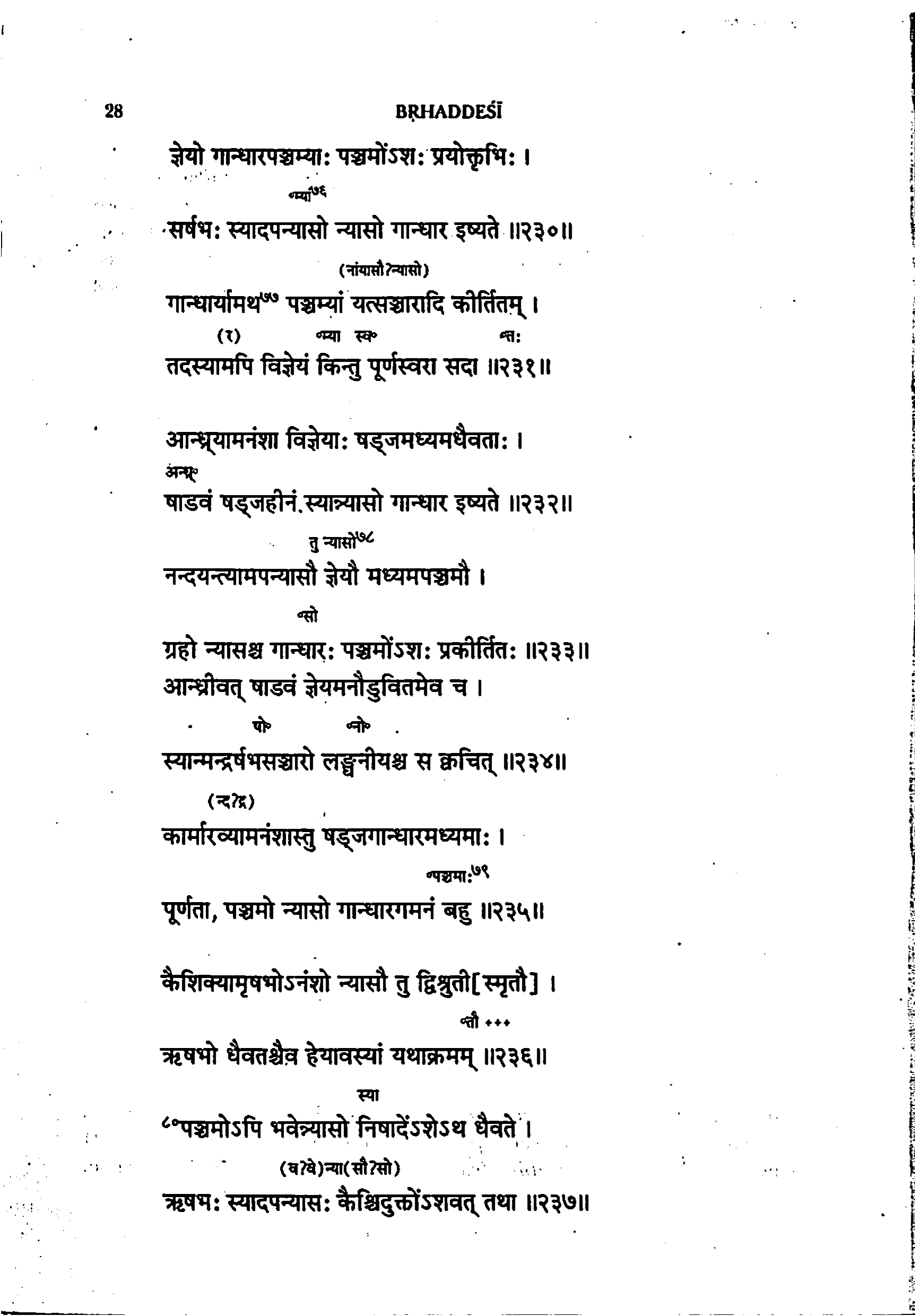
The performers should know pañcama as the amsa of gandhara-pañcami11;
the same (
pañcama) alongwith rṣabha is
apanyāsa and
gāndhāra is desired to
be the
nyāsa.
(230)
Whatever sañcāra (to and fro movement) and the like has been said in the
case of gandhari and then pancami, that should be known also in this
(gāndhārapañcamī), but it is always with complete svaras1.
(231)
In āndhrī, şadja, madhyama and dhaivata should be known as non-amsas.12 Its
ṣāḍava form is devoid of ṣaḍja and gāndhāra should be its nyāsa5.
(232)
In nandayanti, madhyama and pañcama should be known as the two
apanyāsas14,
gāndhāra is the graha and nyāsa, (and) pañcama is said to be the
ariisa6.
(233)
Its ṣāḍava form should be known as that of āndhrī, it has no auḍuva form.13
It has
sañcāra (in and around) the low rṣabha, which is also sometimes
omissible.
(234):
ln
kārmāravī, şadja,
gāndhāra and
madhyama are non-amsas. It has
completeness,
pañcama is the nyāsa (and) there is profuse movement
towards gāndhāra8.
(235)
In
kaiśikī, ṛṣabha is non-aṁśa and the two svaras composed of two śrutis each ;
are the nyāsas. Rṣabha and
dhaivata alone are to be omitted respectively (in
the şādava and audava states).
......................................
When niṣāda and
dhaivata are the aṁśas then
pañcama also could become ...
the nyāsa. Ŗṣabha is the
apanyāsa and some have said that it is similar to amsa...
(237)
, ' ,
. . .