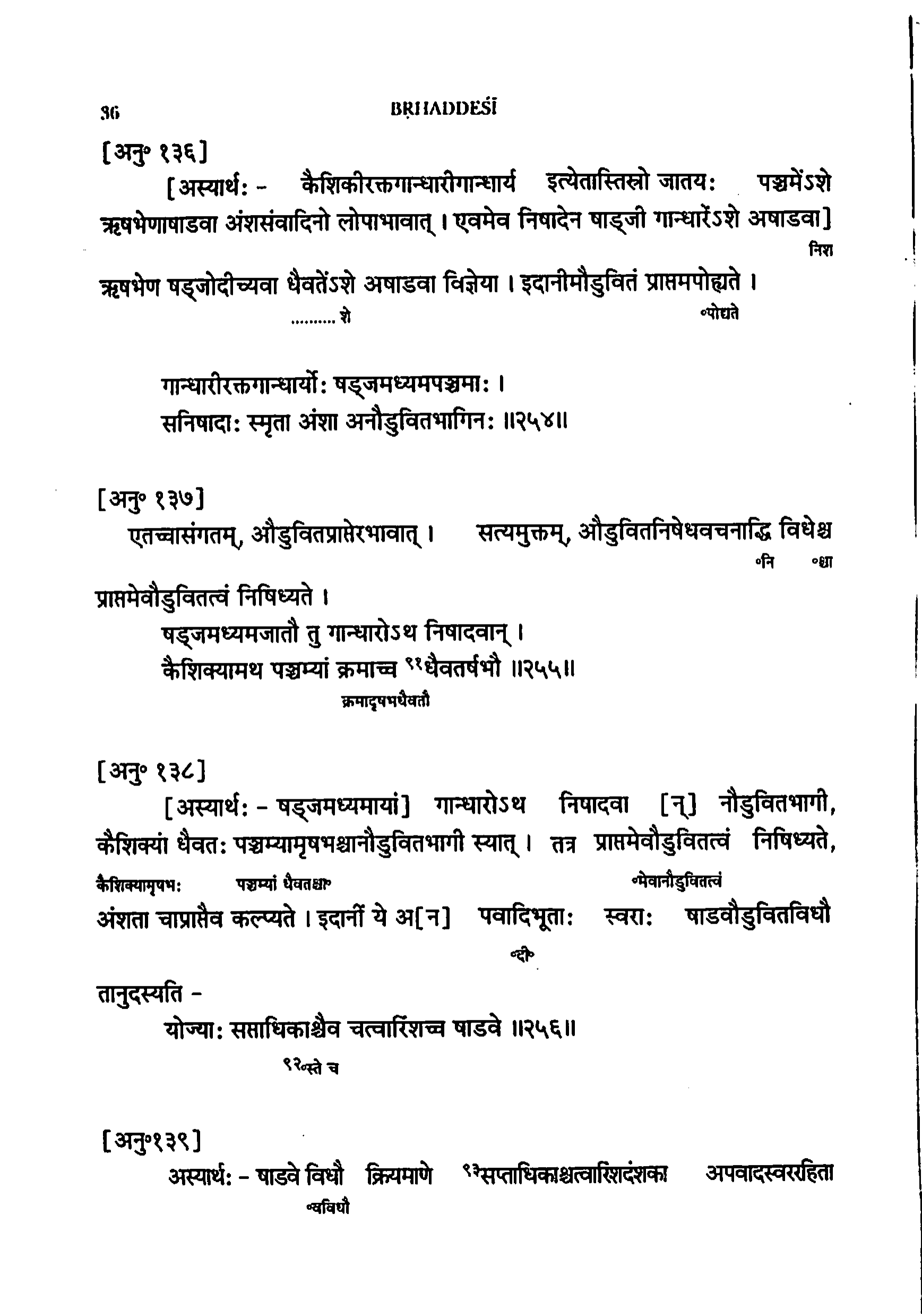
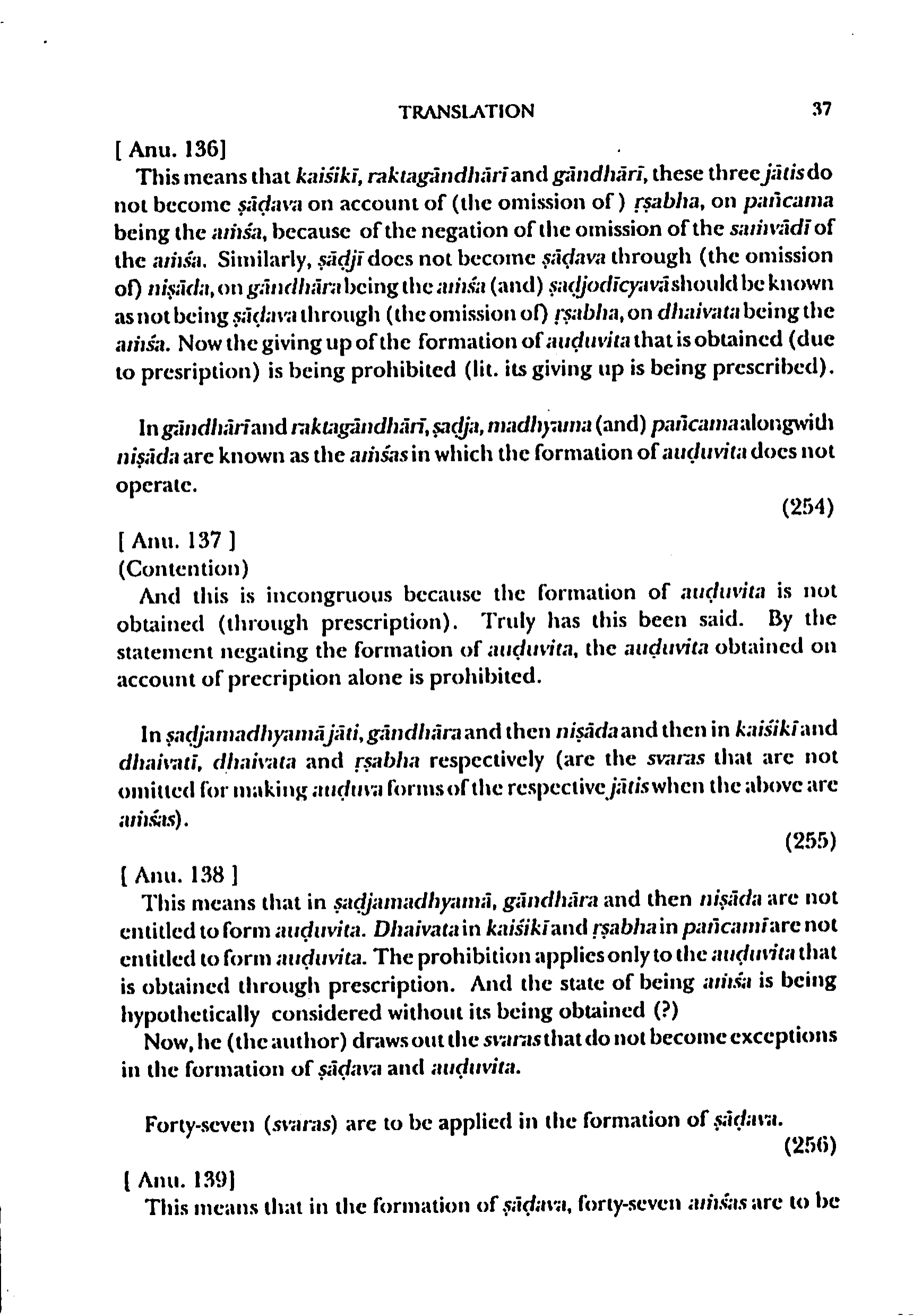
[Anu. 136]
This means that
kaiśikī,
raktagāndhārī and
gāndhārī, these three jātis do
not become ṣāḍava on account of (the omission of) ṛṣabha, on
pañcama
being the amśa, because of the negation of the omission of the
samvādī of
the amśa. Similarly, ṣāḍjī does not become ṣāḍava through (the omission
of) niṣāda, on
gāndhāra being the aniśa (and)
ṣadjodīcyavā should be known
as not being ṣāḍava through (the omission of) ṛṣabha, on dhaivata being the
ainsa10. Now the giving up of the formation of
auduvita that is obtained (due
to presription) is being prohibited (lit. its giving up is being prescribed).
In gāndhārī and raktagāndhārī, ṣaḍja, madhyama (and) pañcama alongwith
niṣāda are known as the amśas in which the formation of auduvita does not
operate.2
(254)
[Anu. 137]
(Contention)
And this is incongruous because the formation of
auduvita is not
obtained (through prescription). Truly has this been said.
By the
statement negating the formation of auduvita, the auduvita obtained on
account of precription alone is prohibited.1
In
ṣadjamadhyamā jāti,
gāndhāra and then niṣāda and then in
kaiśikī and
dhaivatī,
dhaivata and ṛṣabha respectively (are the svaras that are not
omitted for making auduva forms of the respective jātis when the above are
aniśas).
(255)
[Anu. 138]
This means that in
ṣadjamadhyamā,
gāndhāra and then niṣāda are not
entitled to form
auduvita.
Dhaivatain kaiśikī and ṛṣabhain pañcamī are not
entitled to form auduvita.65 The prohibition applies only to the
auduvita that
is obtained through prescription. And the state of being anisa is being
hypothetically considered without its being obtained (?)
Now, he (the author) draws out the svaras that do not become exceptions
in the formation of
ṣāḍava and auḍuvita.
Forty-seven (svaras) are to be applied in the formation of ṣāḍava.11
(256)
[Anu. 139]
This means that in the formation of ṣāḍava, forty-seven ainśas are to be