Source scans · vol_II_p054
recto · open full
scan recto
verso · open full
scan verso
Bṛhaddeśī · Volume II
pp. 90–91folio 054
Devanāgarī
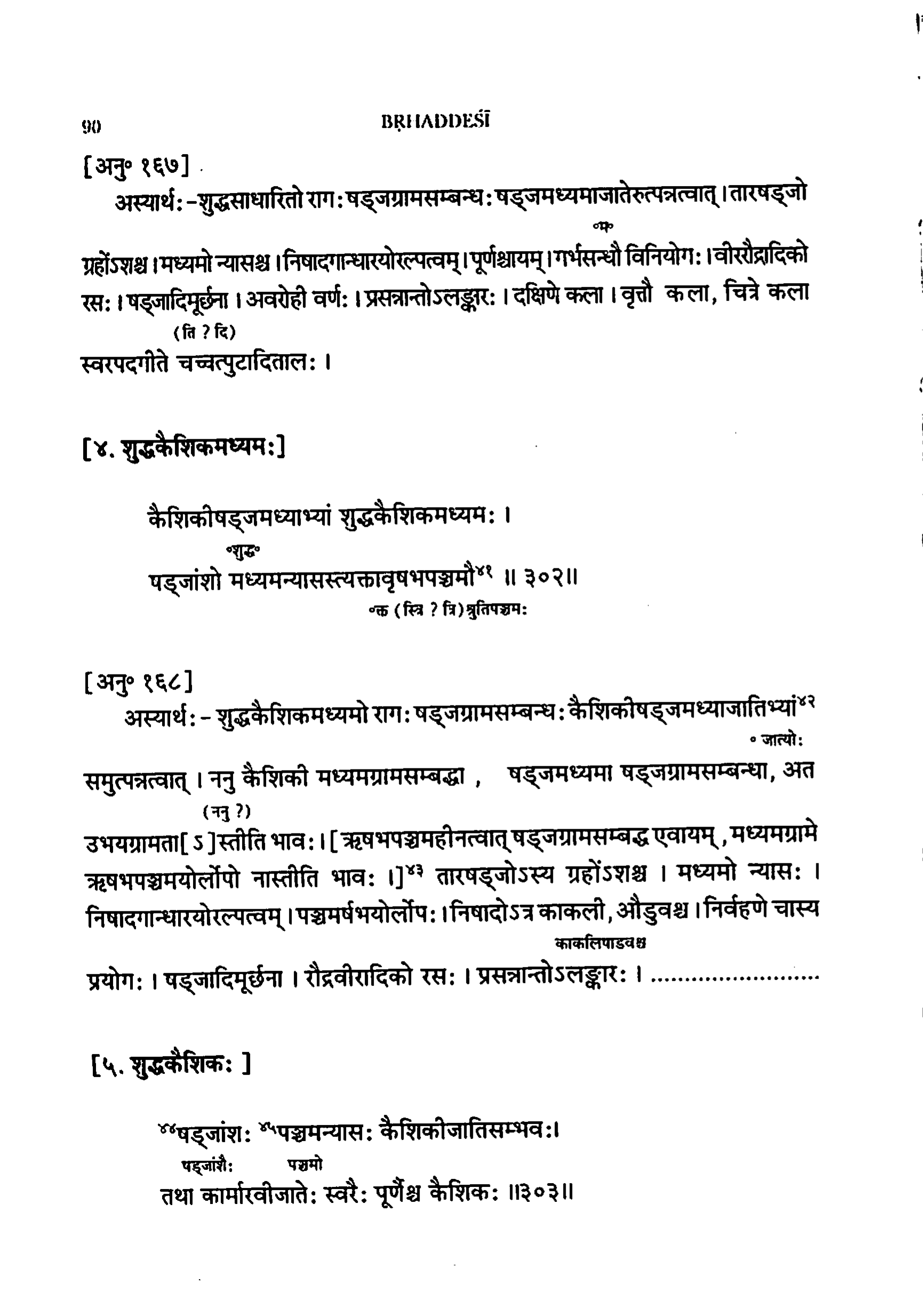
[अन्॰ १६७]
अस्यार्थ: -शुद्धसाधारितो राग: षड्जग्रामसम्बन्ध: षड्जमध्यमाजातेरुत्पत्रत्वात्।1 तारषड्जो ग्रहोंऽशश्च । मध्यमो न्यासश्च । निषादगान्धारयोरल्पत्वम् । पूर्णश्चायम् । गर्भसन्धौ विनियोगः । वीररौद्रादिको रसः । षड्जादिमूर्छना(ति ? दि) । अवरोही वर्णः । प्रसन्नान्तोऽलङ्कारः । दक्षिणे कला । वृत्तौ कला , चित्रे कला स्वरपदगीते चच्चत्पुटादिताल:।4
[४. शुद्धकैशिकमध्यम:]
कैशिकीषड्जमध्याभ्यां॰शुद्ध॰ शुद्धकैशिकमध्यमः।
षड्जांशो मध्यमन्यासस्त्यक्तावृषभपञ्चमौ6४१॰क (स्त्रि ? त्रि) त्रुतिपञ्चम: ॥३०२॥
[अनु॰ १६८]
अस्यार्थ: - शुद्धकैशिकमध्यमो राग: षड्जग्रामसम्बन्ध: कैशिकीषड्जमध्याजातिभ्यां४२॰ जात्यो: समुत्पन्नत्वात् । ननु(ननु ?) कैशिको मध्यमग्रामसम्बद्धा , षड्जमध्यमा षड्जग्रामसम्बन्धा, अत उभयग्रामता[ऽ]स्तीति भाव:।[ऋषभपञ्चमहीनत्वात् षड्जग्रामसम्बद्ध एवायम्2 , मध्यमग्रामे
ऋषभपञ्चमयोर्लोपो नास्तीति भाव: ।]४३ तारषड्जोऽस्य ग्रहोंऽशश्च । मध्यमो न्यास: ।
निषादगान्धारयोरल्पत्वम् । पञ्चमर्षभयोर्लोप: । निषादोऽत्र काकली,काकलिपाडवश औडुवश्च5 । निर्वहणे चास्य प्रयोग: । षड्जादिमूर्छना । रौद्रवीरादिको रस: । प्रसन्नान्तोऽलङ्कार: । .....
[५. शुद्धकैशिक:]
४४षड्जांश:पड्जांशै: ४५पञ्चमन्यास:पञ्चमो कैशिकीजातिसम्भव:।
तथा कार्मारवीजाते: स्वरै: पूर्णेश्च कैशिक:3 ॥३०३॥
English — Sharma (translation)
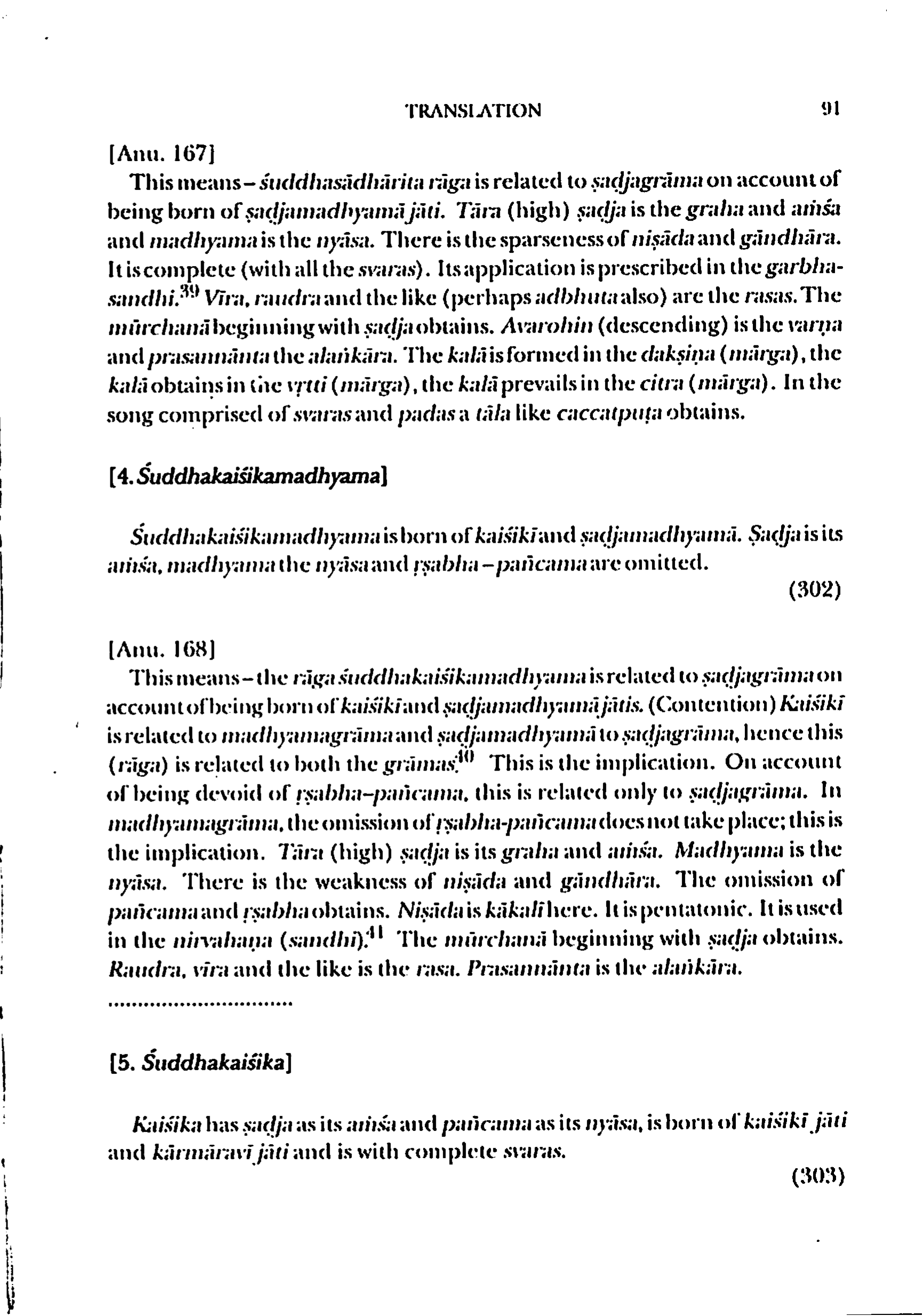
[Anu. 167]
This means – śuddhasādhārita rāga is related to ṣaḍjagrāma on account of being born of şadjamadhyamā jāti1. Tāra (high) şadja is the graha and amśa and madhyama is the nyāsa. There is the sparseness of niṣāda and gāndhāra. It is complete (with all the svaras). Its application is prescribed in the garbha- sandhi. 39 Vīra, raudra and the like (perhaps adbhuta also) are the rasas. The mūrchanā beginning with ṣaḍja obtains8. Avarohin (descending) is the varṇa and prasannānta the alarikāra. The kalā is formed in the dakṣiṇa (mārga), the kalā obtains in the vṛtti (mārga), the kalā prevails in the citra (mārga). In the song comprised of svaras and padas a tāla like caccatpuṭa obtains4. Suddhakaisikamadhyama is born of kaisikī and şadjamadhyamā. Şadja is its amśa, madhyama the nyāsa and ṛṣabha – pañcama are omitted6.
(302)
[Anu. 168]
This means—the rāga śuddhakaiśikamadhyama is related to ṣaḍjagrāma on account of being born of kaiśikī and şadjamadhyamā jātis. (Contention) Kaiśikī ŧ is related to madhyamagrāma and ṣadjamadhyamā to ṣadjagrāma, hence this (<math>r\bar{a}ga</math>) is related to both the <math>gr\bar{a}mas^{40}</math>. This is the implication. On account of being devoid of ṛṣabha-pañcama, this is related only to ṣaḍjagrāma2. In madhyamagrāma, the omission of ṛṣabha-pañcama does not take place7; this is the implication. Tāra (high) ṣaḍja is its graha and aniśa. Madhyama is the nyāsa. There is the weakness of niṣāda and gāndhāra. The omission of pañcama and ṛṣabha obtains. Niṣāda is kākalī here. It is pentatonic10.5 It is used in the nirvahaṇa (sandhi).41 The mūrchanā beginning with ṣaḍja obtains. Raudra, vīra and the like is the rasa. Prasannānta is the alankāra. ..................
[5. Šuddhakaisika]
Kaišika has ṣaḍja as its amśa and pañcama as its nyāsa, is born of kaišikī jāti and kārmāravī jāti and is with complete svaras3.
(303)
1.[relation]śuddhasādhrita rāga is related to ṣaḍjagrāma because it is born of ṣadjamadhyamā jātiशुद्धसाधारितो रागः षड्जग्रामसम्बन्धः षड्जमध्यमाज?ातेरुत्पत्रत्वात्।
2.[relation]śuddhakaiśikamadhyama rāga is related only to ṣaḍjagrāma on account of being devoid of ṛṣabha-pañcamaऋषभपञ्चमहीनत्वात् षड्जग्रामसम्बद्ध एवायम्
3.[relation]Śuddhakaiśika is born of kaiśikī jāti and kārmāravī jātiतथा कार्मारवीज?ातेः स्वरैः पूर्णेश्च कैशिकः
4.[structural]A tāla like caccatpuṭa obtains in a song comprised of svaras and padas in śuddhasādhrita rāgaस्वरपदगीते चच्चत्पुटादितालः।
5.[structural] śuddhakaiśikamadhyama rāga is pentatonicनिषादोऽत्र काकली, औडुवश्च
6.[structural]Ṛṣabha and pañcama are omitted in śuddhakaiśikamadhyama rāga which is related to ṣaḍjagrāmaत्यक्तावृषभपञ्चमौ
7.[structural]In madhyamagrāma, the omission of ṛṣabha-pañcama does not take placeमध्यमग्रामे ऋषभपञ्चमयोर्लोपो नास्तीति भावः।
8.[structural]The mūrchanā beginning with ṣaḍja obtains in śuddhasādhrita rāgaषड्ज?ादिमूर्छना।
9.[structural]śuddhakaiśikamadhyama rāga is used in the nirvahaṇa (sandhi)निर्वहणे चास्य काकलिपाडवश प्रयोगः।
10.[structural]In śuddhakaiśikamadhyama rāga, niṣāda is kākalīनिषादोऽत्र काकली, औडुवश्च।
11.[structural]Prasannānta is the alaṅkāra of śuddhasādhrita rāgaप्रसन्नान्तोऽलङ्कारः।
12.[structural]Tāra (high) ṣaḍja is the graha and aṁśa in śuddhasādhrita rāgaतारषड्ज?ो ग्रहोंऽशश्च।
1.[relation] śuddhasādhrita rāga is related to ṣaḍjagrāma because it is born of ṣadjamadhyamā jātiśuddhasādhārita rāga is related to ṣaḍjagrāma on account of being born of şadjamadhyamā jāti
2.[relation] śuddhakaiśikamadhyama rāga is related only to ṣaḍjagrāma on account of being devoid of ṛṣabha-pañcamaOn account of being devoid of ṛṣabha-pañcama, this is related only to ṣaḍjagrāma
3.[relation] Śuddhakaiśika is born of kaiśikī jāti and kārmāravī jātiis born of kaišikī jāti and kārmāravī jāti and is with complete svaras
4.[structural] A tāla like caccatpuṭa obtains in a song comprised of svaras and padas in śuddhasādhrita rāgaIn the song comprised of svaras and padas a tāla like caccatpuṭa obtains
5.[structural]śuddhakaiśikamadhyama rāga is pentatonicIt is pentatonic.
6.[structural] Ṛṣabha and pañcama are omitted in śuddhakaiśikamadhyama rāga which is related to ṣaḍjagrāmaṛṣabha – pañcama are omitted
7.[structural] In madhyamagrāma, the omission of ṛṣabha-pañcama does not take placeIn madhyamagrāma, the omission of ṛṣabha-pañcama does not take place
8.[structural] The mūrchanā beginning with ṣaḍja obtains in śuddhasādhrita rāgaThe mūrchanā beginning with ṣaḍja obtains
9.[structural] śuddhakaiśikamadhyama rāga is used in the nirvahaṇa (sandhi)It is used in the nirvahaṇa (sandhi)
10.[structural] In śuddhakaiśikamadhyama rāga, niṣāda is kākalīNiṣāda is kākalī here. It is pentatonic
12.[structural] Tāra (high) ṣaḍja is the graha and aṁśa in śuddhasādhrita rāgaTāra (high) şadja is the graha and aṁśa