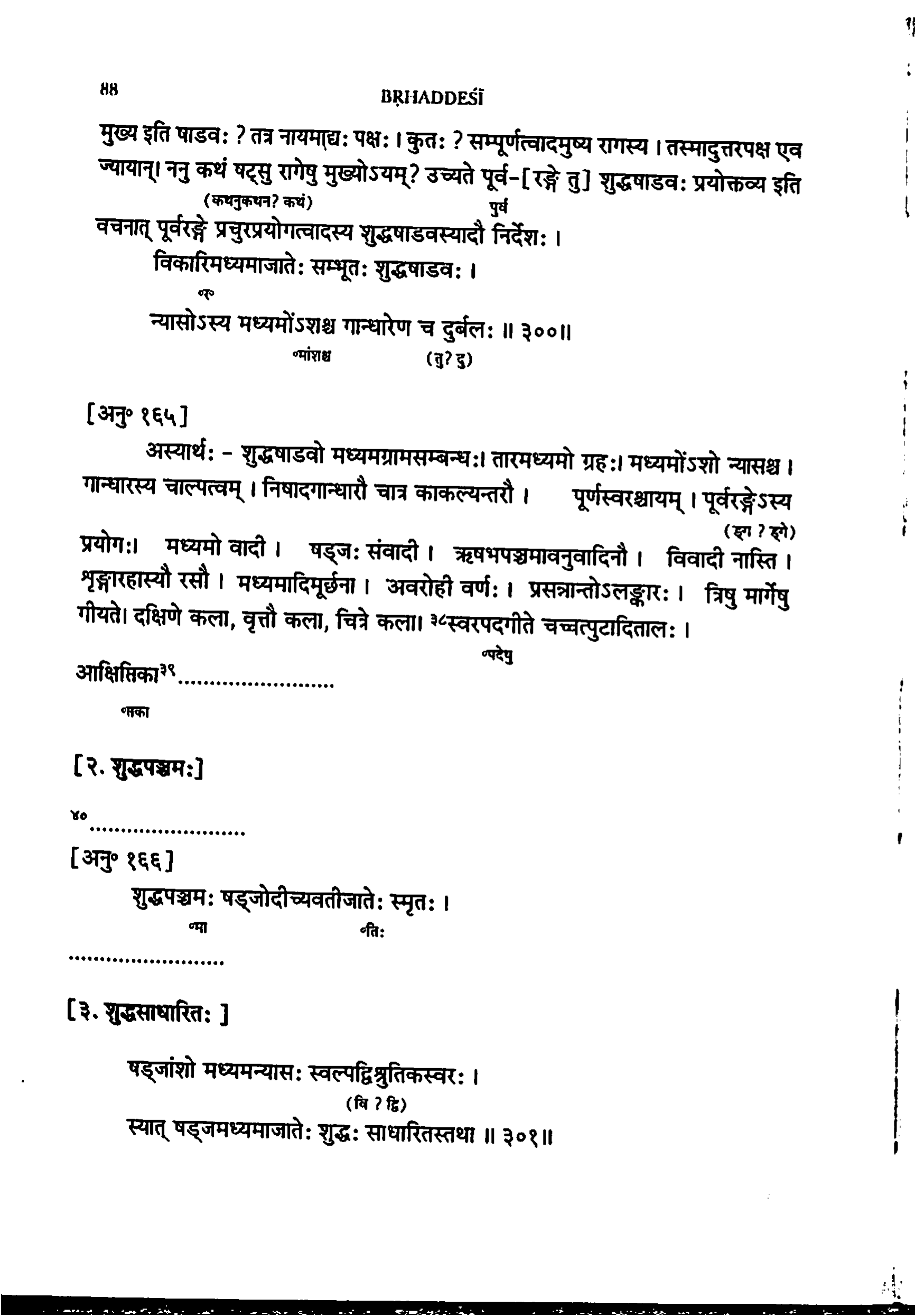
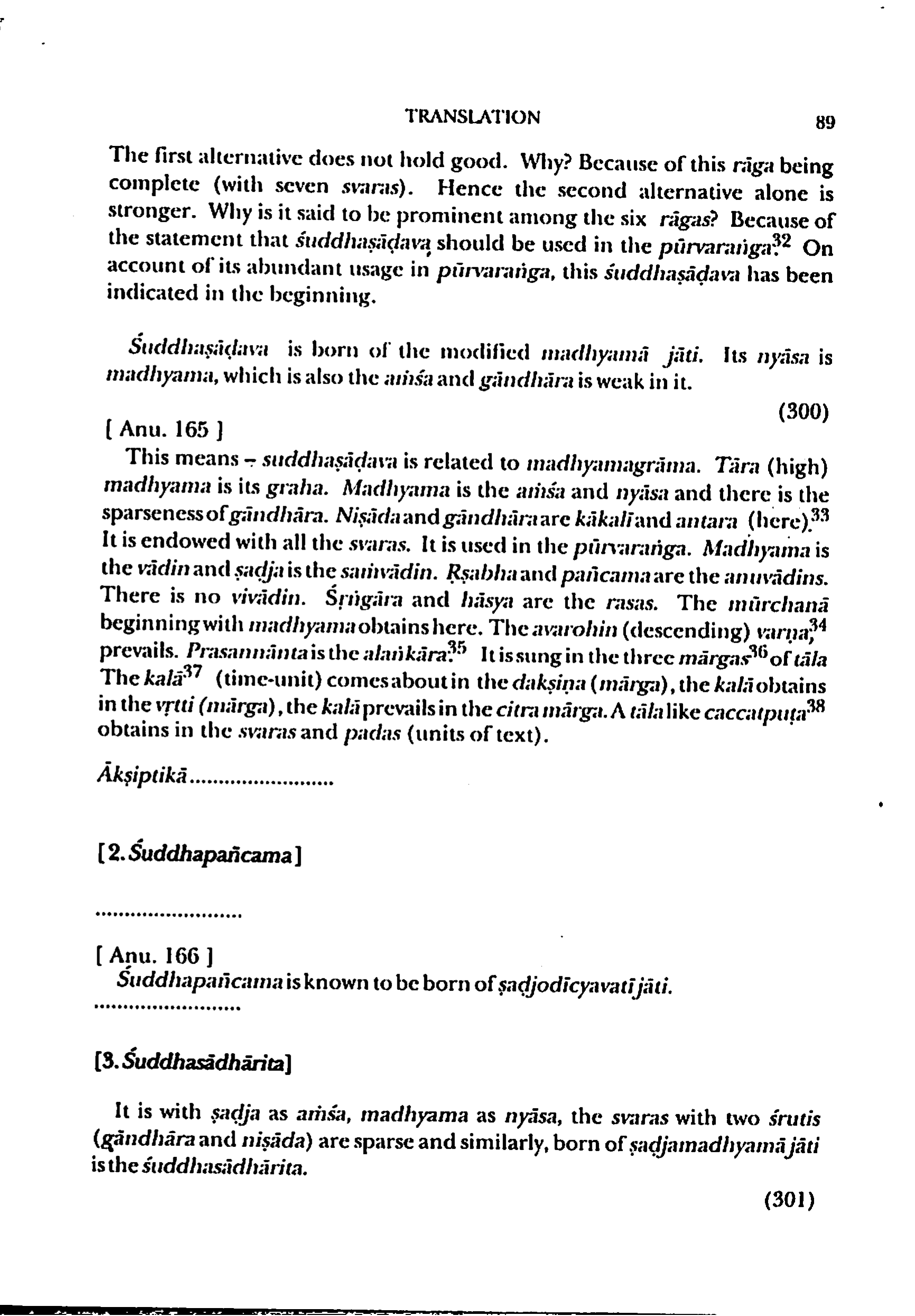
The first alternative does not hold good. Why? Because of this rāga being
complete (with seven svaras). Hence the second alternative alone is
stronger. Why is it said to be prominent among the six rāgas?
Because of
the statement that śuddhaṣāḍava should be used in the pūrvaraiga.4 On
account of its abundant usage in
pūrvaranga, this śuddhaṣāḍava has been
indicated in the beginning.
Suddhaṣāḍava is born of the modified
madhyamā jāti.
Its
nyāsa is
madhyama, which is also the amśa and
gāndhāra is weak in it.
(300)
[Anu. 165]
This means -
suddhaṣāḍava is related to madhyamagrāma.2 Tāra (high)
madhyama is its graha.
Madhyama is the amśa and nyāsa and there is the
sparseness of
gāndhāra.
Niṣāda and gāndhāra are kākalī and antara (here).1133
It is endowed with all the svaras. It is used in the
pūrvaranga.
Madhyama is
the vādin and ṣaḍja is the samvādin.65 Ŗṣabha and pañcama are the anuvādins.7
There is no vivādin.81 Śṛṅgāra and hāsya are the rasas.
The mūrchanā
beginning with madhyama obtains here.9 The avarohin (descending) varņa,34
prevails.13 Prasannānta is the
alankāra. It is sung in the three mārgas 36 of tāla
The kalā
37 (time-unit) comes about in the
dakṣiṇa (mārga), the kalā obtains
in the
vṛtti (mārga), the kalā prevails in the
citra mārga.
A tāla like caccatpuṭa 38
obtains in the svaras and padas (units of text).12
Ākṣiptikā.....
[2. Suddhapañcama]
*********
[Anu. 166]
Šuddhapancama is known to be born of
şadjodicyavatī jāti.
---------------------------------------
[3. Šuddhasādhārita]
It is with sadja as amsa,
madhyama as nyāsa, the svaras with two śrutis
(
gāndhāra and niṣāda) are sparse and similarly,
born of ṣaḍjamadhyamā jāti
is the śuddhasādhārita.3
(301)
A Section of the second section of the section of the section of the section of the section of the section of the section of the section of the section of the section of the section of the section of the section of the sec