Source scans · vol_II_p148
recto · open full
scan recto
verso · open full
scan verso
Bṛhaddeśī · Volume II
pp. 0–279folio 148
Devanāgarī (Bṛhaddeśī)
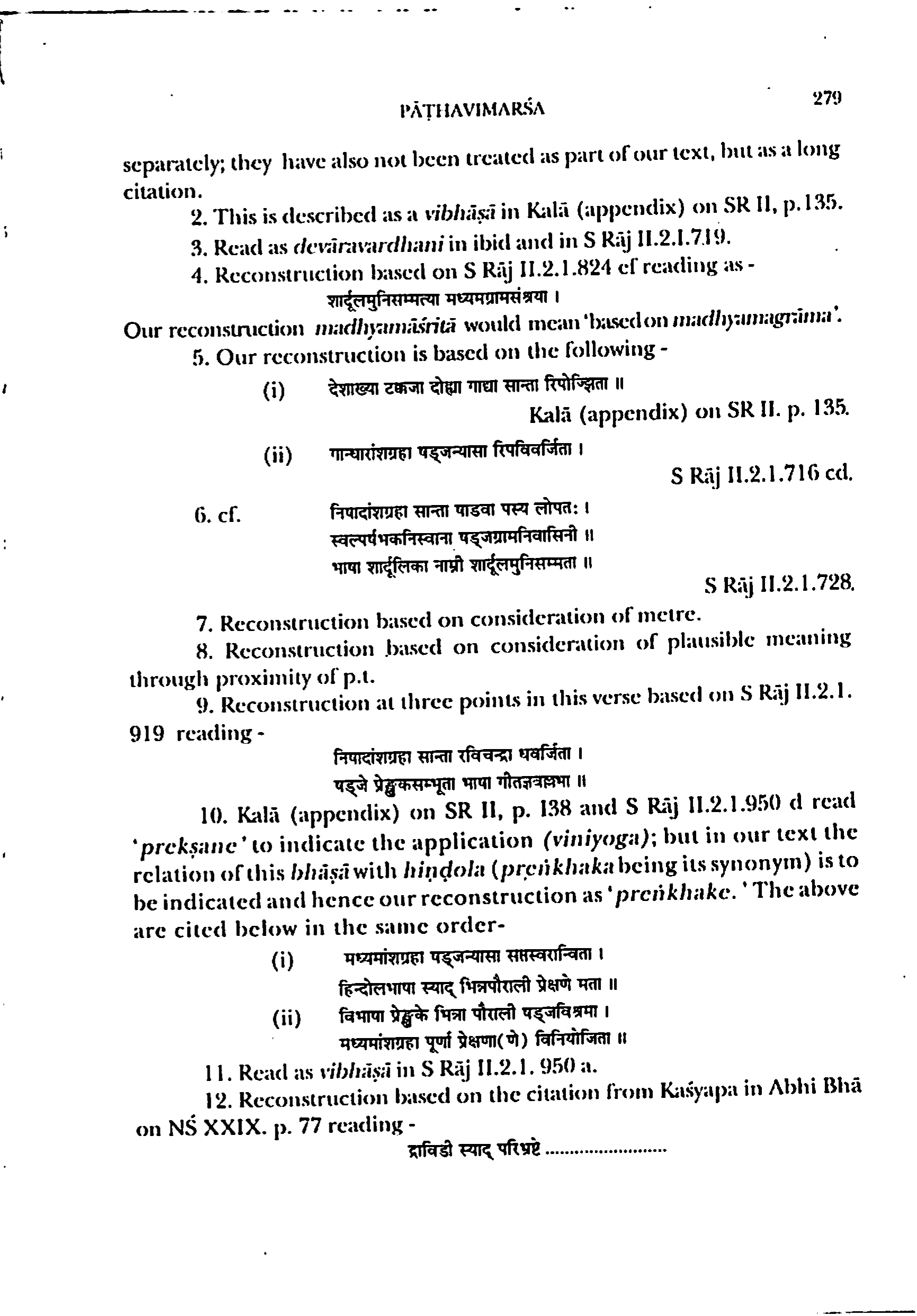
Ç≛ 20040 - 15 which is said to be omitted, is profusely used therein:
पासागममाधाधा पामाससानिसानि सानिमगमामापाधामपामारीसानि धापामहमामाधानीरिरिरिसागारि ऋपभारिरिपका ।
133. P.t. omits the description of gāndhārī. Other texts describe it as follows-
गान्धारपञ्चमे भाषा गान्धारी सगभूषिता ।
(i)
धाद्यना सर्वलोकस्य हद्या स्त्रीणां विशेषत:॥
Kalā (appendix) on SR II, p.139 (ii)
गान्धारपञ्चमे रागे गान्धारी भाषिकैकिका ।
धैवतांशग्रहन्यासा पङ्जमध्यमभूयसी ॥
गान्धारबहुला वाऽपि षड्जग्रामनिवासिनी ॥
S Rāj II.2.1.1006. 134. Kalli has described a bhāṣā named śakā, pertaining to revagupta; that description is different from the one of our text.
सन्यासा रेवगुप्तस्य भाषा मांशा शकाह्या ।
गपाभ्यां बहुला पूर्णा रिधाभ्यामपि भूयसी ॥
Kalā (appendix) on SR II. p.142. S Rāj II.2.1.1100 describes śakabhāṣā as pertaining to pañcamaṣāḍava, falling in line with our text, as follows -
ऋषभांशा मध्यमान्ता सम्पूर्णा गपभूयसी ।
रिधयो: सङ्गता प्रोक्ताशकभाषाद्वया ....। रागे पञ्चमषाडवे ॥
Kalli describes a bhāṣā named potā under revagupta; the same seems to find place in S Rāj under the name revaguptā; the two descriptions are very similar. पोता - ्रऋषभांशग्रहन्यासा धहीना निसभूयसी ।
पोता प्रोक्ता मतङ्गेन भाषा पञ्चमषाङ्ये13
Kalā (appendix) on SR II. p. 142. रेवगुप्ता –   ऋषभांशग्रहन्यासा निभूयिष्ठा धदुर्बला ।
रेवगुप्ता स्मृता भाषा रागे पञ्चमषाडवे14
S Rāj 11.2.1.1102. It may be noted that potā has been enumerated under pañcamaṣāḍava in S Rāj II.2.1.100 cd, but it has not been described in that text. 1. We are treating the matter falling under this heading as forming part of the chapter entitled bhāṣālakṣaṇa, but the verses have been numbered
English — Sharma
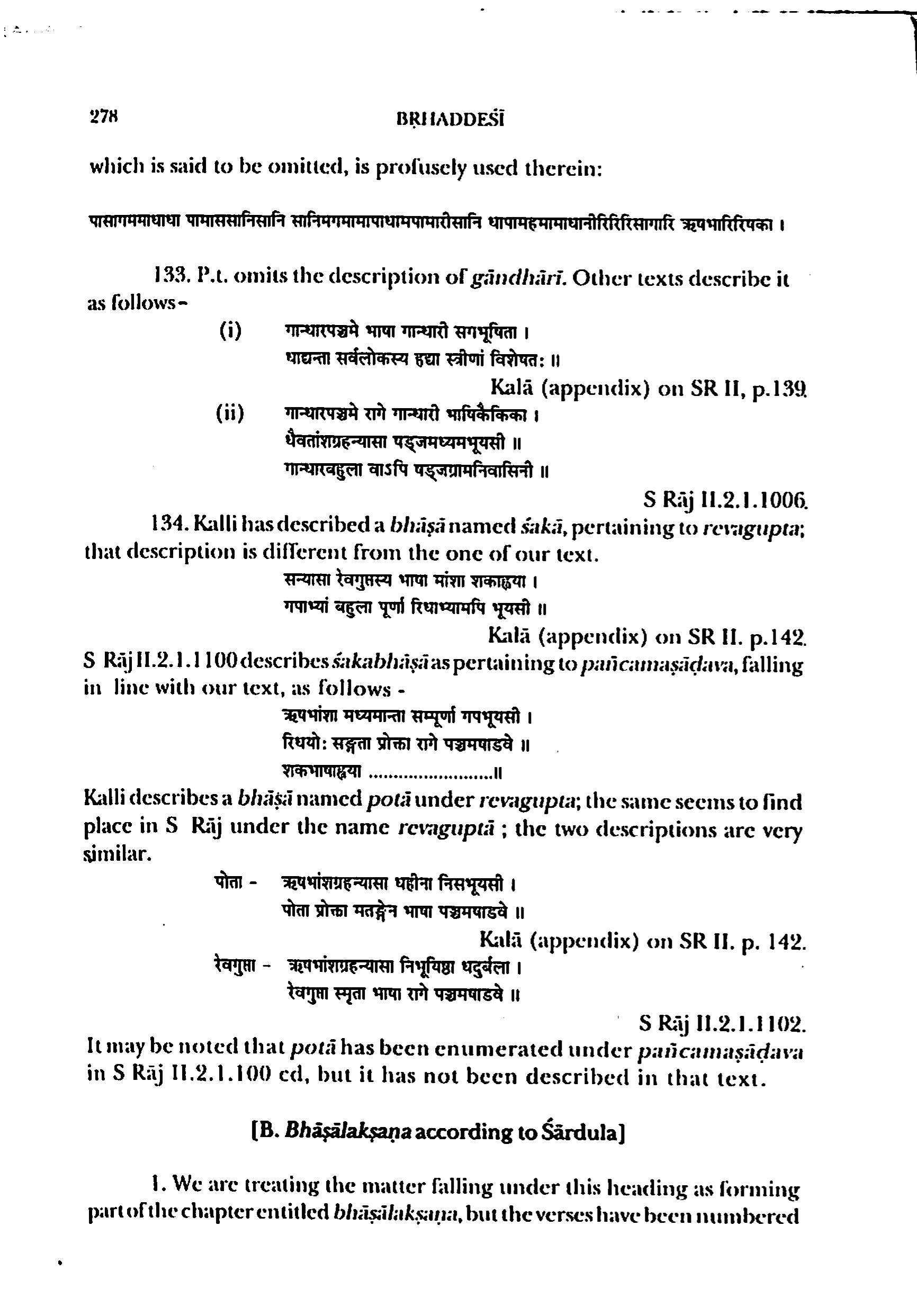
PĂŢĦAVIMARŚA separately; they have also not been treated as part of our text, but as a long citation. 2. This is described as a vibhāṣā in Kalā (appendix) on SR II, p.135.6 ; 3. Read as devāravardhani in ibid and in S Rāj II.2.I.719. 4. Reconstruction based on S Rāj II.2.1.824 ef reading as -
शार्दूलमुनिसम्मत्या मध्यमग्रामसंश्रया ।
Our reconstruction madhyamāśritā would mean 'basedon madhyamagrāma'. 5. Our reconstruction is based on the following -
देशाख्या टक्षजा दोह्या गाद्या सान्ता रिपोज?्झिता ॥
ı (i) Kalā (appendix) on SR II. p. 135.
गान्धारांशग्रहा षड्जन्यासा रिपविवर्ज?िता ।
(ii) S Rāj II.2.1.716 cd.
निपादांशग्रहा सान्ता पाडवा पस्य लोपतः ।
6. cf.
स्वल्पर्पभकनिस्वाना षड्जग्रामनिवासिनी ॥
:
भाषा शार्दृलिका नाम्री शार्दूलमुनिसम्मता ॥
S Rāj II.2.1.728. 7. Reconstruction based on consideration of metre. 8. Reconstruction based on consideration of plausible meaning through proximity of p.t. 9. Reconstruction at three points in this verse based on S Rāj II.2.1. 919 reading -
निपादांशग्रहा सान्ता रविचन्द्रा धवर्ज?िता ।
षड्ज? प्रेङ्खकसम्भूता भाषा गीतज्ञवलमा ॥
10. Kalā (appendix) on SR II, p. 138 and S Rāj II.2.1.950 d read 'prekṣane' to indicate the application (viniyoga); but in our text the relation of this bhāṣā with hiṇḍola (prenkhaka being its synonym)9 is to be indicated and hence our reconstruction as 'prenkhake.' The above are cited below in the same order-
मध्यमांशप्रहा पड्जन्यासा सप्तस्वरान्विता ।
(i)
हिन्दोलभाषा स्याद् भिन्नपौराली प्रेक्षणे मता ॥
विभाषा प्रेह्नके भित्रा पौराली पड्जविश्रमा ।
(ii)
मध्यमांशग्रहा पूर्णा प्रेक्षणा(णे) विनियोज?िता ॥
11. Read as vibhāṣā in S Rāj II.2.1, 950 a. 12. Reconstruction based on the citation from Kasyapa in Abhi Bhā on NS XXIX. p. 77 reading - द्राविडी स्याद् परिभ्रष्टे .....
8.[relation]Madhyamagrāma is a foundational musical scale or framework used in the classification of bhāṣāsशार्दूलमुनिसम्मत्या मध्यमग्रामसंश्रया
12.[structural]Gāndhārī is a bhāṣā (musical mode variant) based on the gāndhāra and pañcama notesगान्धारपञ्चमे भाषा गान्धारी सगभूषिता
13.[structural]Potā is a bhāṣā characterized by ṛṣabhāṃśa at the beginning and ending on dhā with sparse use of niऋषभांशग्रहन्यासा धहीना निसभूयसी । पोता प्रोक्ता मतङ्गेन भाषा पञ्चमषाङ्ये
14.[structural]Revaguptā is a bhāṣā in the pañcamaṣāḍava rāga, characterized by ṛṣabhāṃśa grahaṇyāsa and sparse dhāरेवगुप्ता – ऋषभांशग्रहन्यासा निभूयिष्ठा धदुर्बला । रेवगुप्ता स्मृता भाषा रागे पञ्चमषाडवे
1.[attribution]Śakā is a bhāṣā pertaining to revaguptaKalli has described a bhāṣā named śakā, pertaining to revagupta
2.[attribution]Śārdula is an author whose bhāṣālakṣaṇa (description of bhāṣā characteristics) is cited in this text[B. Bhāṣālakṣaṇa according to Śārdula]
3.[attribution]Kalli is an author who described multiple bhāṣās including śakā and potāKalli has described a bhāṣā named śakā, pertaining to revagupta; that description is different from the one of our text.
4.[citation]Kalā is a treatise (appendix to SR) containing descriptions of bhāṣās and musical modesKalā (appendix) on SR II, p.139
5.[citation]S Rāj is a musical treatise that provides alternative descriptions and classifications of bhāṣāsS Rāj II.2.1.1006
6.[definition]Vibhāṣā is a variant or sub-category of bhāṣā in Indian classical musicThis is described as a vibhāṣā in Kalā (appendix) on SR II, p.135.
7.[relation]Pañcamaṣāḍava is a rāga category under which multiple bhāṣās are classifiedS Rāj II.2.1.1100 describes śakabhāṣā as pertaining to pañcamaṣāḍava
9.[relation]Hiṇḍola is related to prenkhaka and to certain bhāṣās with specific melodic characteristicsthe relation of this bhāṣā with hiṇḍola (prenkhaka being its synonym)
10.[relation]Prenkhaka is a synonym for hiṇḍola, both referring to a melodic application or rāga typehiṇḍola (prenkhaka being its synonym)
11.[relation]Potā is enumerated under pañcamaṣāḍava in S Rāj II.2.1.100 but lacks description in that textIt may be noted that potā has been enumerated under pañcamaṣāḍava in S Rāj II.2.1.100 cd, but it has not been described in that text.