Source scans · vol_II_p147
recto · open full
scan recto
verso · open full
scan verso
Bṛhaddeśī · Volume II
pp. 276–277folio 147
Devanāgarī (Bṛhaddeśī)
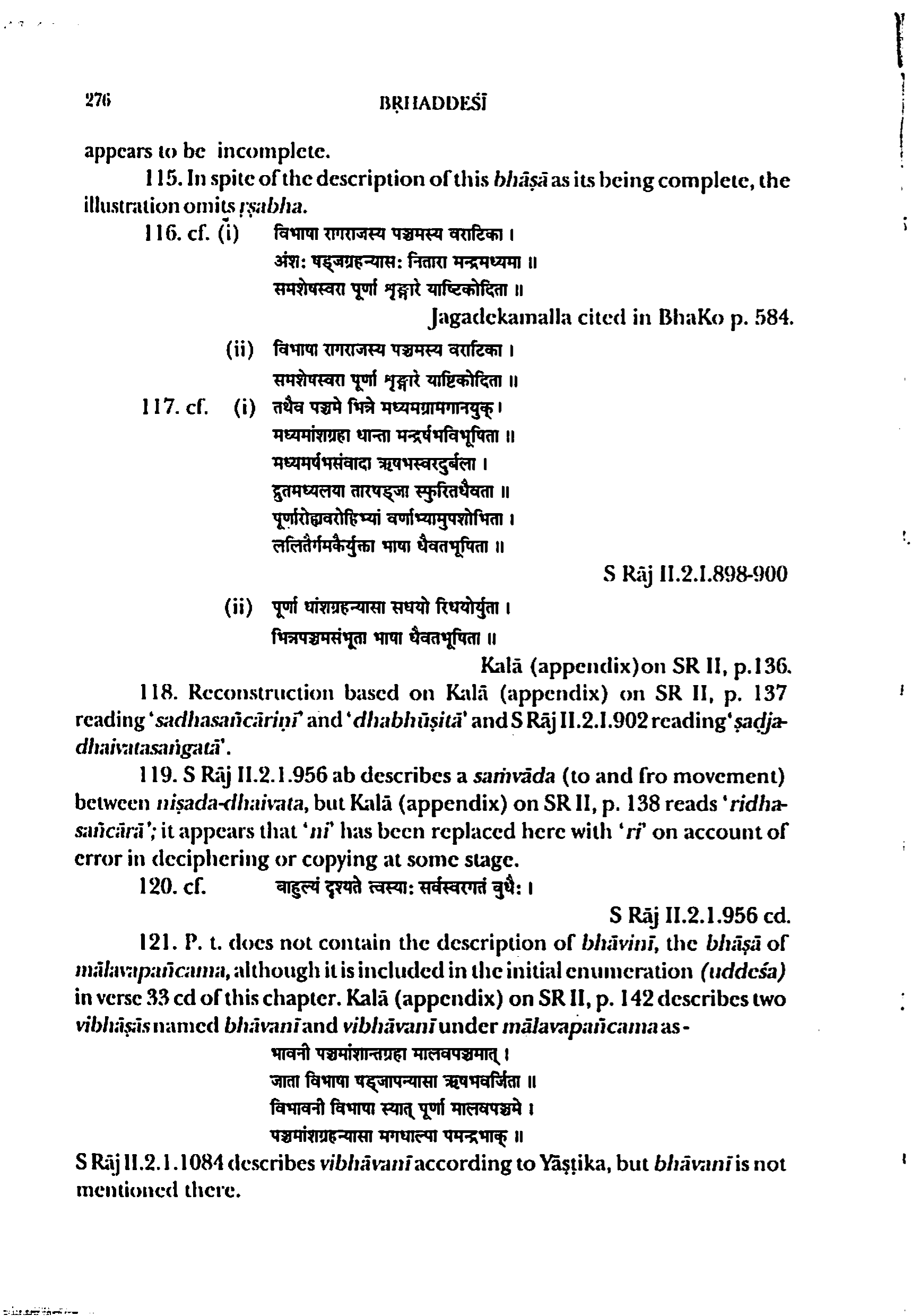
appears to be incomplete. 115. In spite of the description of this bhāṣā as its being complete, the illustration omits ṛṣabha. ì 116. cf. (i)
्विभाषा रागराजस्य पञ्चमस्य वराटिका ।
अंश: षड्जग्रहन्यास: नितारा मन्द्रमध्यमा ॥
समशेषस्वरा पूर्णा शृङ्गारे याष्टिकोदिता8
Jagadekamalla cited in BhaKo p. 584.
विभाषा रागराजस्य पञ्चमस्य वराटिका ।
(ii)
समशेषस्वरा पूर्णा शृङ्गारे याष्ट्रिकोदिता ॥
117. cf. (i) तथैव पञ्चमे भिन्ने मध्यमग्रामगानयुक्।
मध्यमांशग्रहा धान्ता मन्द्रर्षभविभूषिता ॥
मध्यमर्पभसंवादा ऋषभस्वरदुर्बला ।
द्रुतमध्यलया तारपङ्जा स्फुरितधैवता ॥
पूर्णारोह्मवरोहिभ्यां वर्णाभ्यामुपशोभिता ।
लिलतेर्गमकैर्युक्ता भाषा धैवतभूषिता ॥
S Rāj II.2.I.898-900
(ii) पूर्णा धांशग्रहन्यासा सधयो रिधयोर्युता ।
भित्रपञ्चमसंभूता भाषा धैवतभूषिता ॥
Kalā (appendix) on SR II, p.136. 118. Reconstruction based on Kalā (appendix) on SR II, p. 137 ŀ reading 'sadhasañcārini' and 'dhabhūṣitā' and S Rāj II.2.I.902 reading 'ṣadja- dhaivatasangatā'. 119. S Rāj II.2.1.956 ab describes a samvāda (to and fro movement) between niṣada-dhaivata, but Kalā (appendix) on SR II, p. 138 reads 'ridha- sañcārā'; it appears that 'ni' has been replaced here with 'ri' on account of error in deciphering or copying at some stage.
वाहुल्यं दृश्यते त्वस्या: सर्वस्वरगतं वृधै: ।
120. cf. S Rāj II.2.1.956 cd. 121. P. t. does not contain the description of bhāvinī, the bhāṣā of mālavapanīcama, although it is included in the initial enumeration (uddeša) in verse 33 cd of this chapter. Kalā (appendix) on SR II, p. 142 describes two vibhāṣās named bhāvanī and vibhāvanī under mālavapañcama as-4 भावनी पञ्चमांशान्तग्रहा मालवपञ्चमात् । जाता विभाषा षड्जापन्यासा ऋषभवर्जिता9 विभावनी विभाषा स्यात् पूर्णा मालवपञ्चमे
पञ्चमांशग्रहन्यासा मगधाल्पा पमन्द्रभाक्107
S Rāj II.2.1.1084 describes vibhāvanī according to Yāṣṭika, but bhāvanī is not ł mentioned there. Districted the fire
English — Sharma
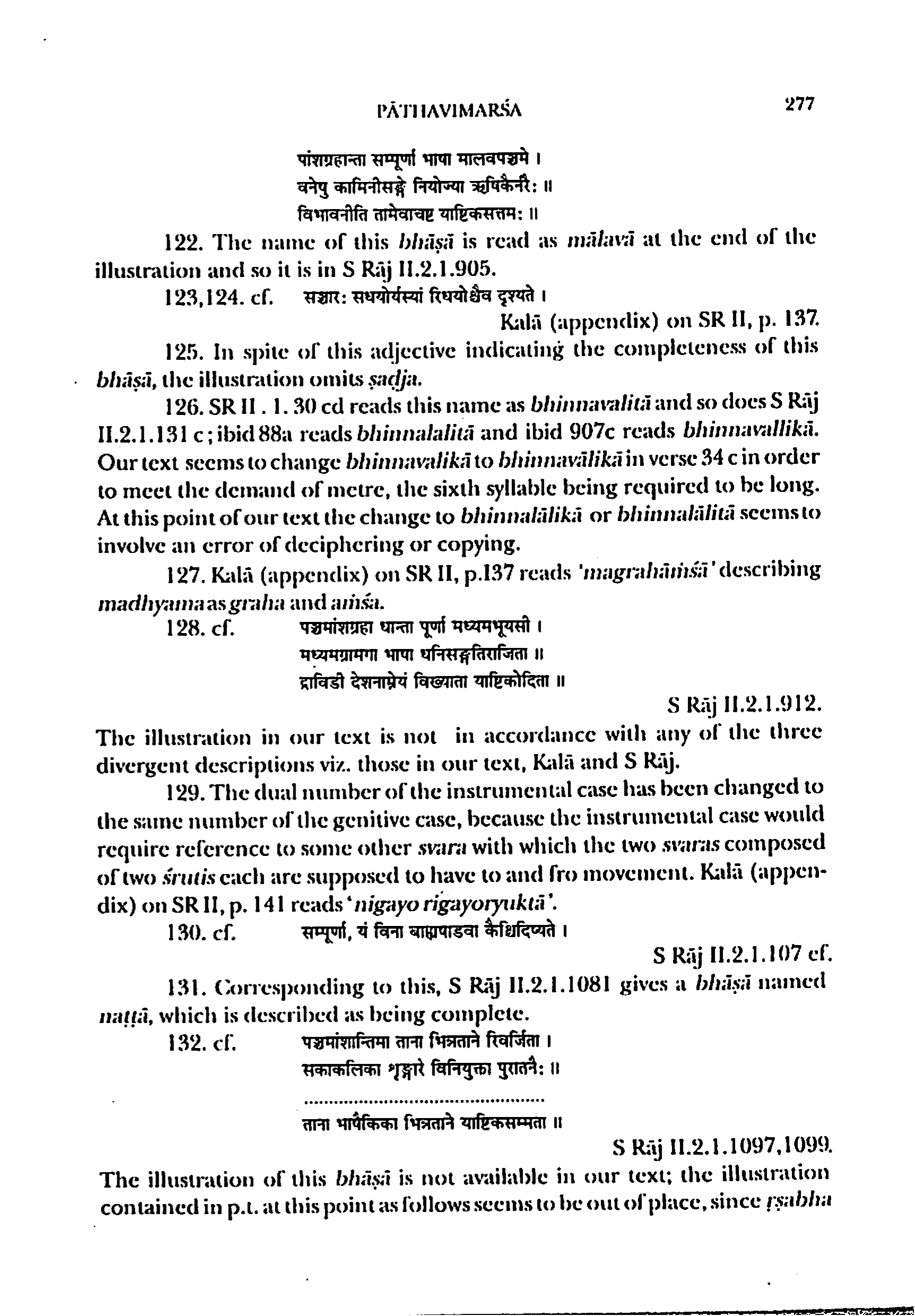
पांशग्रहान्ता सम्पूर्णा भाषा मालवपञ्चमे
वनेषु कामिनीसङ्गे नियोज्या ऋषिकैनरै:॥
विभावनीति तामेवाचष्ट याष्टिकसत्तमः॥
122. The name of this bhāṣā is read as mālavā at the end of the illustration and so it is in S Rāj II.2.1.905.
123,124. cf. सञ्चार: सधयोर्यस्यां रिधयोधैव दृश्यते ।
Kalā (appendix) on SR II, p. 137. 125. In spite of this adjective indicating the completeness of this bhāṣā, the illustration omits ṣaḍja. 126. SR II. 1. 30 cd reads this name as bhinnavalitā and so does S Rāj II.2.1.131 c; ibid 88a reads bhinnalalitā and ibid 907c reads bhinnavallikā5. Our text seems to change bhinnavalikā to bhinnavālikā in verse 34 c in order to meet the demand of metre, the sixth syllable being required to be long. At this point of our text the change to bhinnalālikā or bhinnalālitā seems to involve an error of deciphering or copying. 127. Kalā (appendix) on SR II, p.137 reads 'magrahāmśā' describing madhyama as graha and aṁśa.
128. cf. पञ्चमांशग्रहा धान्ता पूर्णा मध्यमभूयसी ।
मध्यमग्रामगा भाषा धनिसङ्गतिराजिता ॥
द्राविडी देशनाम्रेयं विख्याता याष्ट्रिकोदिता ॥
S Rāj II.2.1.912. The illustration in our text is not in accordance with any of the three divergent descriptions viz. those in our text, Kalā and S Rāj. 129. The dual number of the instrumental case has been changed to the same number of the genitive case, because the instrumental case would require reference to some other svara with which the two svaras composed of two śrutis each are supposed to have to and fro movement. Kalā (appen- dix) on SRII, p. 141 reads 'nigayo rigayoryuktā'.
्सम्पूर्णा, यं विना बाह्मपाडवा कैधिदिप्यते ।
130. cf. S Rāj II.2.1.107 cf. 131. Corresponding to this, S Rāj II.2.1.1081 gives a bhāṣā named națță, which is described as being complete.
पञ्चमांशान्तिमा ताना भिन्नताने रिवर्जिता ।
132. cf.
सकाकलिका शृङ्गारे विनियुक्ता पुरातनै: ॥
ताना भाषैकिका भिन्नताने याष्ट्रिकसम्मता ॥
S Rāj 11.2.1.1097,1099. The illustration of this bhāṣā is not available in our text; the illustration contained in p.t. at this point as follows seems to be out of place, since rşabha --------------------------------------
4.[citation] Kalā is an appendix commentary on S Rāj II that provides alternative descriptions of vibhāṣāsKalā (appendix) on SR II, p. 142 describes two vibhāṣās named bhāvanī and vibhāvanī under mālavapañcama as-
7.[enumeration] mālavapañcama has associated vibhāṣās including bhāvanī and vibhāvanīKalā (appendix) on SR II, p. 142 describes two vibhāṣās named bhāvanī and vibhāvanī under mālavapañcama as- भावनी पञ्चमांशान्तग्रहा मालवपञ्चमात् । ज?ाता विभाषा षड्ज?ापन्यासा ऋषभवर्ज?िता ॥ विभावनी विभाषा स्यात् पूर्णा मालवपञ्चमे । पञ्चमांशग्रहन्यासा मगधाल्पा पमन्द्रभाक्
8.[structural]vibhāṣā is a musical category with complete (samśeṣa) svara contentसमशेषस्वरा पूर्णा शृङ्गारे याष्टिकोदिता
9.[structural]bhāvanī is a vibhāṣā of mālavapañcama with pañcama as graha and śaḍja as nyāsa, lacking ṛṣabhaभावनी पञ्चमांशान्तग्रहा मालवपञ्चमात् । ज?ाता विभाषा षड्ज?ापन्यासा ऋषभवर्ज?िता
10.[structural]vibhāvanī is a complete vibhāṣā of mālavapañcama with pañcama as graha and nyāsa, described as magadhālapāविभावनी विभाषा स्यात् पूर्णा मालवपञ्चमे । पञ्चमांशग्रहन्यासा मगधाल्पा पमन्द्रभाक्
1.[attribution]S Rāj is a treatise that describes vibhāṣā varieties and their characteristicsS Rāj II.2.I.898-900
2.[attribution]Yāṣṭika is an authority cited for descriptions of vibhāṣāsS Rāj II.2.1.1084 describes vibhāvanī according to Yāṣṭika
3.[attribution]Jagadekamalla is cited as a source for vibhāṣā descriptions in the BhaKo treatiseJagadekamalla cited in BhaKo p. 584.
4.[citation]Kalā is an appendix commentary on S Rāj II that provides alternative descriptions of vibhāṣāsKalā (appendix) on SR II, p. 142 describes two vibhāṣās named bhāvanī and vibhāvanī under mālavapañcama
5.[citation]bhinnavalitā has variant textual readings across different manuscript sourcesSR II. 1. 30 cd reads this name as bhinnavalitā and so does S Rāj II.2.1.131 c; ibid 88a reads bhinnalalitā and ibid 907c reads bhinnavallikā
6.[definition]samvāda refers to to-and-fro movement between two svarasS Rāj II.2.I.956 describes a samvāda (to and fro movement) between niṣada-dhaivata
7.[enumeration]mālavapañcama has associated vibhāṣās including bhāvanī and vibhāvanīKalā (appendix) on SR II, p. 142 describes two vibhāṣās named bhāvanī and vibhāvanī under mālavapañcama
11.[structural]Some vibhāṣā descriptions in the primary text omit certain svaras despite being described as completeIn spite of the description of this bhāṣā as its being complete, the illustration omits ṛṣabha.