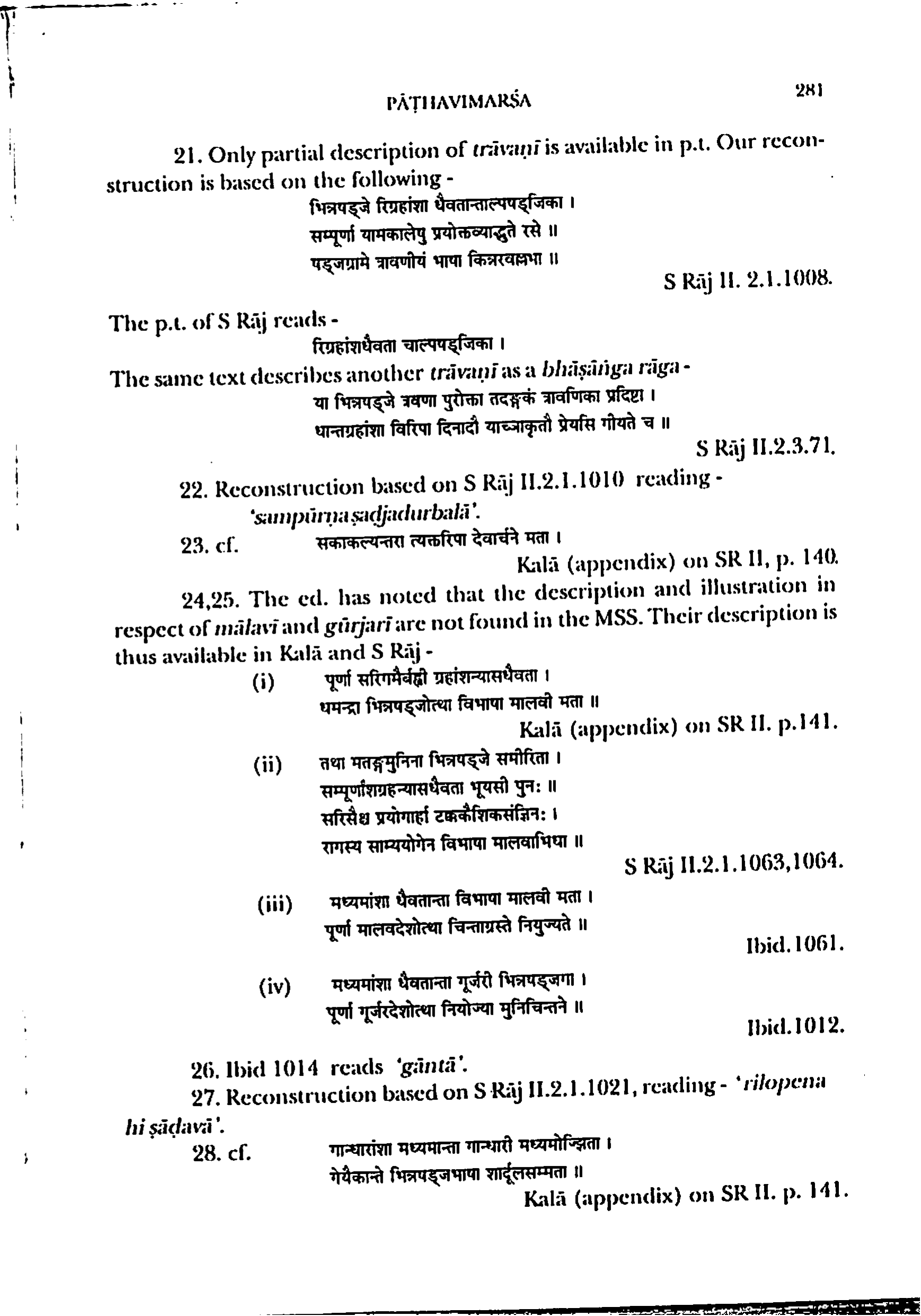
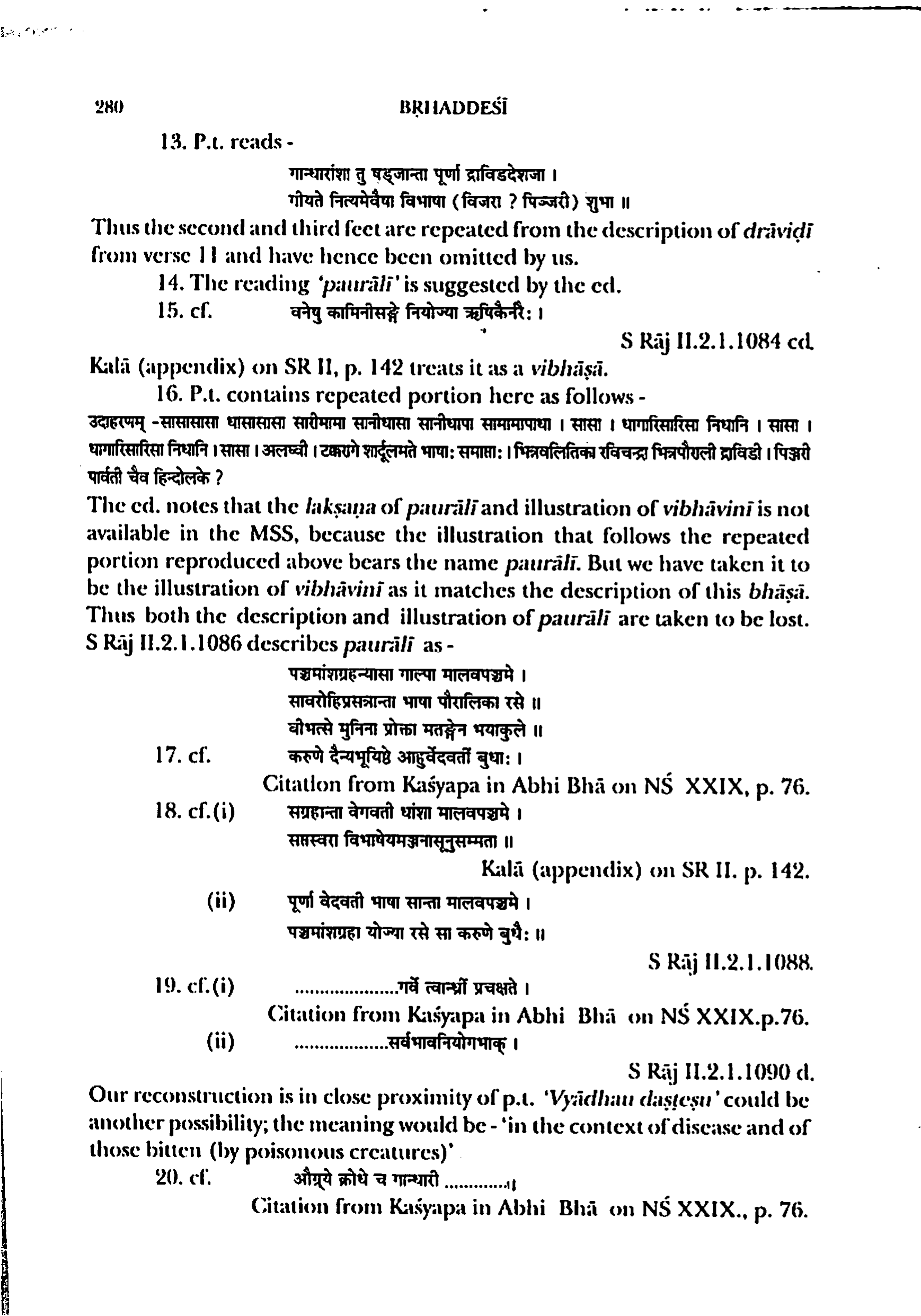
Source scans · vol_II_p149
recto · open full
scan recto
verso · open full
scan verso
Bṛhaddeśī · Volume II
pp. 280–281folio 149
Devanāgarī (Bṛhaddeśī)
San Carlotte Comment 13. P.t. reads - गान्धारांशा तु षड्जान्ता पूर्णा द्राविडदेशजा ।9
गीयते नित्यमेवैषा विभाषा (विजरा ? पिञ्जरी) शुभा ॥
Thus the second and third feet are repeated from the description of drāviḍī from verse 11 and have hence been omitted by us. 14. The reading 'paurālī' is suggested by the ed.
वनेषु कामिनीसङ्गे नियोज्या ऋषिकैनरै: ।
15. cf. S Rāj II.2.1.1084 cd. Kalā (appendix) on SR II, p. 142 treats it as a vibhāṣā. 16. P.t. contains repeated portion here as follows -
उदाहरणम् -सासासासा धासासासा सारीमामा सानीधासा सानीधापा सामामापाधा । सासा । धागारिसारिसा निधानि । सासा ।
धागारिसारिसा निधानि । सासा । अलघ्वी । टक्करागे शार्दूलमते भाषा: समाप्ता: । भित्रवलितिका रविचन्द्रा भित्रपौराली द्राविडी । पिञ्जरी पार्वती चैव हिन्दोलके ? The ed. notes that the lakṣaṇa of paurālī and illustration of vibhāvinī is not available in the MSS, because the illustration that follows the repeated portion reproduced above bears the name paurālī. But we have taken it to be the illustration of vibhāvinī as it matches the description of this bhāṣā. Thus both the description and illustration of paurālī are taken to be lost. S Rāj II.2.1.1086 describes paurālī as - पञ्चमांशग्रहन्यासा गाल्पा मालवपञ्चमे10
सावरोहिप्रसन्त्रान्ता भाषा पौरालिका रसे ॥
बीभत्से मुनिना प्रोक्ता मतङ्गेन भयाकुले ॥
करुणे दैन्यभूयिष्ठे आहुर्वेदवर्ती बुधा: ।
17. cf. Citation from Kaśyapa in Abhi Bhā on NŚ XXIX, p. 76.
सग्रहान्ता वेगवती धांशा मालवपञ्चमे
18. cf.(i)
सप्तस्वरा विभाषेयमञ्जनासून्सम्मता ॥
Kalā (appendix) on SR II. p. 142. (ii)
पूर्णा वेदवती भाषा सान्ता मालवपञ्चमे
पञ्चमांशग्रहा योज्या रसे सा करुणे बुधै: ॥
S Rāj II.2.1.1088.
.....गर्वे त्वान्ध्रॉ प्रचक्षते ।
19. cf.(i) Citation from Kaśyapa in Abhi Bhā on NŚ XXIX.p.76. (ii)
.....सर्वभावनियोगभाक् ।
S Rāj 11.2.1.1090 d. Our reconstruction is in close proximity of p.t. 'Vyādhau daṣṭeṣu' could be another possibility; the meaning would be - 'in the context of disease and of those bitten (by poisonous creatures)* 20. cf. औप्र्वे क्रोधे च गान्धारी .....ा Citation from Kasyapa in Abhi Bhā on NŚ XXIX., p. 76.
English — Sharma
PĀŢĦAVIMARŚA 21. Only partial description of trāvaņī is available in p.t.3 Our recon- struction is based on the following -
भित्रपड्ज? रिग्रहांशा धैवतान्ताल्पपड्ज?िका ।
सम्पूर्णा यामकालेषु प्रयोक्तव्याद्धते रसे ॥
पड्जग्रामे त्रावणीयं भाषा कित्ररवक्षभा ॥
S Rāj II. 2.1.1008. The p.t. of S Rāj reads -
रिग्रहांशधैवता चाल्पपड्ज?िका ।
The same text describes another trāvaņī as a bhāṣāṅga rāga-8
या भित्रपड्ज? त्रवणा पुरोक्ता तदङ्गकं त्रावणिका प्रदिष्टा ।
धान्तग्रहांशा विरिपा दिनादी याच्ञाकृती प्रेयसि गीयते च ॥
S Rāj II.2.3.71. 22. Reconstruction based on S Rāj II.2.1.1010 reading - ʻsampūrņa şadjadurbalāʼ.
सकाकल्यन्तरा त्यक्तरिपा देवार्चने मता ।
23. cf. Kalā (appendix) on SR II, p. 140. 24,25. The ed. has noted that the description and illustration in respect of mālavī and gūrjarī are not found in the MSS.4 Their description is thus available in Kalā and S Rāj -
पूर्णा सरिगमैबंह्री ग्रहांशन्यासधैवता ।
(i)
धमन्द्रा भिन्नपङ्ज?ोत्था विभाषा मालवी मता ॥
Kalā (appendix) on SR II. p.141.
तथा मतङ्गमुनिना भित्रयङ्ज? समीरिता ।
(ii)
सम्पूर्णाशग्रहन्यासधैवता भूयसी पुनः॥
सरिसैध प्रयोगाहा टक्ककैशिकसंज?्ञिनः।
रागस्य साम्ययोगेन विभाषा मालवाभिधा ॥
ŧ S Rāj II.2.1.1063,1064.
मध्यमांशा धैवतान्ता विभाषा मालवी मता ।
(iii)
पूर्णा मालवदेशोत्था चिन्ताग्रस्ते नियुज?्यते ॥
Ibid. 1061.
मध्यमांशा धैवतान्ता गूर्जरी भित्रयङ्जगा ।
(iv)
पूर्णा गूर्जरदेशोत्था नियोज?्या मुनिचिन्तने ॥
Ibid. 1012. 26. Ibid 1014 reads 'gāntā'. 27. Reconstruction based on S Rāj II.2.1.1021, reading - 'rilopena hi şāḍavā’.
गान्धारांशा मध्यमान्ता गान्धारी मध्यमोज?्झिता ।
28. cf.
गेयैकान्ते भित्रपङ्जभाषा शार्दूलसम्मता ॥
Kalā (appendix) on SR II. p. 141. and the second second second second second second second second second second second second second second second second second second second second second second second second second second second second second second seco . . . . . . . . . . . . . . . .
9.[structural]drāviḍī is a regional mode originating from the Dravida regionगान्धारांशा तु षड्ज?ान्ता पूर्णा द्राविडदेशजा ।
10.[structural]paurālī is characterized by pancham-amsha graha and nyasa, with gandhar endingपञ्चमांशग्रहन्यासा गाल्पा मालवपञ्चमे
11.[structural]trāvaņī has bhittra-pañja graha-amsha and dhaivatanta characteristicsभित्रपड्ज? रिग्रहांशा धैवतान्ताल्पपड्ज?िका ।
12.[structural]mālavī is characterized by madhyama-amsha, dhaivatanta, and originates from Malava regionमध्यमांशा धैवतान्ता विभाषा मालवी मता । पूर्णा मालवदेशोत्था
13.[structural]gūrjarī is characterized by madhyama-amsha, dhaivatanta, and originates from Gurjara regionमध्यमांशा धैवतान्ता गूर्जरी भित्रयङ्जगा । पूर्णा गूर्जरदेशोत्था
1.[attribution]Kaśyapa is cited as an authority on musical modes in the Abhinavagupta commentary on NatyasastraCitation from Kaśyapa in Abhi Bhā on NŚ XXIX, p. 76.
2.[citation]Both the description and illustration of paurālī are taken to be lost in the manuscriptsThus both the description and illustration of paurālī are taken to be lost.
3.[citation]Only partial description of trāvaņī is available in the manuscriptOnly partial description of trāvaņī is available in p.t.
4.[citation]Description and illustration of mālavī are not found in the manuscriptsThe ed. has noted that the description and illustration in respect of mālavī and gūrjarī are not found in the MSS.
5.[citation]S Rāj is a musical treatise that provides descriptions of bhāṣā modes and their characteristicsS Rāj II.2.1.1084 cd.
6.[citation]Kalā is an appendix to a musical text that provides supplementary descriptions of bhāṣā modesKalā (appendix) on SR II, p. 142 treats it as a vibhāṣā.
7.[definition]vibhāṣā is a category of musical modes with specific characteristicsKalā (appendix) on SR II, p. 142 treats it as a vibhāṣā.
8.[relation]bhāṣāṅga refers to modes that are components or aspects of bhāṣāThe same text describes another trāvaņī as a bhāṣāṅga rāga-