Source scans · vol_II_p156
recto · open full
scan recto
verso · open full
scan verso
Bṛhaddeśī · Volume II
pp. 294–295folio 156
Bṛhaddeśī
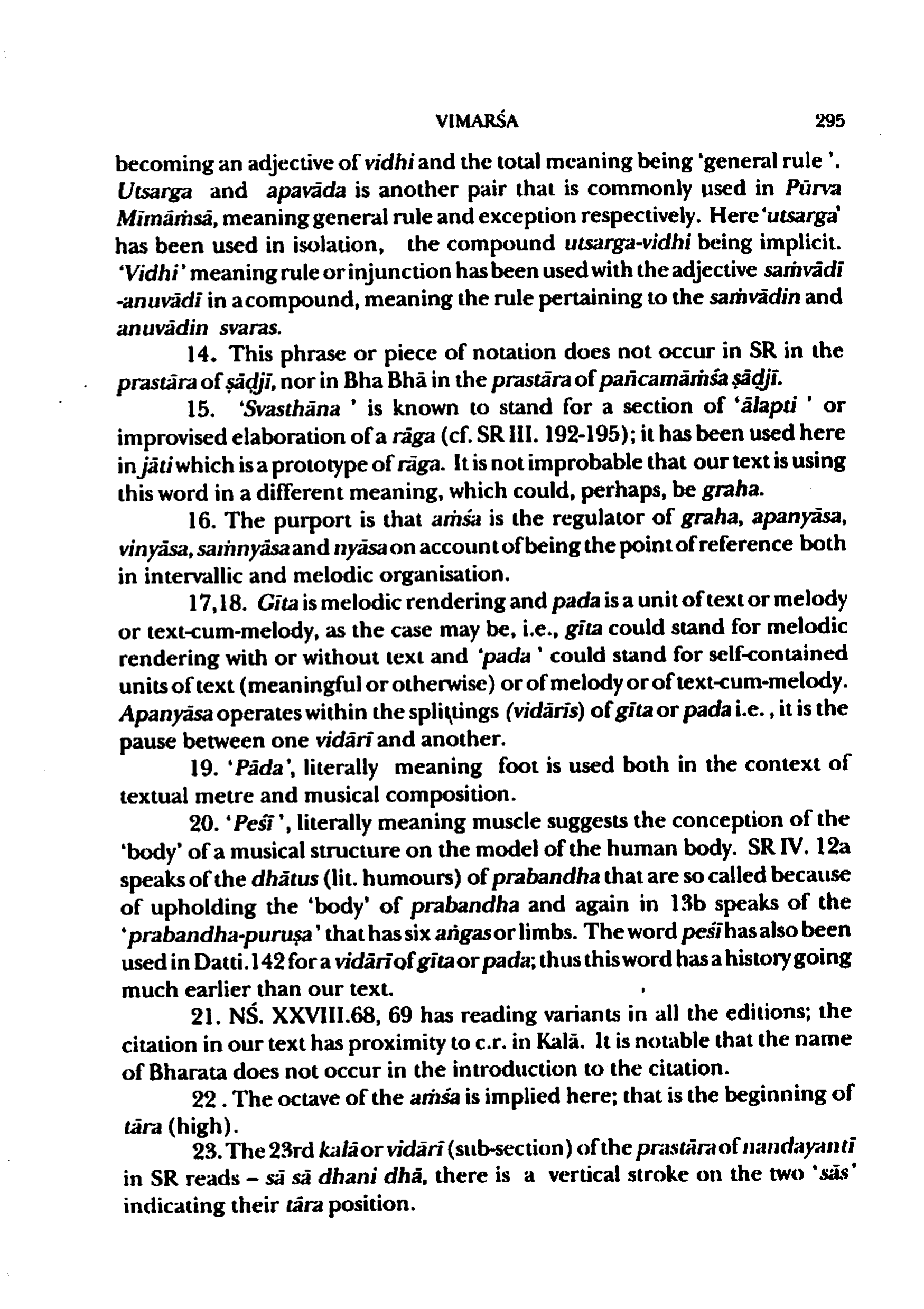
svara which has lent its name to the jāti concerned, out of the amsas prescribed in the same, change of graha, violation of the complete state i.e. formation of hexatonic and pentatonic varieties and change in apanyāsa - these are the possibilities of the vikṛtā state of seven jātis, but the nyāsa is never altered. 5. The statement that śuddhā jātis are twofold viz. śuddhā and vikṛtā, seems to be confusing on the face of it. Really speaking, the first śuddhā stands here for the jātis that derive their name from svaras, referred to as svarākhyā in Anu.115 above and as svarajāti in NŚ XXVIII, p. 37 (prose portion). The reference to these jātis as śuddhā is based on NS XXVIII. 46 cited immediately after Anu.117. 6. 'Samsarga' has been rendered as blending. SR 1.7.8 clearly states that the blending takes place among the vikṛtā forms of the seven jātis. 7. The purport seems to be that the act of blending itself involves a violation of 'purity' or original form. Moreover, the blending is effected among only vikṛtā forms of jātis. 8. 'Samūha' has been rendered as organised grouping, because the melodic 'group' or samūha is not a random or unplanned formation. 9. The statement that "the experience of rasa is born of jātis or begins with them " is significant. Jāti is the first culmination of the process of melodic abstraction i.e. is the first formulation of melodic organisation, configuration or crystallization; grāma and mūrchanā are only scalic formulations. Hence rasa could be related only to jāti; scale or intervallic organisation merely provides the raw material for melody and emotive content could not be related to bare scalic organisation. The further culmination of melodic organisation is rāga, but jāti is definitely the first formulation based on melodic abstraction. 10. Vādin pertains to intervallic organisation and aṁśa to melodic structuring i.e. the svara that is the point of reference for establishing the samvāda- anuvāda-vivāda relationship among the svaras of a scale is vādin and the same svara (vādin) is known as amsa when it discharges the function of being the point of reference in melodic organisation culminating in jāti and rāga. 11. Aṁśa is said to be the progenitor of rāga or delight/colour, because it is fundamental in melodic organisation and because the latter alone brings in the element of specificity of delight or 'colour' in svaras, unorganised svaras as single entities cannot give delight. 12,13. Utsarga and vidhi are terms of the Pūrva Mimāmsā system of philosophy; they are generally used in a compound as utsarga-vidhi, 'utsarga'
Vimarśa
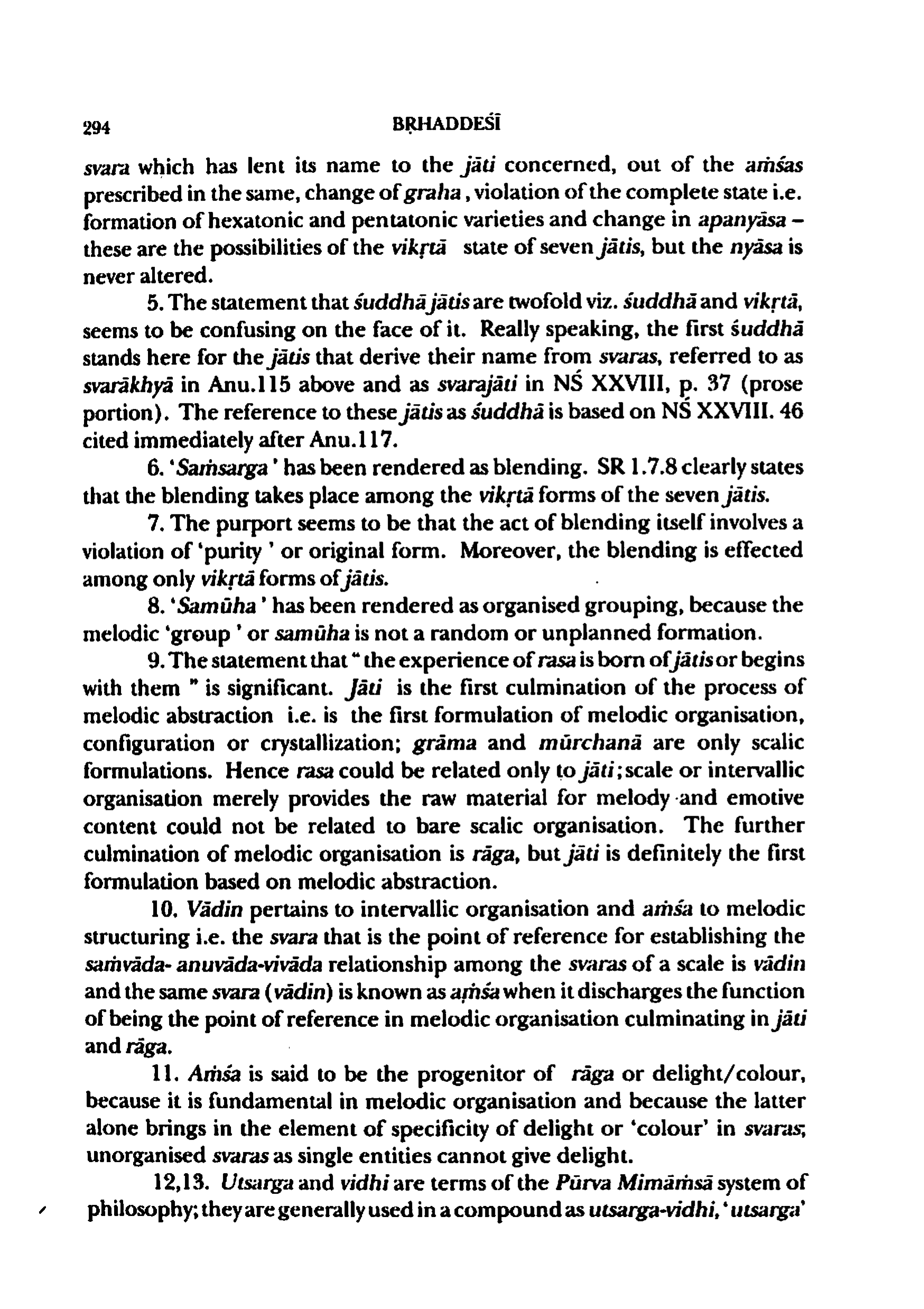
becoming an adjective of vidhi and the total meaning being 'general rule'. Utsarga and apavāda is another pair that is commonly used in Pūrva Mīmāmsā, meaning general rule and exception respectively7. Here 'utsarga' has been used in isolation, the compound utsarga-vidhi being implicit. 'Vidhi' meaning rule or injunction has been used with the adjective samvādī -anuvādī in a compound, meaning the rule pertaining to the samvādin and anuvādin svaras. 14. This phrase or piece of notation does not occur in SR in the prastāra of ṣāḍjī, nor in Bha Bhā in the prastāra of pancamāmśa ṣāḍjī. 15. 'Svasthāna' is known to stand for a section of 'ālapti' or improvised elaboration of a rāga (cf. SR III. 192-195); it has been used here in jāti which is a prototype of rāga. It is not improbable that our text is using this word in a different meaning, which could, perhaps, be graha. 16. The purport is that amsa is the regulator of graha, apanyasa, vinyāsa, samnyāsa and nyāsa on account of being the point of reference both in intervallic and melodic organisation. 17,18. Gīta is melodic rendering and pada is a unit of text or melody or text-cum-melody, as the case may be, i.e., gīta could stand for melodic rendering with or without text and 'pada' could stand for self-contained units of text (meaningful or otherwise) or of melody or of text-cum-melody. Apanyāsa operates within the splittings (vidārīs) of gīta or pada i.e., it is the pause between one vidārī and another. 19. 'Pāda', literally meaning foot is used both in the context of textual metre and musical composition. 20. 'Peśī', literally meaning muscle suggests the conception of the 'body' of a musical structure on the model of the human body. SR IV. 12a speaks of the dhātus (lit. humours) of prabandha that are so called because of upholding the 'body' of prabandha and again in 13b speaks of the 'prabandha-puruşa' that has six angas or limbs. The word peśī has also been used in Datti. 142 for a vidārī of gīta or pada; thus this word has a history going much earlier than our text. 21. NS. XXVIII.68, 69 has reading variants in all the editions; the citation in our text has proximity to c.r. in Kalā. It is notable that the name of Bharata does not occur in the introduction to the citation. 22. The octave of the amsa is implied here; that is the beginning of tāra (high). 23. The 23rd kalā or vidārī (sub-section) of the prastāra of nandayantī in SR reads - sā sā dhani dhā, there is a vertical stroke on the two 'sās' indicating their tara position.
1.[attribution]Dhātus of prabandha are so called because of upholding the 'body' of prabandhaSR IV. 12a speaks of the dhātus (lit. humours) of prabandha that are so called because of upholding the 'body' of prabandha
2.[attribution]Pūrva Mīmāṃsā is a philosophical system that employs the terms utsarga-vidhi and apavādaUtsarga and vidhi are terms of the Pūrva Mimāmsā system of philosophy
3.[citation]Pancamāmśa ṣāḍjī is a prastāra mentioned in Bhārata's treatisenor in Bha Bhā in the prastāra of pancamāmśa ṣāḍjī
4.[citation]Bha Bhā is a treatise that contains a prastāra of pancamāmśa ṣāḍjīnor in Bha Bhā in the prastāra of pancamāmśa ṣāḍjī
5.[definition]Svarākhyā refers to jātis that derive their name from svarasthe first śuddhā stands here for the jātis that derive their name from svaras, referred to as svarākhyā in Anu.115
6.[definition]Svarajāti is another term for jātis that derive their name from svarasreferred to as svarākhyā in Anu.115 above and as svarajāti in NŚ XXVIII, p. 37 (prose portion)
7.[definition]Apavāda is paired with utsarga in Pūrva Mīmāṃsā philosophy and means 'exception'Utsarga and apavāda is another pair that is commonly used in Pūrva Mīmāmsā, meaning general rule and exception respectively
8.[definition]Vidārī is a sub-section or splitting of gīta or padaApanyāsa operates within the splittings (vidārīs) of gīta or pada i.e., it is the pause between one vidārī and another
9.[definition]Peśī literally means muscle and suggests the conception of the body of a musical structure on the model of the human body'Peśī', literally meaning muscle suggests the conception of the 'body' of a musical structure on the model of the human body
10.[definition]Utsarga-vidhi is a compound term from Pūrva Mīmāṃsā meaning 'general rule'Utsarga and vidhi are terms of the Pūrva Mimāmsā system of philosophy; they are generally used in a compound as utsarga-vidhi, 'utsarga' becoming an adjective of vidhi and the total meaning being 'general rule'
11.[relation]Samvāda-anuvāda-vivāda relationship is established among svaras of a scale by the vādinthe svara that is the point of reference for establishing the samvāda- anuvāda-vivāda relationship among the svaras of a scale is vādin
12.[relation]Vinyāsa is regulated by amsa as a point of reference in melodic organisationamsa is the regulator of graha, apanyasa, vinyāsa, samnyāsa and nyāsa on account of being the point of reference both in intervallic and melodic organisation
13.[relation]Samnyāsa is regulated by amsa as a point of reference in melodic organisationamsa is the regulator of graha, apanyasa, vinyāsa, samnyāsa and nyāsa on account of being the point of reference both in intervallic and melodic organisation
14.[structural]Nandayantī is a prastāra in Saṅgīta Ratnākara with at least 23 kalās or vidārīsThe 23rd kalā or vidārī (sub-section) of the prastāra of nandayantī in SR reads - sā sā dhani dhā
15.[structural]Prabandha-puruşa is a concept in Saṅgīta Ratnākara that has six aṅgas or limbsSR IV. 13b speaks of the 'prabandha-puruşa' that has six angas or limbs