Source scans · vol_II_p158
recto · open full
scan recto
verso · open full
scan verso
Bṛhaddeśī · Volume II
pp. 298–299folio 158
Bṛhaddeśī
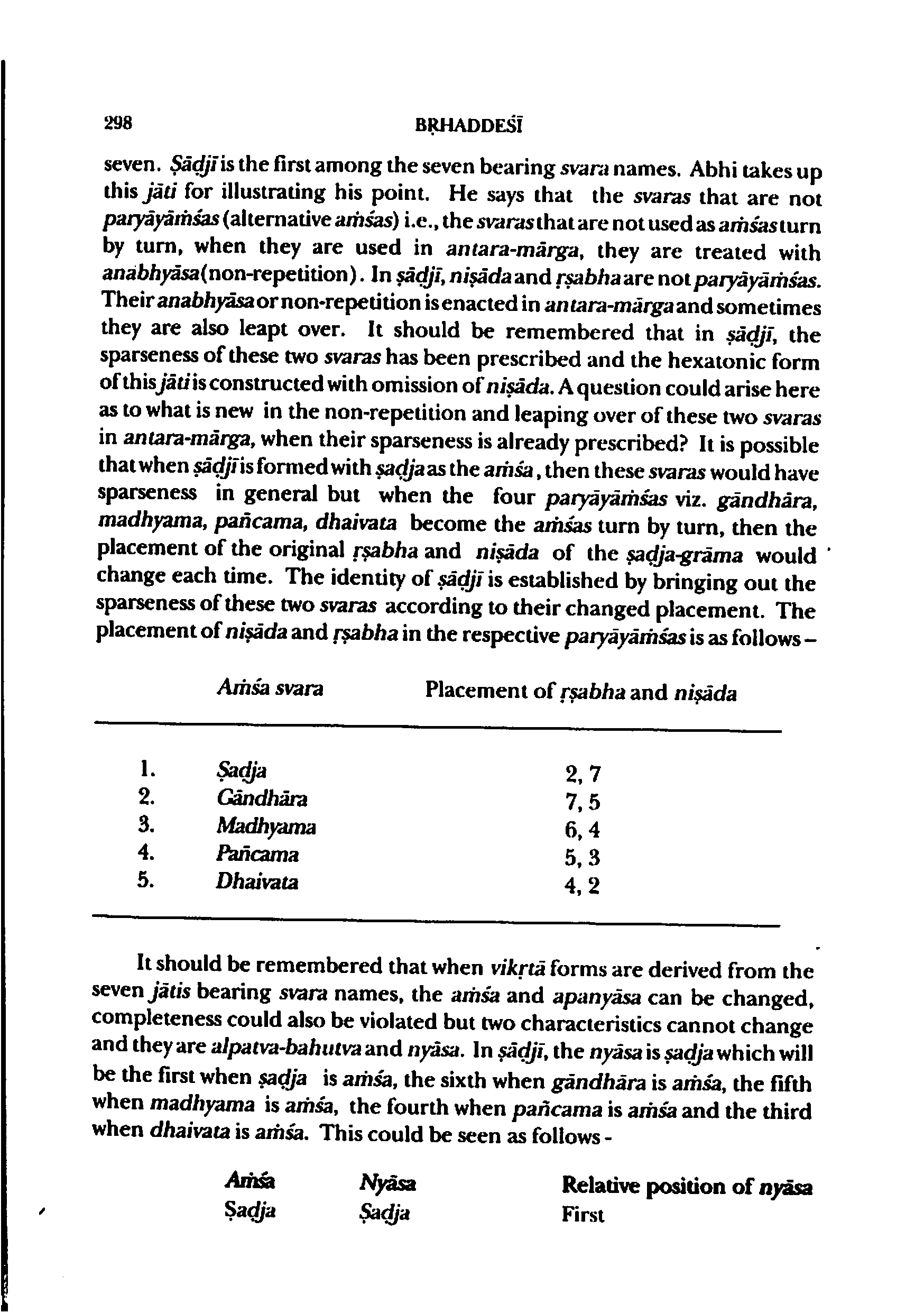
seven. Ṣādjī is the first among the seven bearing svara names. Abhi takes up this jāti for illustrating his point. He says that the svaras that are not paryāyāmsas (alternative amsas) i.e., the svaras that are not used as amsas turn by turn, when they are used in antara-marga, they are treated with anabhyāsa(non-repetition). In ṣādjī, niṣāda and ṛṣabha are not paryāyāmsas. Their anabhyāsa or non-repetition is enacted in antara-mārga and sometimes they are also leapt over. It should be remembered that in sādjī, the sparseness of these two svaras has been prescribed and the hexatonic form of this jāti is constructed with omission of niṣāda. A question could arise here as to what is new in the non-repetition and leaping over of these two svaras in antara-mārga, when their sparseness is already prescribed? It is possible that when ṣādjī is formed with ṣaḍja as the amsa, then these svaras would have
table
Placement of ṛṣabha and niṣāda in respective paryāyāṃśas of ṣāḍjī jāti — Brhaddesi p.298 — after discussion of antara-mārga, anabhyāsa, and sparseness of ṛṣabha/niṣāda; table introduced by 'The placement of niṣāda and ṛṣabha in the respective paryāyāṃśas is as follows —'
#Aṃśa svaraPlacement of ṛṣabha and niṣāda
1.Ṣaḍja2, 7
2.Gāndhāra7, 5
3.Madhyama6, 4
4.Pañcama5, 3
5.Dhaivata4, 2
— Aṃśa svara / Placement of ṛṣabha and niṣāda
placement of the original ṛṣabha and niṣāda of the ṣaḍja-grāma would change each time. The identity of sadjī is established by bringing out the sparseness of these two svaras according to their changed placement. The placement of niṣāda and ṛṣabha in the respective paryāyāṁśas is as follows -
It should be remembered that when vikṛtā forms are derived from the seven jātis bearing svara names, the aṁśa and apanyāsa can be changed, completeness could also be violated but two characteristics cannot change and they are alpatva-bahutva and nyāsa. In ṣāḍjī, the nyāsa is ṣaḍja which will be the first when sadja is amsa, the sixth when gandhara is amsa, the fifth when madhyama is amsa, the fourth when pañcama is amsa and the third
Vimarśa
table
amsa-svara correspondences (which svara becomes amsa and its position relative to sadja) — Top of page 299 (Vimarsa). Continuation of a list showing svaras that can serve as amsa with sadja as reference; positions below sadja indicated.
svara (amsa)reference svaraposition
GandharaSadjaSixth or third below
MadhyamaSadjaFifth or fourth below
PancamaSadjaFourth or fifth below
DhaivataSadjaThird or sixth below
— ?
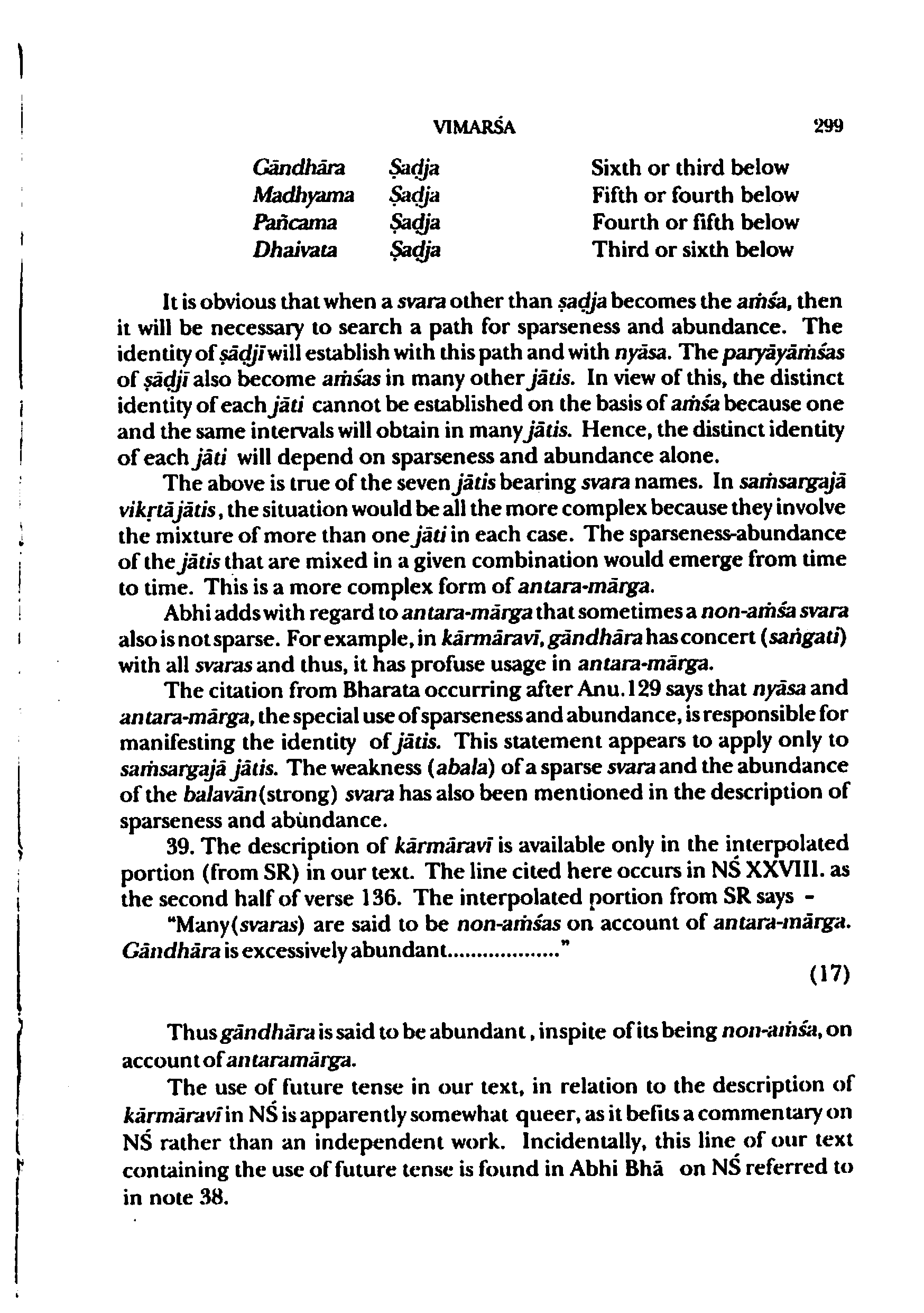
It is obvious that when a svara other than sadja becomes the amsa, then it will be necessary to search a path for sparseness and abundance. The identity of sadjī will establish with this path and with nyasa. The paryayamsas of ṣāḍjī also become amsás in many other jātis. In view of this, the distinct identity of each jāti cannot be established on the basis of amśa because one and the same intervals will obtain in many jātis. Hence, the distinct identity of each jāti will depend on sparseness and abundance alone.12 The above is true of the seven jātis bearing svara names. In samsargajā vikṛtā jātis, the situation would be all the more complex because they involve the mixture of more than one jāti in each case.4 The sparseness-abundance of the jātis that are mixed in a given combination would emerge from time to time. This is a more complex form of antara-mārga. Abhi adds with regard to antara-mārga that sometimes a non-amśa svara also is not sparse. For example, in kārmāravī, gāndhāra has concert (sangati) with all svaras5 and thus, it has profuse usage in antara-mārga.10 The citation from Bharata occurring after Anu. 129 says that nyāsa and antara-mārga, the special use of sparseness and abundance, is responsible for manifesting the identity of jātis.1 This statement appears to apply only to samsargajā jātis. The weakness (abala) of a sparse svara and the abundance of the balavan(strong) svara11 has also been mentioned in the description of sparseness and abundance. 39. The description of kārmāravī is available only in the interpolated portion (from SR) in our text. The line cited here occurs in NS XXVIII. as the second half of verse 136. The interpolated portion from SR says - "Many(svaras) are said to be non-amsas on account of antara-marga. Gāndhāra is excessively abundant......
(17)
Thus gāndhāra is said to be abundant, inspite of its being non-amśa, on account of antaramārga. The use of future tense in our text, in relation to the description of kārmāravī in NS is apparently somewhat queer, as it befits a commentary on NS rather than an independent work. Incidentally, this line of our text containing the use of future tense is found in Abhi Bhā on NŚ referred to in note 38.
1.[citation]Bharata is cited as a source authority regarding the role of nyāsa and antara-marga in manifesting jāti identityThe citation from Bharata occurring after Anu. 129 says that nyāsa and antara-mārga, the special use of sparseness and abundance, is responsible for manifesting the identity of jātis.
2.[definition]Paryāyāmsas are alternative amsas that are used turn by turn in the structure of jātisthe svaras that are not paryāyāmsas (alternative amsas) i.e., the svaras that are not used as amsas turn by turn
3.[definition]Antara-marga is a melodic pathway where non-repetition and leaping over of svaras is enactedwhen they are used in antara-marga, they are treated with anabhyāsa(non-repetition)
4.[definition]Samsargajā vikṛtā jātis involve the mixture of more than one jāti in each case and exhibit complex antara-marga patternsIn samsargajā vikṛtā jātis, the situation would be all the more complex because they involve the mixture of more than one jāti in each case.
5.[definition]Sangati refers to a relationship or concordance between a svara and other svaras in the melodic frameworkgāndhāra has concert (sangati) with all svaras
6.[structural]In ṣādjī, niṣāda and ṛṣabha are not paryāyāmsas and show sparsenessIn ṣādjī, niṣāda and ṛṣabha are not paryāyāmsas. Their anabhyāsa or non-repetition is enacted in antara-mārga
7.[structural]In vikṛtā forms derived from the seven jātis, aṁśa and apanyāsa can be changed and completeness can be violated, but alpatva-bahutva and nyāsa cannot changewhen vikṛtā forms are derived from the seven jātis bearing svara names, the aṁśa and apanyāsa can be changed, completeness could also be violated but two characteristics cannot change and they are alpatva-bahutva and nyāsa.
8.[structural]Alpatva-bahutva (sparseness-abundance) is a characteristic that cannot change in vikṛtā forms and is essential to establishing jāti identitytwo characteristics cannot change and they are alpatva-bahutva and nyāsa
9.[structural]Nyāsa in ṣāḍjī is ṣaḍja, whose position changes based on which svara serves as the aṁśaIn ṣāḍjī, the nyāsa is ṣaḍja which will be the first when sadja is amsa, the sixth when gandhara is amsa, the fifth when madhyama is amsa, the fourth when pañcama is amsa and the third when dhaivata is aṁśa.
10.[structural]In kārmāravī, gāndhāra has sangati with all svaras and thus has profuse usage despite being a non-aṁśa svarain kārmāravī, gāndhāra has concert (sangati) with all svaras and thus, it has profuse usage in antara-mārga.
11.[structural]Balavan (strong svara) is contrasted with weak sparse svaras in describing sparseness and abundanceThe weakness (abala) of a sparse svara and the abundance of the balavan(strong) svara
12.[structural]The distinct identity of each jāti depends on sparseness and abundance rather than on aṁśa aloneHence, the distinct identity of each jāti will depend on sparseness and abundance alone.