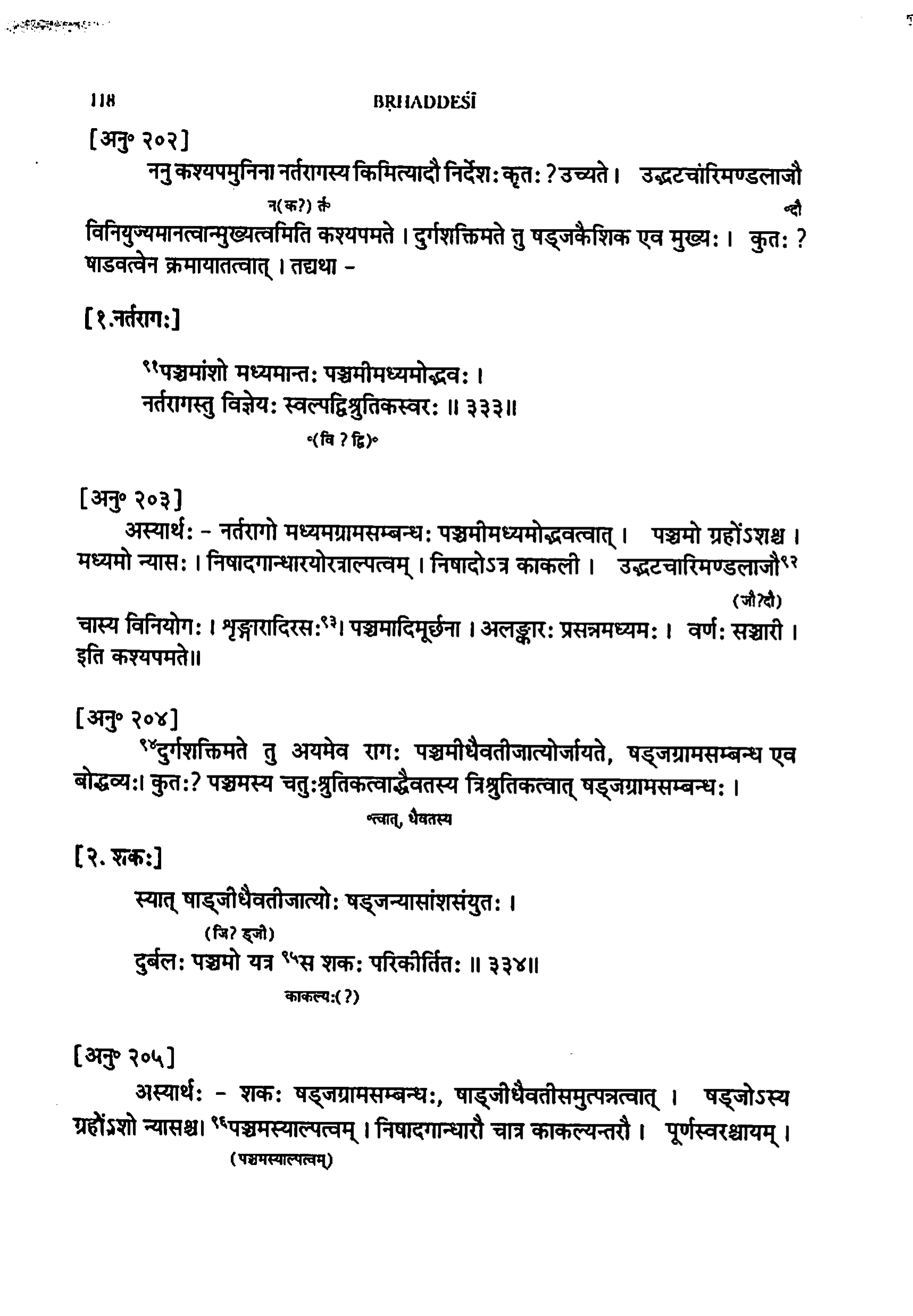
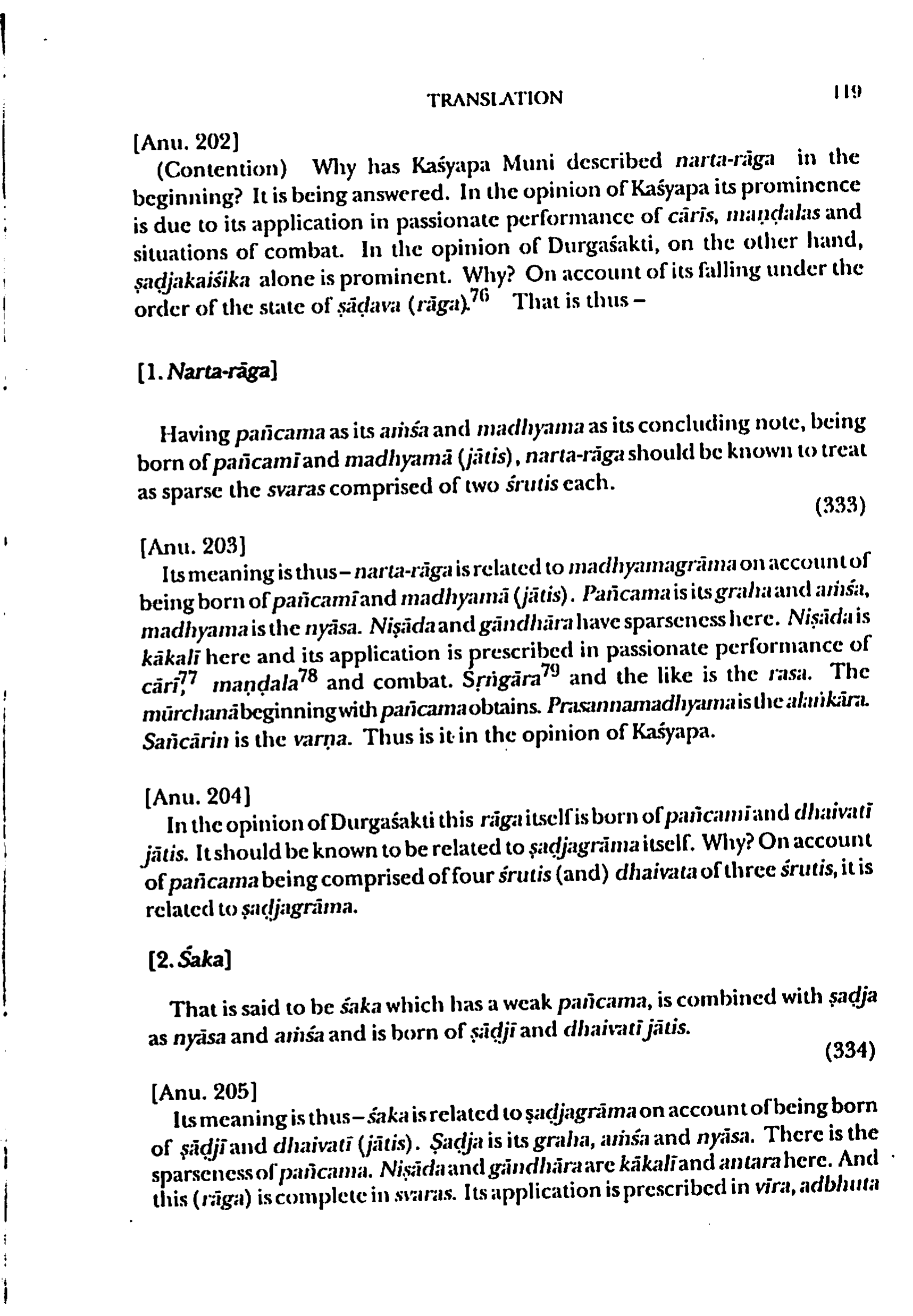
[Anu. 202]
(Contention) Why has
Kasyapa Muni described
narta-rāga in the
beginning? It is being answered.
In the opinion of Kasyapa its prominence
is due to its application in passionate performance of caris, mandalas and
situations of combat.1 In the opinion of Durgaśakti, on the other hand,
sadjakaisika alone is prominent.3 Why? On account of its falling under the
order of the state of sādava (rāga).476 That is thus -
Having
pañcama as its amśa and
madhyama as its concluding note, being
born of
pañcamī and
madhyamā (jātis),
narta-rāga should be known to treat
as sparse the svaras comprised of two śrutis each.
(333)
[Anu. 203]
Its meaning is thus -
narta-rāga is related to madhyamagrāma on account of
being born of pañcamî and madhyamā (jātis).87 Pañcama is its graha and aniśa,
madhyama is the nyāsa. Niṣāda and
gāndhāra have sparseness here. Niṣāda is
kākalī here and its application is prescribed in passionate performance of cārī, maṇḍala and combat. Sṛṅgāra and the like is the rasa.
The
mūrchanā beginning with pañcama obtains.14 Prasannamadhyama is the
alankāra.
Sañcārin is the varņa.9 Thus is it in the opinion of
Kaśyapa.
[Anu. 204]
In the opinion of Durgaśakti this rāga itself is born of pañcamī and dhaivatī
jātis. It should be known to be related to şadjagrāma itself.2 Why? On account
of
pañcama being comprised of four śrutis (and)
dhaivata of three śrutis, it is
related to
şadjagrāma.
[2. Saka]
That is said to be śaka which has a weak pañcama12, is combined with ṣaḍja
as nyāsa and aniśa and is born of
ṣāḍjī and dhaivatī jātis.
(334)
[Anu. 205]
Its meaning is thus -
śaka is related to şadjagrāma on account of being born
of ṣāḍjī and dhaivatī (jātis).6 Ṣaḍja is its graha, amśa and nyāsa. There is the
sparseness of
pañcama. Niṣāda and
gāndhāra are kākalī and antara here.
And
this (rāga) is complete in svaras.13 Its application is prescribed in vīra, adbhuta