Source scans · vol_II_p104
recto · open full
scan recto
verso · open full
scan verso
Bṛhaddeśī · Volume II
pp. 37–370folio 104
Devanāgarī
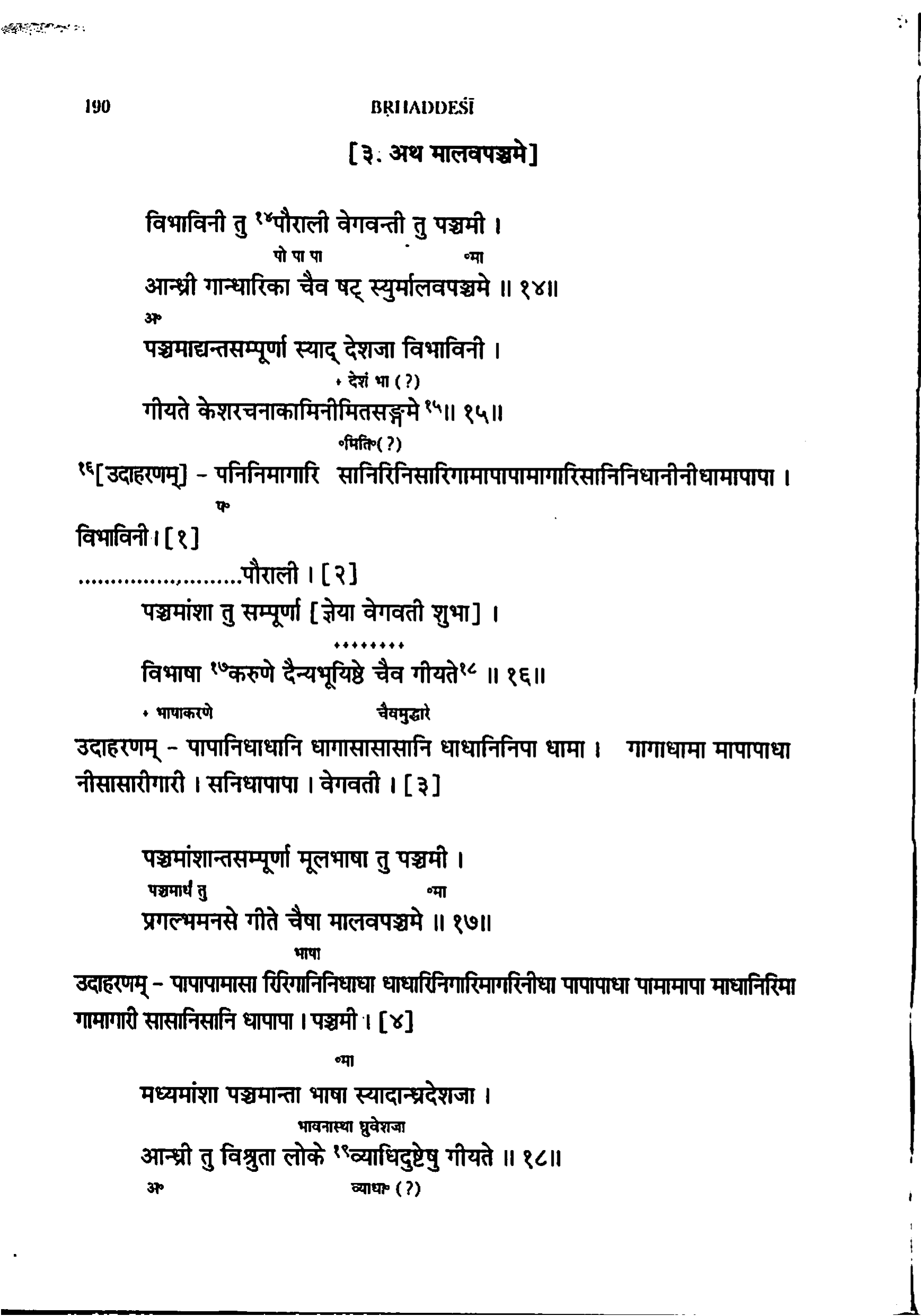
後継続(国際)できます。 [३. अथ मालवपञ्चमे]
विभाविनी तु १४पौरालीपो पा पा वेगवन्ती तु पञ्चमी ।
आन्ध्री गान्धारिका चैव षट् स्युर्मालवपञ्चमे ॥१४॥
पञ्चमाद्यन्तसम्पूर्णा स्याद् देशजा+ देशं भा (?) विभाविनी128
गीयते केशरचनाकामिनीमितसङ्गमे2॰िमति॰(?) १५॥१५॥
१६[उदाहरणम्] – पनिनिमागारि सानिरिनिसारिगामापापामागारिसानिनिधानीनीधामापापा ।
υo विभाविनी।[१] ..पौराली । [२]
पञ्चमांशा तु सम्पूर्णा139 [ज्ञेया वेगवती शुभा] ।
विभाषा+ भाषाकरणे १७करुणे दैन्यभूयिष्ठे चैवचैवमुद्धारे गीयते3 १८ ॥१६॥ उदाहरणम् - पापानिधाधानि धागासासासानि धाधानिनिपा धामा । गागाधामा मापापाधा नीसासारीगारी । सनिधापापा । वेगवती । [३]
पञ्चमांशान्तसम्पूर्णापञ्चमार्ध तु मूलभाषा तु पञ्चमी10
प्रगल्भमनसे गीते चैषा मालवपञ्चमे4 ॥१७॥ उदाहरणम् – पापापामासा रिरिगानिनिधाधा॰मा धाधारिनिगारिमागरिनीधा पापापाधा पामामापा माधानिरिमा गामागारी सासानिसानि धापापा । पञ्चमी । [४]
मध्यमांशा पञ्चमान्ता भाषा स्यादान्ध्रदेशजा11भावनास्था घ्रुवेशजा
आन्ध्री तु विश्रुता लोके5 १९व्याधिदुष्टेषुव्याधाः (?) गीयते6 ॥१८॥
English — Sharma (translation)
ŀ
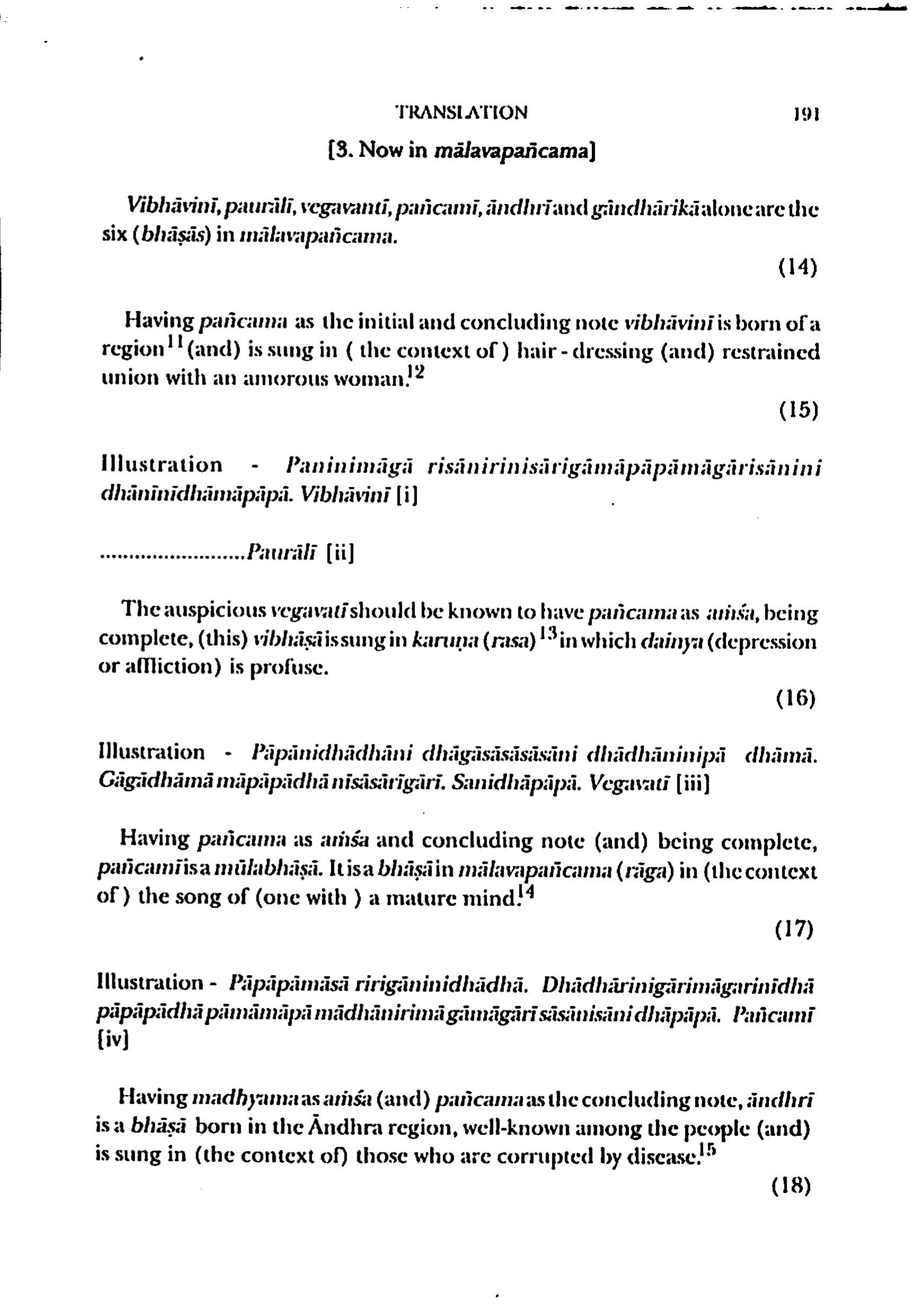
[3. Now in mālavapancama]
Vibhāvinī, paurālī, vegavantī, pañcamī, āndhrī and gāndhārikā alone are the six (bhāṣās) in mālavapañcama.1
(14)
Having pañcama as the initial and concluding note vibhāvinī is born of a region12811 (and) is sung in (the context of) hair - dressing (and) restrained union with an amorous woman.212
(15)
Illustration - Paninimāgā risānirinisārigāmāpāpāmāgārisānini dhānīnīdhāmāpāpā. Vibhāvinī [i] .....Paurālī [ii] The auspicious vegavatī should be known to have pañcama as amsa, being complete9, (this) vibhāṣā is sung in karuṇa (rasa)7 13 in which dainya (depression or affliction) is profuse.3
(16)
Illustration - Pāpānidhādhāni dhāgāsāsāsāsāni dhādhāninipā dhāmā. Gāgādhāmā māpāpādhā nīsāsārīgārī. Sanidhāpāpā. Vegavatī [iii] Having pañcama as amsa and concluding note (and) being complete, pañcamī is a mūlabhāṣā.10 It is a bhāṣā in mālavapañcama (rāga) in (the context of) the song of (one with) a mature mind.4 14
(17)
Illustration - Pāpāpāmāsā ririgāninidhādhā. Dhādhārinigārimāgarinīdhā pāpāpādhā pāmāmāpā mādhānirimā gāmāgārī sāsānisāni dhāpāpā. Pañcamī
[iv]
Having madhyama as amśa (and) pañcama as the concluding note, andhri is a bhāṣā born in the Āndhra region, well-known among the people5 (and) is sung in (the context of) those who are corrupted by disease.6 15
(18)
2.[relation] Vibhāvinī is sung in the context of hair-dressing and restrained union with an amorous womanगीयते केशरचनाकामिनीमितसङ्गमे
3.[relation] Vegavantī is sung in karuṇa rasa with profuse dainya (depression or affliction)विभाषा १७करुणे दैन्यभूयिष्ठे चैव गीयते
4.[relation] Pañcamī is a bhāṣā in mālavapañcama sung in the context of one with a mature mindप्रगल्भमनसे गीते चैषा मालवपञ्चमे
5.[relation] Āndhrī is born in the Āndhra region and is well-known among the peopleआन्ध्री तु विश्रुता लोके
6.[relation] Āndhrī is sung in the context of those who are corrupted by diseaseव्याधिदुष्टेषु गीयते
8.[structural] Vibhāvinī has pañcama as both initial and concluding note and is born of a regionपञ्चमाद्यन्तसम्पूर्णा स्याद् देशजा विभाविनी
9.[structural] Vegavantī has pañcama as amśa and is completeपञ्चमांशा तु सम्पूर्णा
10.[structural] Pañcamī is a mūlabhāṣā having pañcama as amśa and concluding note and being completeपञ्चमांशान्तसम्पूर्णा मूलभाषा तु पञ्चमी
11.[structural] Āndhrī is a bhāṣā with madhyama as amśa and pañcama as concluding noteमध्यमांशा पञ्चमान्ता भाषा स्यादान्ध्रदेशजा
12.[structural] Bhāṣā varieties are distinguished by their amśa (characteristic note) and concluding noteपञ्चमाद्यन्तसम्पूर्णा स्याद् देशजा विभाविनी
13.[structural] Amśa is a structural feature of bhāṣās that can be pañcama or madhyamaपञ्चमांशा तु सम्पूर्णा
1.[enumeration]Mālavapancama contains six bhāṣās: vibhāvinī, paurālī, vegavantī, pañcamī, āndhrī, and gāndhārikāVibhāvinī, paurālī, vegavantī, pañcamī, āndhrī and gāndhārikā alone are the six (bhāṣās) in mālavapañcama.
2.[relation]Vibhāvinī is sung in the context of hair-dressing and restrained union with an amorous womanis sung in (the context of) hair - dressing (and) restrained union with an amorous woman.
3.[relation]Vegavantī is sung in karuṇa rasa with profuse dainya (depression or affliction)(this) vibhāṣā is sung in karuṇa (rasa) 13 in which dainya (depression or affliction) is profuse.
4.[relation]Pañcamī is a bhāṣā in mālavapañcama sung in the context of one with a mature mindIt is a bhāṣā in mālavapañcama (rāga) in (the context of) the song of (one with) a mature mind.
5.[relation]Āndhrī is born in the Āndhra region and is well-known among the peopleborn in the Āndhra region, well-known among the people
6.[relation]Āndhrī is sung in the context of those who are corrupted by diseaseis sung in (the context of) those who are corrupted by disease.
7.[relation]Karuṇa rasa is associated with vegavantī bhāṣā(this) vibhāṣā is sung in karuṇa (rasa)
8.[structural]Vibhāvinī has pañcama as both initial and concluding note and is born of a regionHaving pañcama as the initial and concluding note vibhāvinī is born of a region
9.[structural]Vegavantī has pañcama as amśa and is completeThe auspicious vegavatī should be known to have pañcama as amsa, being complete
10.[structural]Pañcamī is a mūlabhāṣā having pañcama as amśa and concluding note and being completeHaving pañcama as amsa and concluding note (and) being complete, pañcamī is a mūlabhāṣā.
11.[structural]Āndhrī is a bhāṣā with madhyama as amśa and pañcama as concluding noteHaving madhyama as aṁśa (and) pañcama as the concluding note, andhri is a bhāṣā
12.[structural]Bhāṣā varieties are distinguished by their amśa (characteristic note) and concluding noteHaving pañcama as the initial and concluding note vibhāvinī is born of a region
13.[structural]Amśa is a structural feature of bhāṣās that can be pañcama or madhyamaHaving pañcama as amsa, being complete