Source scans · vol_II_p164
recto · open full
scan recto
verso · open full
scan verso
Bṛhaddeśī · Volume II
pp. 310–311folio 164
Bṛhaddeśī
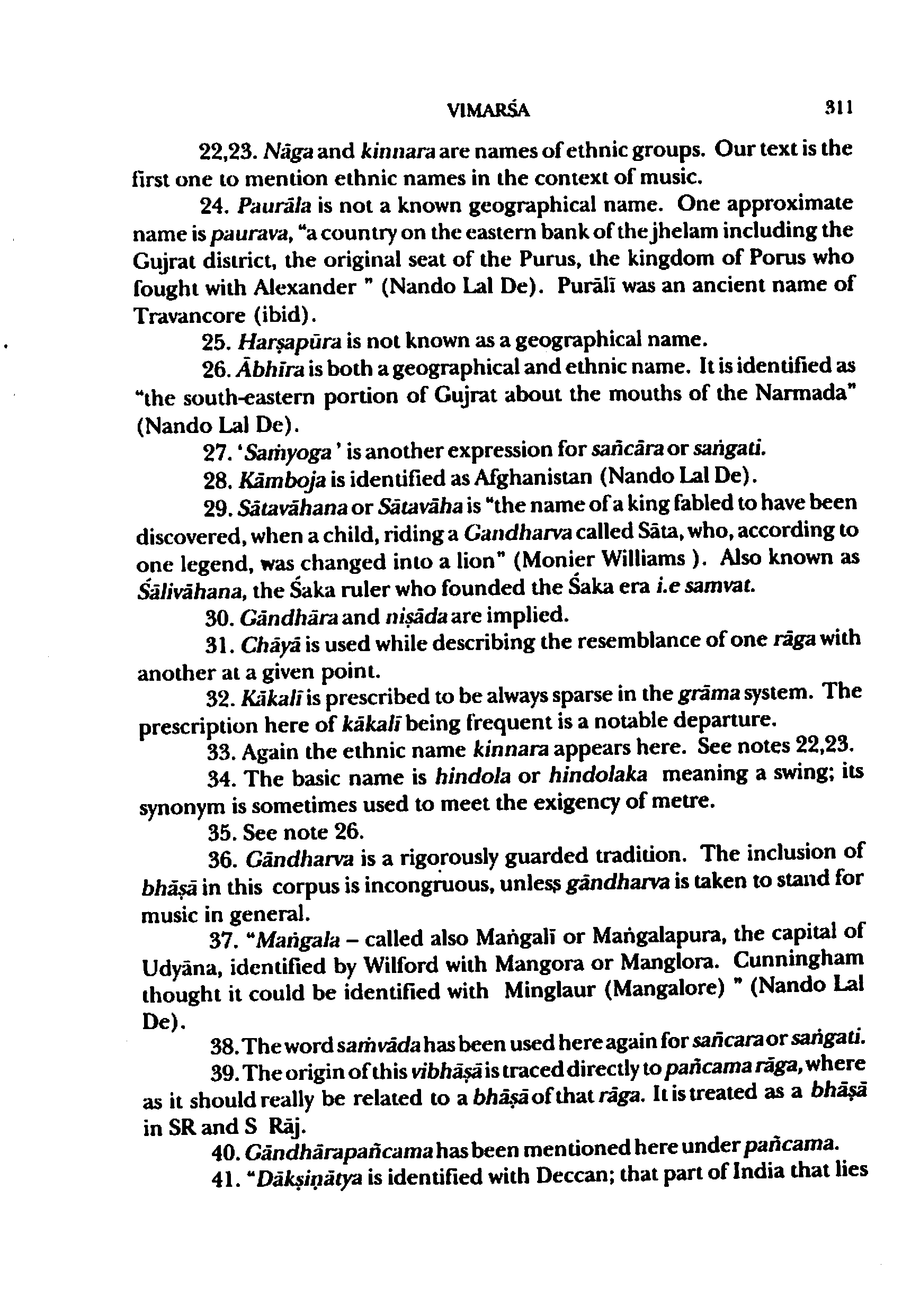
separately in order to indicate that it is not part of the original text, but is an addition. 2. Bhāṣā-vibhāṣā - antarabhāṣā is a triad devised for grouping varieties of grāmarāgas on the model of grouping of dialects and sub-dialects of languages (See Vol. III).7 3-6. The four types of bhāṣās mentioned here stand for varieties of rāgas that are self-sustained (mūlā), mixed (sankīrņā), regional (dešī) and that bear the chāyā (lit. reflection) of a rāga.8 7. ‘Sādhāraņa’ refers to svara - sādhāraņa viz. antara-kākalī. 8,9. Vibhāṣā and antara-bhāṣā are the sub-varieties of bhāṣā and vibhāṣā respectively. 10. The performance of bhāṣā is ascribed to the knowledgeable ones, which implies that bhāṣās are considered to be in no way inferior to grāmarāgas.12 11. Special effort is said to be required for the performance of bhāṣās. 12. See notes 8,9. Antara-bhāṣās are mentioned in an extremely small number. 13. ‘Revagupta’ is misplaced here, because śakākhyā bhāṣā is described towards the end of this section under pañcamaṣāḍava. 14. 'Sañcāra' is intended here. 15. Being ujjvala or brilliant with a svara could, perhaps, mean that the svara concerned becomes the amsa.10 16. This is a peculiar use of the word 'samvāda 'for sancāra or sangati. It is found for the first time in our text, in this meaning. SR II.2.123ab also contains this usage. 17. Here the word sangati is used. Thus we have 'sancāra', 'parasparagamana ', 'samvāda' and 'sangati' for one and the same melodic phenomenon.9 18. Here merely 'gamana' (movement) has been used for conveying mutual movement. 19. See note 16. 20. 'Ambāhera' is not known to be a geographical name. Ambara, known to-day as Amer is the country of Jaipur, said to have been founded by Ambarīṣa, the son of Māndhātā. Amer is a corruption of Ambarishnagar (Nando Lal De). Ambāherī could be conjectured to be related to the Amer region. 21. This name is notable because bhāṣās are not directly related to grāma.
translation
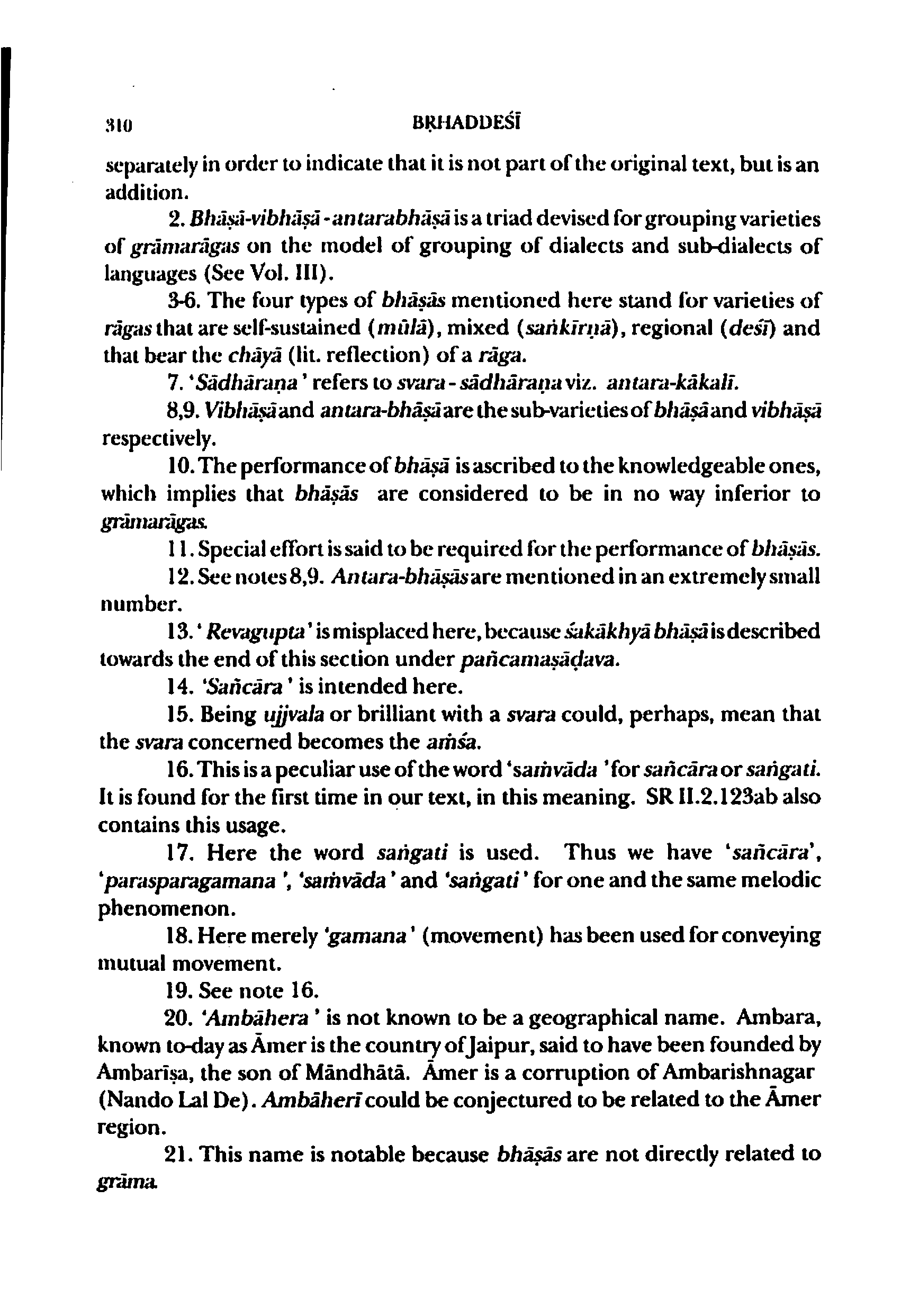
22,23. Nāga and kinnara are names of ethnic groups. Our text is the first one to mention ethnic names in the context of music. 24. Paurāla is not a known geographical name. One approximate name is paurava, "a country on the eastern bank of the jhelam including the Gujrat district, the original seat of the Purus, the kingdom of Porus who fought with Alexander " (Nando Lal De). Purālī was an ancient name of Travancore (ibid). 25. Harşapūra is not known as a geographical name. 26. <math>\bar{A}bh\bar{i}ra</math> is both a geographical and ethnic name. It is identified as "the south-eastern portion of Gujrat about the mouths of the Narmada" (Nando Lal De). 27. 'Samyoga' is another expression for sancara or sangati. 28. Kāmboja is identified as Afghanistan (Nando Lal De). 29. Sātavāhana or Sātavāha is "the name of a king fabled to have been discovered, when a child, riding a Gandharva called Sāta, who, according to one legend, was changed into a lion" (Monier Williams). Also known as Sālivāhana, the Śaka ruler who founded the Śaka era i.e samvat. 30. Gāndhāra and niṣāda are implied. 31. Chāyā is used while describing the resemblance of one rāga with another at a given point. 32. Kākalī is prescribed to be always sparse in the grāma system. The prescription here of kākalī being frequent is a notable departure. 33. Again the ethnic name kinnara appears here. See notes 22,23. 34. The basic name is hindola or hindolaka meaning a swing; its synonym is sometimes used to meet the exigency of metre. 35. See note 26. 36. Gāndharva is a rigorously guarded tradition. The inclusion of bhāṣā in this corpus is incongruous, unless gāndharva is taken to stand for music in general. 37. "Mangala - called also Mangali or Mangalapura, the capital of Udyāna, identified by Wilford with Mangora or Manglora. Cunningham thought it could be identified with Minglaur (Mangalore) " (Nando Lal De). 38. The word samvāda has been used here again for sancara or sangati. 39. The origin of this vibhāṣā is traced directly to pañcama rāga, where as it should really be related to a bhāṣā of that rāga. It is treated as a bhāṣā in SR and S Rāj. 40. Gändhärapañcama has been mentioned here under pañcama. 41. "Dākṣiṇātya is identified with Deccan; that part of India that lies
7.[enumeration] These three terms form a triad for grouping varieties of grāmarāgas, modeled on the classification of dialects and sub-dialects of languagesBhāṣā-vibhāṣā - antarabhāṣā is a triad devised for grouping varieties of grāmarāgas on the model of grouping of dialects and sub-dialects of languages (See Vol. III).
8.[enumeration] Four types of bhāṣās are distinguished: self-sustained (mūlā), mixed (sankīrņā), regional (dešī), and those bearing the chāyā (reflection) of a rāgaThe four types of bhāṣās mentioned here stand for varieties of rāgas that are self-sustained (mūlā), mixed (sankīrņā), regional (dešī) and that bear the chāyā (lit. reflection) of a rāga.
9.[relation] These four terms (sangati, sancāra, parasparagamana, samvāda) are used interchangeably to describe the same melodic phenomenonThus we have 'sancāra', 'parasparagamana ', 'samvāda' and 'sangati' for one and the same melodic phenomenon.
10.[relation] Being ujjvala (brilliant) with a svara could mean that the svara concerned becomes the amsaBeing ujjvala or brilliant with a svara could, perhaps, mean that the svara concerned becomes the amsa.
12.[structural] The performance of bhāṣā is ascribed to knowledgeable ones, implying bhāṣās are considered not inferior to grāmarāgasThe performance of bhāṣā is ascribed to the knowledgeable ones, which implies that bhāṣās are considered to be in no way inferior to grāmarāgas.
1.[attribution]Nāga and kinnara are names of ethnic groups, and this text is the first to mention ethnic names in the context of musicNāga and kinnara are names of ethnic groups. Our text is the first one to mention ethnic names in the context of music.
2.[definition]Kāmboja is identified as AfghanistanKāmboja is identified as Afghanistan
3.[definition]Hindola (or hindolaka) means a swing, and the synonym is sometimes used to meet the exigency of metreThe basic name is hindola or hindolaka meaning a swing; its synonym is sometimes used to meet the exigency of metre.
4.[definition]Chāyā is used when describing the resemblance of one rāga with another at a given pointChāyā is used while describing the resemblance of one rāga with another at a given point.
5.[definition]Sādhāraņa refers to svara, specifically sādhāraņa svara also known as antara-kākalī'Sādhāraņa' refers to svara - sādhāraņa viz. antara-kākalī.
6.[definition]Ādhīra is both a geographical and ethnic name, identified as the south-eastern portion of Gujarat about the mouths of the NarmadaĀbhīra is both a geographical and ethnic name. It is identified as "the south-eastern portion of Gujrat about the mouths of the Narmada"
7.[enumeration]These three terms form a triad for grouping varieties of grāmarāgas, modeled on the classification of dialects and sub-dialects of languagesBhāṣā-vibhāṣā - antarabhāṣā is a triad devised for grouping varieties of grāmarāgas on the model of grouping of dialects and sub-dialects of languages
8.[enumeration]Four types of bhāṣās are distinguished: self-sustained (mūlā), mixed (sankīrņā), regional (dešī), and those bearing the chāyā (reflection) of a rāgaThe four types of bhāṣās mentioned here stand for varieties of rāgas that are self-sustained (mūlā), mixed (sankīrņā), regional (dešī) and that bear the chāyā (lit. reflection) of a rāga.
9.[relation]These four terms (sangati, sancāra, parasparagamana, samvāda) are used interchangeably to describe the same melodic phenomenonThus we have 'sancāra', 'parasparagamana ', 'samvāda' and 'sangati' for one and the same melodic phenomenon.
10.[relation]Being ujjvala (brilliant) with a svara could mean that the svara concerned becomes the amsaBeing ujjvala or brilliant with a svara could, perhaps, mean that the svara concerned becomes the amsa.
11.[relation]Gāndharva is a rigorously guarded tradition, and the inclusion of bhāṣā in this corpus is incongruous unless gāndharva refers to music in generalGāndharva is a rigorously guarded tradition. The inclusion of bhāṣā in this corpus is incongruous, unless gāndharva is taken to stand for music in general.
12.[structural]The performance of bhāṣā is ascribed to knowledgeable ones, implying bhāṣās are considered not inferior to grāmarāgasThe performance of bhāṣā is ascribed to the knowledgeable ones, which implies that bhāṣās are considered to be in no way inferior to grāmarāgas.
13.[structural]Kākalī is prescribed to be always sparse in the grāma system, but here it is prescribed to be frequent, marking a notable departureKākalī is prescribed to be always sparse in the grāma system. The prescription here of kākalī being frequent is a notable departure.