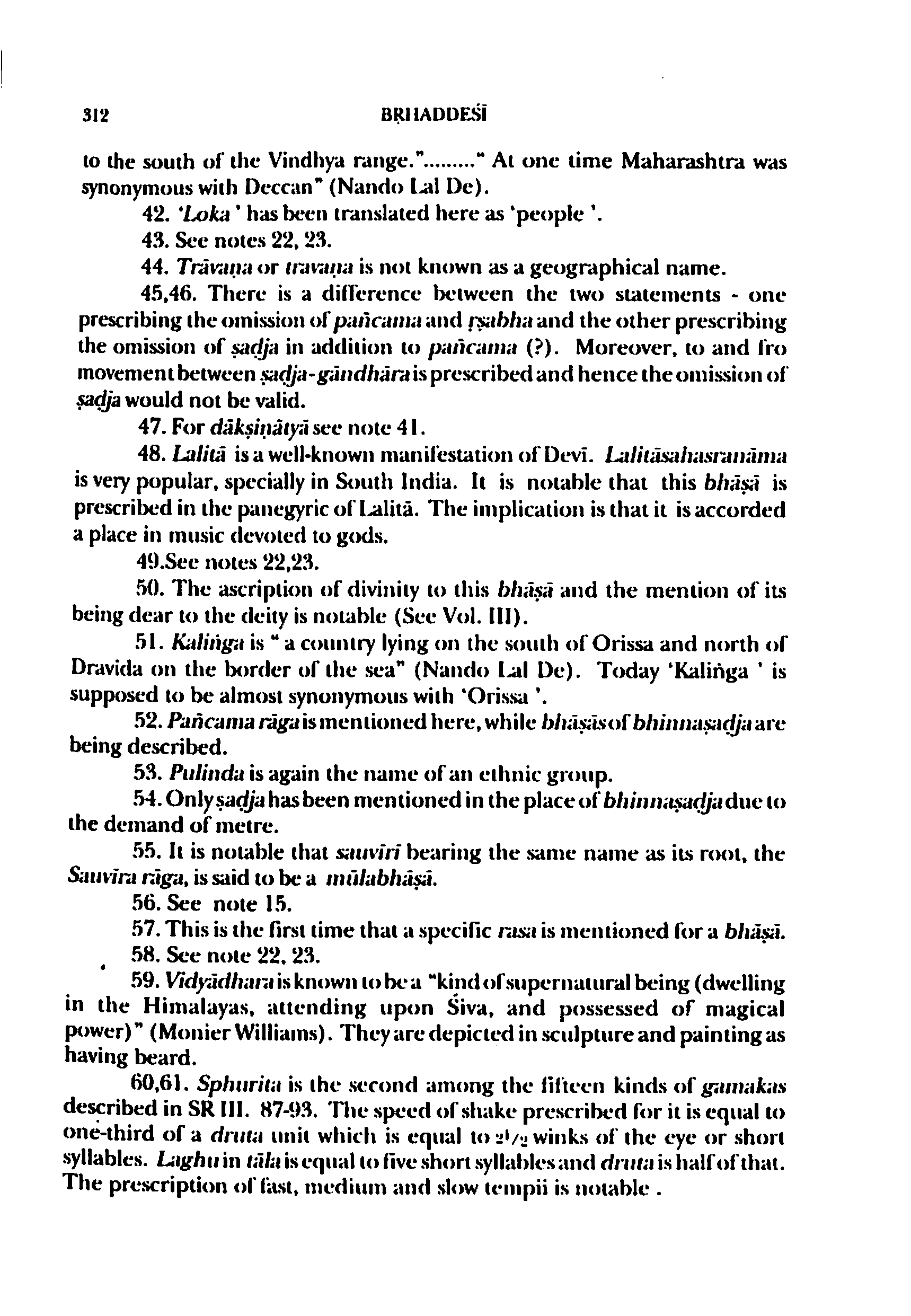
to the south of the Vindhya range."...... At one time Maharashtra was
synonymous with Deccan" (Nando Lal De).
42. 'Loka' has been translated here as 'people'.
43. See notes 22, 23.
44. Trāvaņa or travaņa is not known as a geographical name.
45,46. There is a difference between the two statements - one
prescribing the omission of pancama and ṛṣabha and the other prescribing
the omission of sadja in addition to pancama (?). Moreover, to and fro
movement between ṣaḍja-
gāndhāra is prescribed and hence the omission of
şadja would not be valid.
47. For
dākṣiṇātyā see note 41.
48. Lalitā is a well-known manifestation of Devī.
Lalitāsahasranāma
is very popular, specially in South India. It is notable that this bhāṣā is
prescribed in the panegyric of Lalita.3 The implication is that it is accorded
a place in music devoted to gods.
49.See notes 22,23.
50. The ascription of divinity to this bhāṣā and the mention of its
being dear to the deity is notable (See Vol. III).
51. Kalinga is "a country lying on the south of Orissa and north of
Dravida on the border of the sea" (Nando Lal De). Today 'Kalinga' is
supposed to be almost synonymous with 'Orissa'.
52.
Pañcama rāga is mentioned here, while bhāṣās of bhinnaṣaḍja are
being described.8
53. Pulinda is again the name of an ethnic group.
54.
Only şadja has been mentioned in the place of bhinnaşadja due to
the demand of metre.11
55.
It is notable that sauviri bearing the same name as its root, the
Sauvīra rāga, is said to be a mūlabhāṣā.1
56. See note 15.
57. This is the first time that a specific rasa is mentioned for a bhāṣā.
58. See note 22, 23.
đ
59. Vidyādhara is known to be a "kind of supernatural being (dwelling
in the Himalayas, attending upon Siva, and possessed of magical
power)" (Monier Williams). They are depicted in sculpture and painting as
having beard.
60,61.
Sphurita is the second among the fifteen kinds of
gamakas
described in SR III. 87-93. The speed of shake prescribed for it is equal to
one-third of a druta unit which is equal to 21/2 winks of the eye or short
syllables. Laghuin tāla is equal to five short syllables and druta is half of that.
The prescription of fast, medium and slow tempii is notable.