Source scans · vol_II_p036
recto · open full
scan recto
verso · open full
scan verso
Bṛhaddeśī · Volume II
pp. 54–55folio 036
Devanāgarī (Bṛhaddeśī)
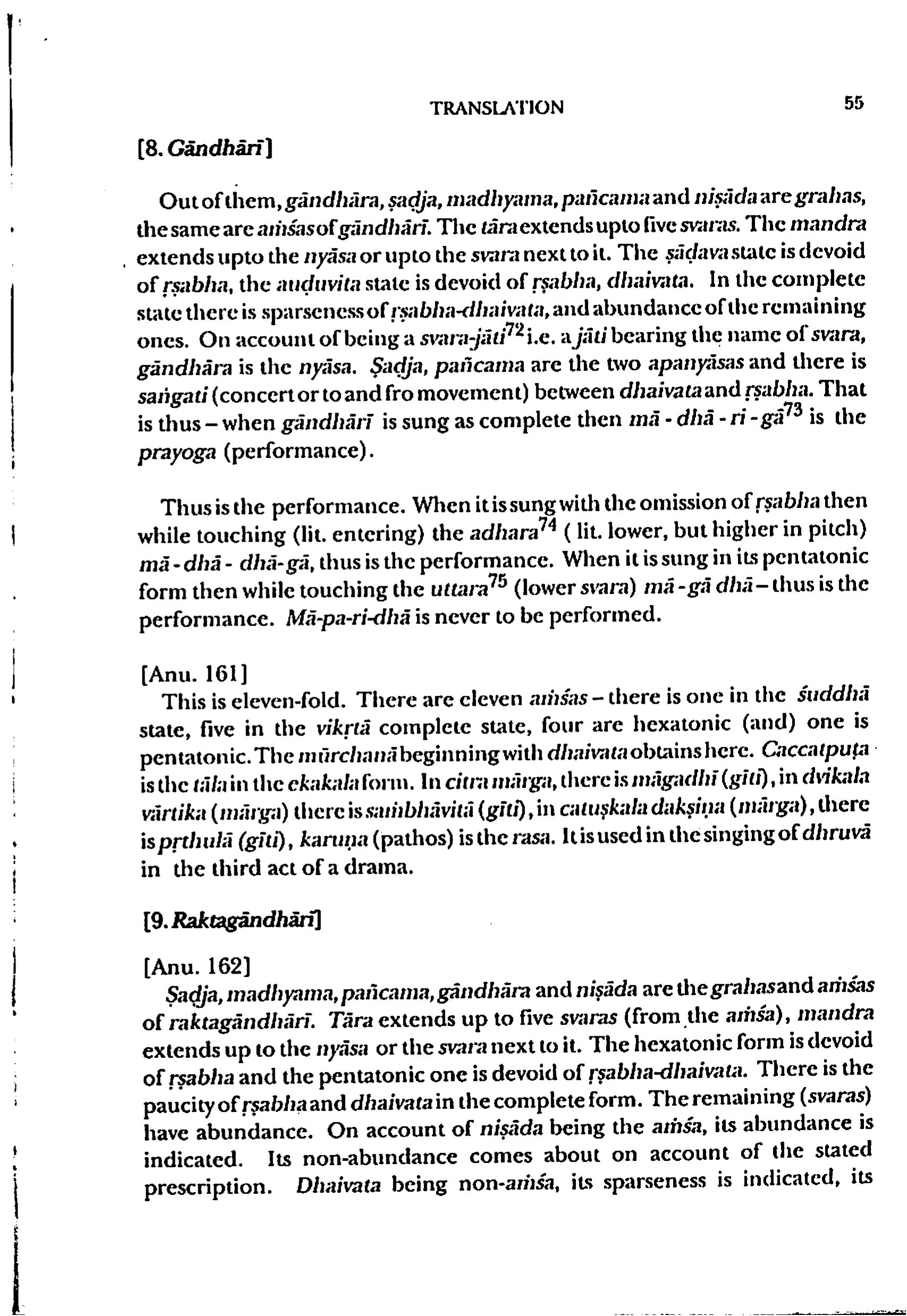
तत्र गान्धार्या गान्धारषड्जमध्यमपञ्चमनिषादा १५७ग्रहा: , त एवांशा:।11 पञ्चस्वरपरस्तारो
न्यासपरस्तत्परो वा मन्द्र:। ऋषभहीनं षाडवम्,1ऋषभधैवतहीनमौडुवितम्।
पूर्णावस्थायामृषभधैवतयोरल्पत्वम्, शेषाणां बहुत्वम्। स्वरजातित्वाद् गान्धारो न्यासः,107 १५८षड्जपञ्चमावपन्यासौ,5॰मध्यमा॰(गि?गः) धैवतर्षभयो: सङ्गति:।8 तद्यथा - गान्धारी यदा सम्पूर्णा<b>ण्नं(?)</b> गीयते तदा माधारिगा९५९ इति प्रयोग: स्यात् । यदा ऋषभहीना गीयते [तदाऽ]धरस्वरप्रवेशने2 माधाधागा इति (甲) प्रयोग: स्यात् । यदा औडुविता गीयते तदा<b>॰यन्ते</b> १६०उत्तर-स्वर-प्रवेशे मागागा इति प्रयोग: स्यात्,
मापरिध इति प्रयोगः कदाचिदपि न स्यात् ।
[अनु॰ १६१]॰द्धा [ एका- ]दशविधत्वमस्या:। एकादशांशका:-शुद्ध:,विकृता: पूर्णा: पञ्च,चत्वार:षाडवा: , औडुवित एक: । मूर्छना धैवतादि: ।13 चच्चत्पुटस्ताल: एककलविधौ चित्रमार्गे·ध: मागधी, द्विकले वार्तिके सम्भाविता, चतुष्कले दक्षिणे पृथुला। रसः 'करुणः'14र६१। ध्रुवागाने तृतीयप्रेक्षणके विनियोग:।।9
[अनु॰ १६२]
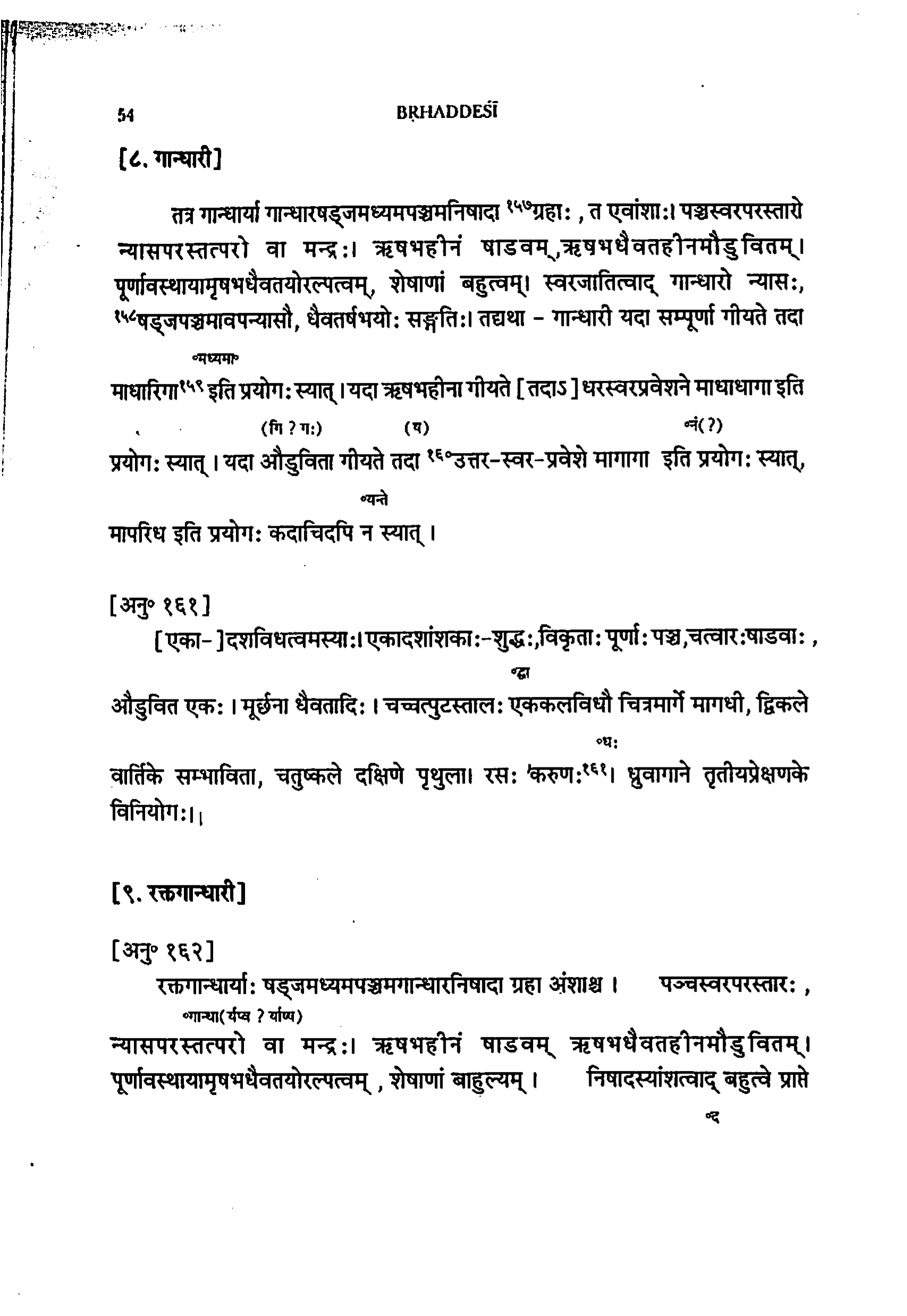
रक्तगान्धार्याः षड्जमध्यमपञ्चमगान्धारनिषादा ग्रहा अंशाश्च । पञ्चस्वरपरस्तारः , गान्धा(यंप्य ? यांप्य)
न्यासपरस्तत्परो वा मन्द्र:। ऋषभहीनं षाडवम् ऋषभधैवतहीनमौडुवितम्।
पूर्णावस्थायामृषभधैवतयोरल्पत्वम् , शेषाणां बाहुल्यम् । निषादस्यांशत्वाद् बहुत्वे प्राप्ते οζ
English — Sharma (translation)
Out of them, gāndhāra, ṣadja, madhyama, pañcama and niṣāda are grahas, the same are amsas of gandhari. The tara extends upto five svaras. The mandra , extends upto the nyāsa or upto the svara next to it. The sādava state is devoid of rṣabha, the auduvita state is devoid of ṛṣabha, dhaivata.4 In the complete state there is sparseness of rṣabha-dhaivata, and abundance of the remaining ones. On account of being a svara-jāti72i.e. a jāti bearing the name of svara, gāndhāra is the nyāsa7. Ṣadja, pañcama are the two apanyāsas and there is sangati (concert or to and fro movement) between dhaivata and ṛṣabha8. That is thus – when <math>g\bar{a}ndh\bar{a}r\bar{i}</math> is sung as complete then <math>m\bar{a}</math> - <math>dh\bar{a}</math> - <math>ri</math> - <math>g\bar{a}^{73}</math> is the prayoga (performance). Thus is the performance. When it is sung with the omission of rṣabha then while touching (lit. entering) the adhara 74 (lit. lower, but higher in pitch)2 mā-dhā-dhā-gā, thus is the performance. When it is sung in its pentatonic form then while touching the uttara 75 (lower svara)3 mā-gā dhā-thus is the performance. Mā-pa-ri-dhā is never to be performed.
[Anu. 161]
This is eleven-fold. There are eleven ainsas - there is one in the suddhā state, five in the vikṛtā complete state, four are hexatonic (and) one is pentatonic.6 The mūrchanā beginning with dhaivata obtains here13. Caccatpuța is the tālain the ekakalaform. In citra mārga, there is māgadhī (gītī), in dvikala vārtika (mārga) there is sambhāvitā (gīti), in catuşkala dakṣiṇa (mārga), there is pṛthulā (gīti), karuṇa (pathos) is the rasa14. It is used in the singing of dhruvā in the third act of a drama.9
[Anu. 162]
Ṣadja, madhyama, pañcama, gândhāra and niṣāda are the grahasand aṁśas of raktagāndhārī. Tāra extends up to five svaras (from the amśa), mandra extends up to the nyāsa or the svara next to it. The hexatonic form is devoid of rṣabha and the pentatonic one is devoid of rṣabha-dhaivata. There is the paucity of rṣabha and dhaivata in the complete form. The remaining (svaras) have abundance. On account of niṣāda being the amśa, its abundance is indicated. Its non-abundance comes about on account of the stated prescription. Dhaivata being non-aniśa, its sparseness is indicated, its
1.[definition]Sādava state is devoid of ṛṣabhaऋषभहीनं षाडवम्,
2.[definition] Adhara refers to the lower (but higher in pitch) svaraयदा ऋषभहीना गीयते [तदाऽ]धरस्वरप्रवेशने
4.[definition]Auduvita state is devoid of ṛṣabha and dhaivataऋषभधैवतहीनमौडुविितम्।
5.[enumeration]Ṣaḍja and pañcama are the two apanyāsasषड्जपञ्चमावपन्यासौ,
6.[enumeration]Gāndhārī is eleven-fold with one in suddhā state, five in vikṛtā complete state, four hexatonic and one pentatonicएकादशविधत्वमस्याः। एकादशांशकाः-शुद्धः,विकृताः पूर्णाः पञ्च,चत्वारःषाडवाः , ॰द्धा औडुवित एकः ।
7.[relation]Gāndhāra is the nyāsa on account of being a svara-jātiस्वरजातित्वाद् गान्धारो न्यासः,
8.[relation]There is sangati (concert or to and fro movement) between dhaivata and ṛṣabhaधैवतर्षभयोः सङ्गतिः।
9.[relation]Gāndhārī is used in the singing of dhruvā in the third act of a dramaध्रुवागाने तृतीयप्रेक्षणके विनियोगः।।
10.[relation]A jāti bearing the name of a svara determines that svara as the nyāsaस्वरजातित्वाद् गान्धारो न्यासः,
11.[structural]Gāndhārī has gāndhāra, ṣaḍja, madhyama, pañcama and niṣāda as its grahas and amsasतत्र गान्धार्या गान्धारषड्जमध्यमपञ्चमनिषादा ग्रहाः , त एवांशाः।
12.[structural]When gāndhārī is sung as complete, mā-dhā-ri-gā is the prayogaगान्धारी यदा सम्पूर्णा गीयते तदा ॰मध्यमा॰ माधारिगा इति प्रयोगः स्यात्
13.[structural]For Gāndhārī, the mūrchanā begins with dhaivataमूर्छना धैवतादिः ।
14.[structural]The rasa of Gāndhārī is karuṇa (pathos)रसः 'करुणः'
15.[structural]Raktagāndhārī has ṣaḍja, madhyama, pañcama, gāndhāra and niṣāda as grahas and amsasरक्तगान्धार्या षड्जमध्यमपञ्चमगान्धारनिषादा ग्रहा अंशाश्च ।
1.[definition] Sādava state is devoid of ṛṣabhaThe sādava state is devoid of ṛṣabha
2.[definition]Adhara refers to the lower (but higher in pitch) svarawhile touching (lit. entering) the adhara 74 (lit. lower, but higher in pitch)
3.[definition]Uttara refers to the lower svara in pitchwhile touching the uttara 75 (lower svara)
4.[definition] Auduvita state is devoid of ṛṣabha and dhaivatathe auduvita state is devoid of ṛṣabha, dhaivata.
5.[enumeration] Ṣaḍja and pañcama are the two apanyāsasṢaḍja, pañcama are the two apanyāsas
6.[enumeration] Gāndhārī is eleven-fold with one in suddhā state, five in vikṛtā complete state, four hexatonic and one pentatonicThis is eleven-fold. There are eleven ainsas - there is one in the suddhā state, five in the vikṛtā complete state, four are hexatonic (and) one is pentatonic.
7.[relation] Gāndhāra is the nyāsa on account of being a svara-jātigāndhāra is the nyāsa
8.[relation] There is sangati (concert or to and fro movement) between dhaivata and ṛṣabhathere is sangati (concert or to and fro movement) between dhaivata and ṛṣabha
9.[relation] Gāndhārī is used in the singing of dhruvā in the third act of a dramaIt is used in the singing of dhruvā in the third act of a drama.
11.[structural] Gāndhārī has gāndhāra, ṣaḍja, madhyama, pañcama and niṣāda as its grahas and amsasgāndhāra, ṣaḍja, madhyama, pañcama and niṣāda are grahas, the same are amsas of gandhari
13.[structural] For Gāndhārī, the mūrchanā begins with dhaivataThe mūrchanā beginning with dhaivata obtains here
14.[structural] The rasa of Gāndhārī is karuṇa (pathos)karuṇa (pathos) is the rasa
15.[structural] Raktagāndhārī has ṣaḍja, madhyama, pañcama, gāndhāra and niṣāda as grahas and amsasṢaḍja, madhyama, pañcama, gândhāra and niṣāda are the grahasand aṁśas of raktagāndhārī.