Source scans · vol_II_p063
recto · open full
scan recto
verso · open full
scan verso
Bṛhaddeśī · Volume II
pp. 108–109folio 063
Devanāgarī (Bṛhaddeśī)
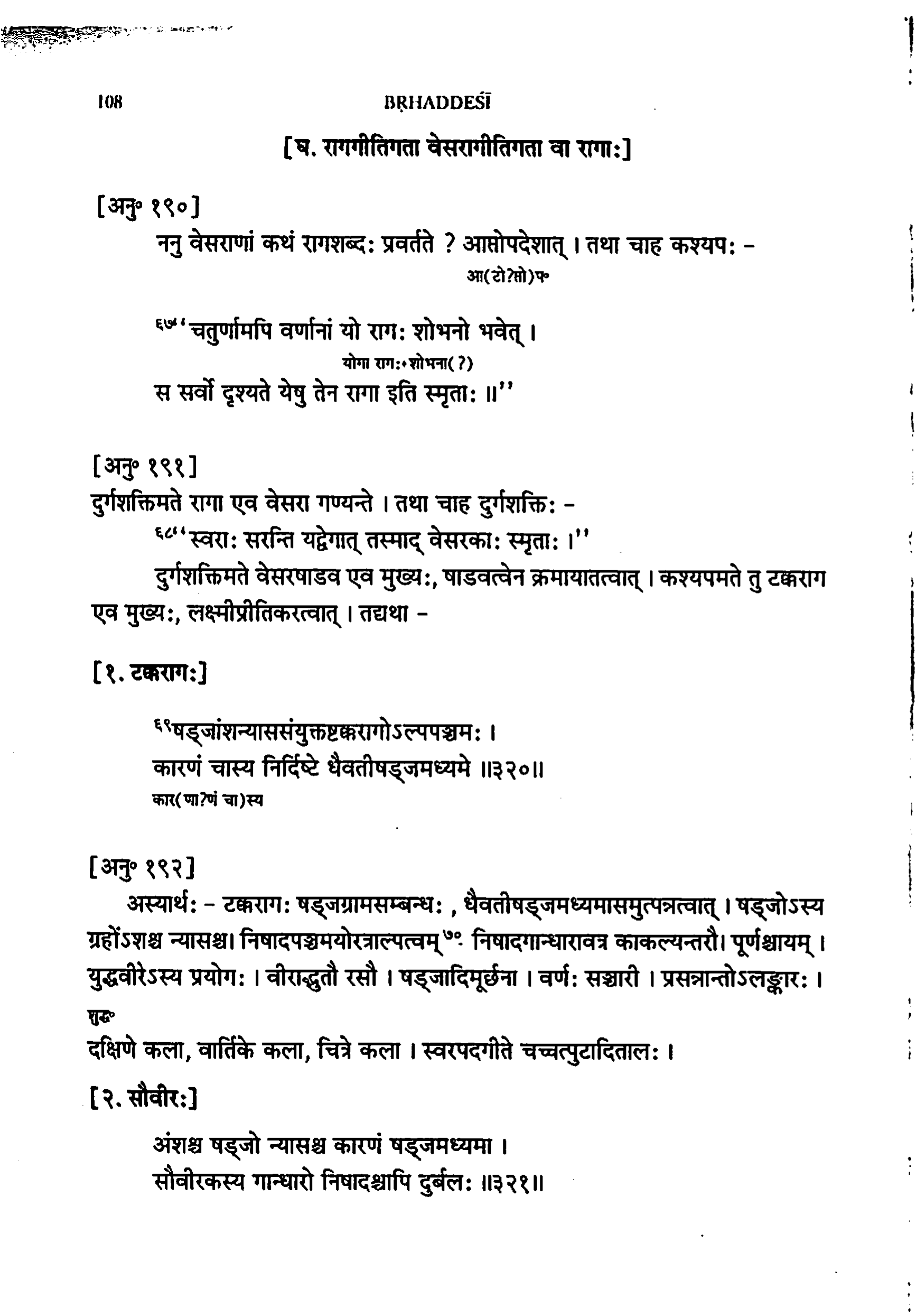
[घ. रागगीतिगता वेसरागीतिगता वा रागा:]
[अनु॰ १९०]
नन् वेसराणां कथं रागशब्द: प्रवर्तते ? आसोपदेशात्आ(टो?प्तो)फ । तथा चाह कश्यप: -
६७ ‘चतुर्णामपि वर्णानां योयोगा राग:+शोभना(?) राग: शोभनो भवेत् ।
स सर्वो दृश्यते येषु तेन रागा इति स्मृता: ॥''
[अनु॰ १९१]
दुर्गशक्तिमते रागा एव वेसरा गण्यन्ते1 । तथा चाह दुर्गशक्ति: - ६८‘‘स्वरा: सरन्ति यद्वेगात् तस्माद् वेसरका: स्मृता:5 ।’’ दुर्गशक्तिमते वेसरषाडव एव मुख्य:, षाडवत्वेन क्रमायातत्वात्2कश्यपमते तु टक्कराग एव मुख्य:, लक्ष्मीप्रीतिकरत्वात्3 । तद्यथा -
[१. टक्करागः]
६९षड्जांशन्याससंयुक्तष्टक्करागोऽल्पपञ्चम:12
कारणं चास्यकार(णा?णं चा)स्य निर्दिष्टे धैवतीषड्जमध्यमे ॥३२०॥
[अनु॰ १९२]
अस्यार्थः - टक्करागः षड्जग्रामसम्बन्धः , धैवतीषड्जमध्यमासमुत्पत्रत्वात्7 । षड्जोऽस्य
ग्रहोंऽशश्च न्यासश्च। निषादपञ्चमयोरत्राल्पत्वम् ७९ निषादगान्धारावत्र काकल्यन्तरौ। पूर्णश्चायम् ।
युद्धवीरेऽस्यशुद्ध प्रयोग:8वीराद्धुतौ रसौ4षड्जादिमूर्छना9 । वर्ण: सञ्चारी । प्रसन्नान्तोऽलङ्कार: ।
दक्षिणे कला, वार्तिके कला, चित्रे कला । स्वरपदगीते चच्चत्पुटादिताल:10
[२. सौवीर:]
अंशश्च षड्जो न्यासश्च कारणं षड्जमध्यमा1413
सौवीरकस्य गान्धारो निषादश्चापि दुर्बल:15 ॥३२१॥
English — Sharma (translation)
. ..... ... ... ....................... r .
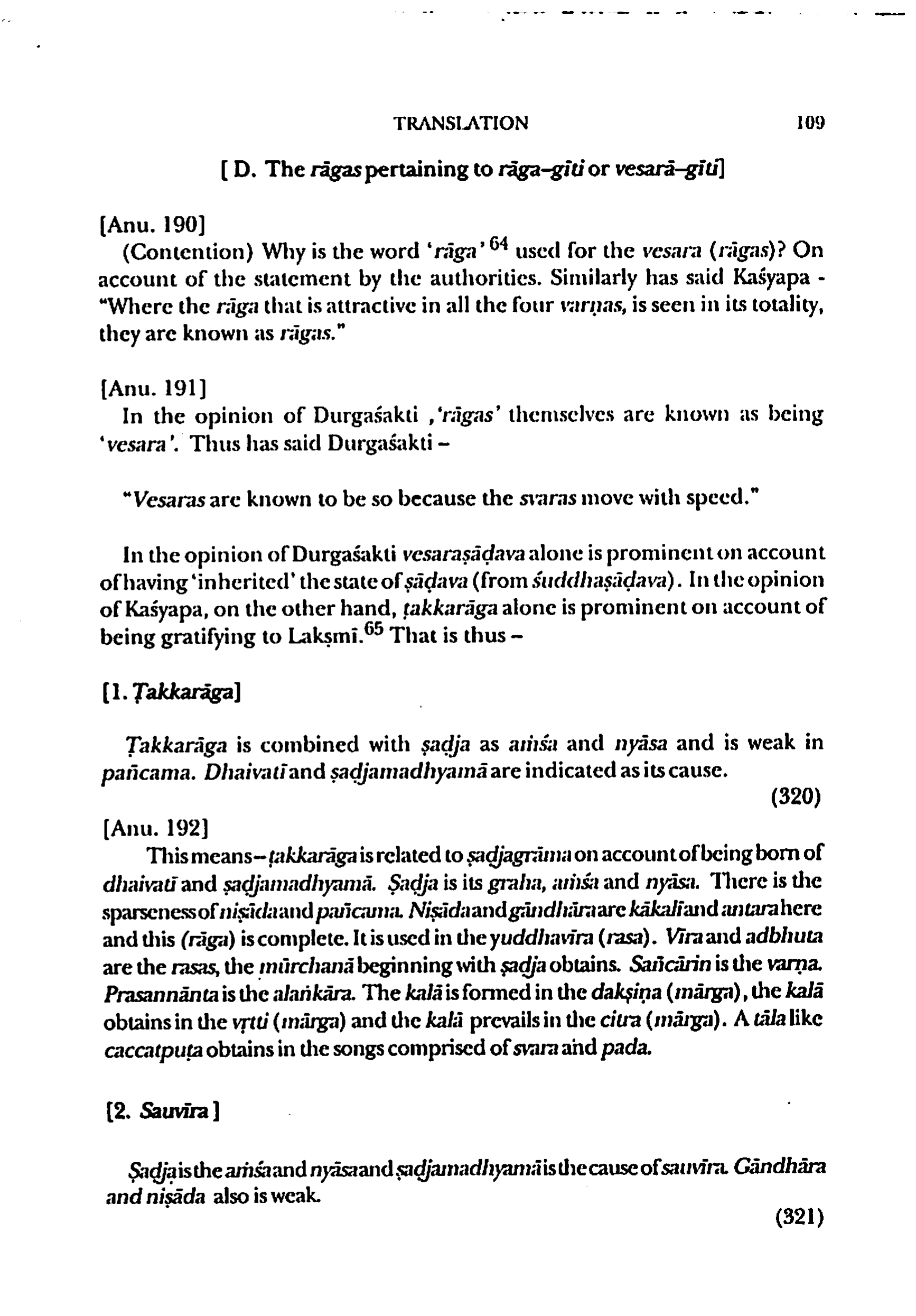
[D. The rāgas pertaining to rāga-gīti or vesarā-gīti]
[Anu. 190]
(Contention) Why is the word 'rāga' 64 used for the vesara (rāgas)? On account of the statement by the authorities. Similarly has said Kaśyapa - "Where the raga that is attractive in all the four varnas, is seen in its totality, they are known as rāgas."
[Anu. 191]
In the opinion of Durgaśakti , 'rāgas' themselves are known as being 'vesara'.1 Thus has said Durgaśakti - "Vesaras are known to be so because the svaras move with speed."5 In the opinion of Durgaśakti vesaraṣāḍava alone is prominent on account of having 'inherited' the state of ṣāḍava (from śuddhaṣāḍava).2 In the opinion of Kasyapa, on the other hand, takkarāga alone is prominent on account of being gratifying to Laksmi.365 That is thus - Takkarāga is combined with şadja as amśa and nyāsa and is weak in pañcama. Dhaivatī and ṣadjamadhyamā are indicated as its cause.
(320)
[Anu. 192]
This means—takkarāga is related to ṣaḍjagrāma on account of being born of dhaivatī and ṣadjamadhyamā.7 Ṣadja is its graha, aniśa and nyāsa. There is the sparseness of niṣāda and pañcama. Niṣāda and gāndhāra are kākalī and antara here and this (rāga) is complete. It is used in the yuddhavīra (rasa).8 Vīra and adbhuta are the rasas4, the mūrchanā beginning with ṣaḍja obtains.9 Sañcārin is the varṇa. Prasannānta is the alankāra. The kalā is formed in the dakṣiṇa (mārga), the kalā obtains in the vṛtti (mārga) and the kalā prevails in the citra (mārga). A tāla like caccatputa obtains in the songs comprised of svara and pada.10 Şadjais the amśa and nyāsa and ṣadjamadhyamā is the cause of sauvīra.14 Gāndhāra and niṣāda also is weak.15
(321)
1.[attribution] In Durgaśakti's opinion, rāgas themselves are known as being vesaraदुर्गशक्तिमते रागा एव वेसरा गण्यन्ते
2.[attribution] Vesaraṣāḍava is prominent according to Durgaśakti on account of having inherited the state of ṣāḍavaदुर्गशक्तिमते वेसरषाडव एव मुख्यः, षाडवत्वेन क्रमायातत्वात्
3.[attribution] Takkarāga is prominent in Kasyapa's opinion on account of being gratifying to Lakshmiकश्यपमते तु टक्कराग एव मुख्यः, लक्ष्मीप्रीतिकरत्वात्
4.[attribution] Vīra and adbhuta are the rasas associated with takkarāgaवीराद्धुतौ रसौ
5.[definition] Vesaras are called so because svaras move with speedस्वराः सरन्ति यद्वेगात् तस्माद् वेसरकाः स्मृताः
6.[relation] Vesarā-gīti is a category of rāgas that fall under rāga-gīti classification[घ. रागगीतिगता वेसरागीतिगता वा रागाः]
7.[relation] Takkarāga is related to ṣaḍjagrāma on account of being born of dhaivatī and ṣadjamadhyamāटक्करागः षड्जग्रामसम्बन्धः , धैवतीषड्जमध्यमासमुत्पत्रत्वात्
8.[relation] Takkarāga is used in the yuddhavīra rasa contextयुद्धवीरेऽस्य प्रयोगः
9.[relation] Mūrchanā beginning with ṣaḍja is employed in takkarāgaषड्ज?ादिमूर्छना
10.[relation] Caccatputa is a tāla used in songs comprised of svara and pada in takkarāgaस्वरपदगीते चच्चत्पुटादितालः
12.[structural] Takkarāga is weak in niṣāda and pañcamaषड्ज?ांशन्याससंयुक्तष्टक्करागोऽल्पपञ्चमः
13.[structural] Ṣaḍja is the aṁśa and nyāsa of Sauvīraअंशश्च षड्ज?ो न्यासश्च कारणं षड्जमध्यमा
14.[structural] Ṣadjamadhyamā is the cause of Sauvīraकारणं षड्जमध्यमा
15.[structural] Gāndhāra and niṣāda are weak in Sauvīraगान्धारो निषादश्चापि दुर्बलः
1.[attribution]In Durgaśakti's opinion, rāgas themselves are known as being vesaraIn the opinion of Durgaśakti , 'rāgas' themselves are known as being 'vesara'.
2.[attribution]Vesaraṣāḍava is prominent according to Durgaśakti on account of having inherited the state of ṣāḍavaIn the opinion of Durgaśakti vesaraṣāḍava alone is prominent on account of having 'inherited' the state of ṣāḍava (from śuddhaṣāḍava).
3.[attribution]Takkarāga is prominent in Kasyapa's opinion on account of being gratifying to LakshmiIn the opinion of Kasyapa, on the other hand, takkarāga alone is prominent on account of being gratifying to Laksmi.
4.[attribution]Vīra and adbhuta are the rasas associated with takkarāgaVīra and adbhuta are the rasas
5.[definition]Vesaras are called so because svaras move with speed"Vesaras are known to be so because the svaras move with speed."
6.[relation]Vesarā-gīti is a category of rāgas that fall under rāga-gīti classification[D. The rāgas pertaining to rāga-gīti or vesarā-gīti]
7.[relation]Takkarāga is related to ṣaḍjagrāma on account of being born of dhaivatī and ṣadjamadhyamātakkarāga is related to ṣaḍjagrāma on account of being born of dhaivatī and ṣadjamadhyamā.
8.[relation]Takkarāga is used in the yuddhavīra rasa contextIt is used in the yuddhavīra (rasa).
9.[relation]Mūrchanā beginning with ṣaḍja is employed in takkarāgathe mūrchanā beginning with ṣaḍja obtains.
10.[relation]Caccatputa is a tāla used in songs comprised of svara and pada in takkarāgaA tāla like caccatputa obtains in the songs comprised of svara and pada.
11.[structural]Takkarāga has ṣaḍja as its graha, aniśa and nyāsaṢaḍja is its graha, aniśa and nyāsa.
12.[structural]Takkarāga is weak in niṣāda and pañcamaTakkarāga is combined with şadja as aṁśa and nyāsa and is weak in pañcama.
13.[structural]Ṣaḍja is the aṁśa and nyāsa of SauvīraŞadjais the aṁśa and nyāsa and ṣadjamadhyamā is the cause of sauvīra.
14.[structural]Ṣadjamadhyamā is the cause of Sauvīraṣadjamadhyamā is the cause of sauvīra.
15.[structural]Gāndhāra and niṣāda are weak in SauvīraGāndhāra and niṣāda also is weak.