Source scans · vol_II_p075
recto · open full
scan recto
verso · open full
scan verso
Bṛhaddeśī · Volume II
pp. 132–133folio 075
Devanāgarī (Bṛhaddeśī)
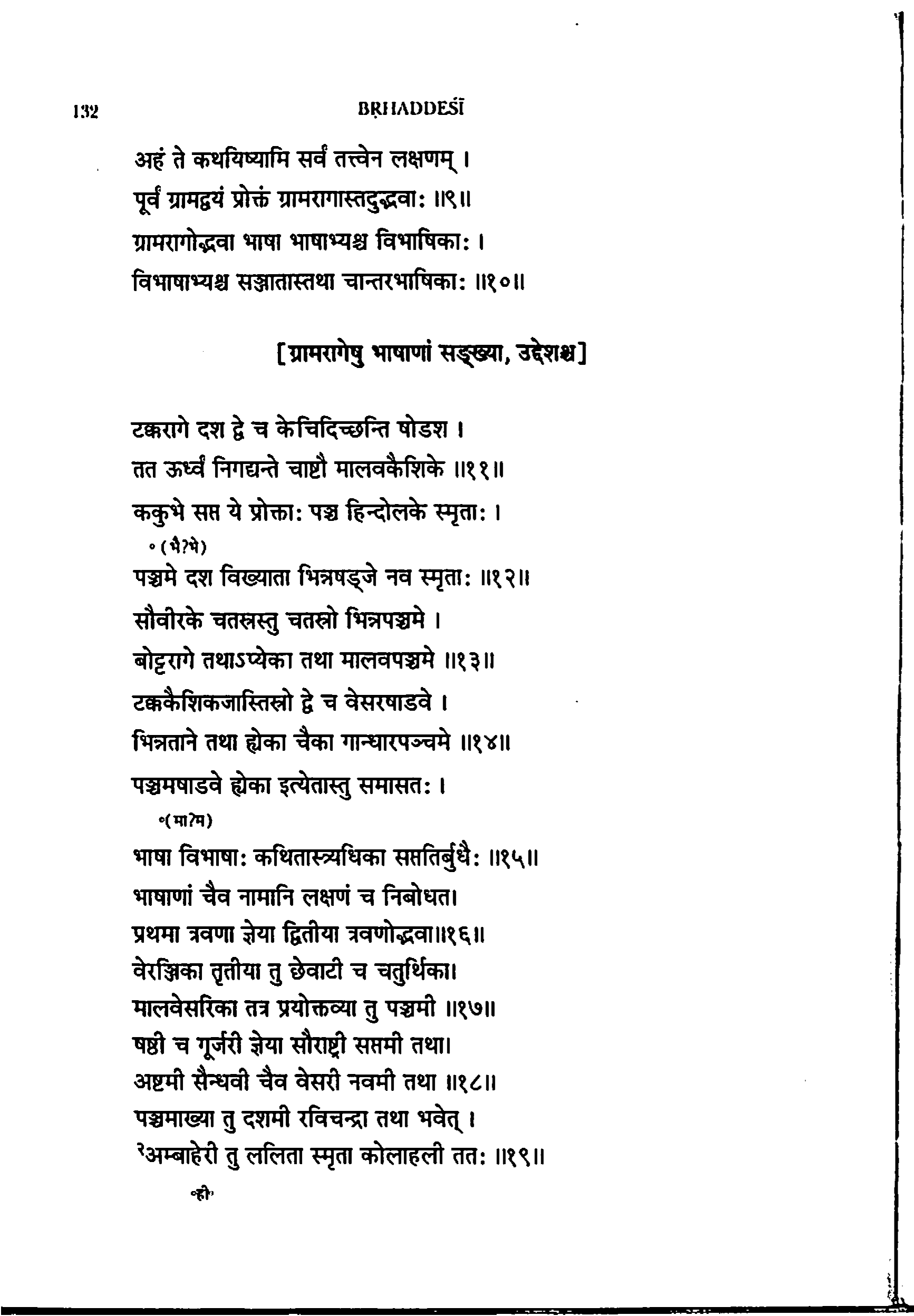
अहं ते कथियध्यामि सर्वं तत्त्वेन लक्षणम् ।
पूर्वं ग्रामह्रयं प्रोक्तं ग्रामरागास्तदुद्भवा4॥९॥ ग्रामरागोद्भवा भाषा भाषाभ्यश्च विभाषिका:।21 विभाषाभ्यश्च सञ्जातास्तथा चान्तरभाषिका:3 ॥१०॥
[ग्रामरागेषु भाषाणां सङ्ख्या, उद्देशश्च]
टक्करागे दश हे च केचिदिच्छन्ति षोडश।5 तत ऊर्ध्वं निगद्यन्ते चाष्टौ मालवकैशिके6 ॥११॥
ककुभे सप्त० (भै?भे) ये प्रोक्ता7पञ्च हिन्दोलके स्मृता8ः ।
पञ्चमे दश विख्याता भित्रषड्जे नव स्मृता:9 ॥१२॥
सौवीरके चतस्रस्तु चतस्रो भिन्नपञ्चमे ।
बोट्टरागे तथाऽप्येका तथा मालवपञ्चमे ॥१३॥
टक्ककैशिकजास्तिस्रो द्वे च वेसरषाडवे।
भिन्नताने तथा ह्येका चैका गान्धारपञ्चमे ॥१४॥
पञ्चमषाडवे॰(मा?म) ह्येका इत्येतास्तु समासत:।
भाषा विभाषा: कथितास्त्र्यधिका सप्ततिर्बुधै:10 ॥१५॥
भाषाणां चैव नामानि लक्षणं च निबोधत।
प्रथमा त्रवणा ज्ञेया11 द्वितीया त्रवणोद्भवा12॥१६॥
वेरिञ्जका तृतीया तु13 छेवाटी च चतुर्थिका14
मालवेसरिका तत्र प्रयोक्तव्या तु पञ्चमी15 ॥१७॥
षष्ठी च गूर्जरी ज्ञेया सौराष्ट्री सप्तमी तथा।
अष्टमी सैन्धवी चैव वेसरी नवमी तथा ॥१८॥
पञ्चमाख्या तु दशमी रविचन्द्रा तथा भवेत्।
अम्बाहेरी तु ललिता स्मृता कोलाहली तत: ॥१९
न्ही?
English — Sharma (translation)
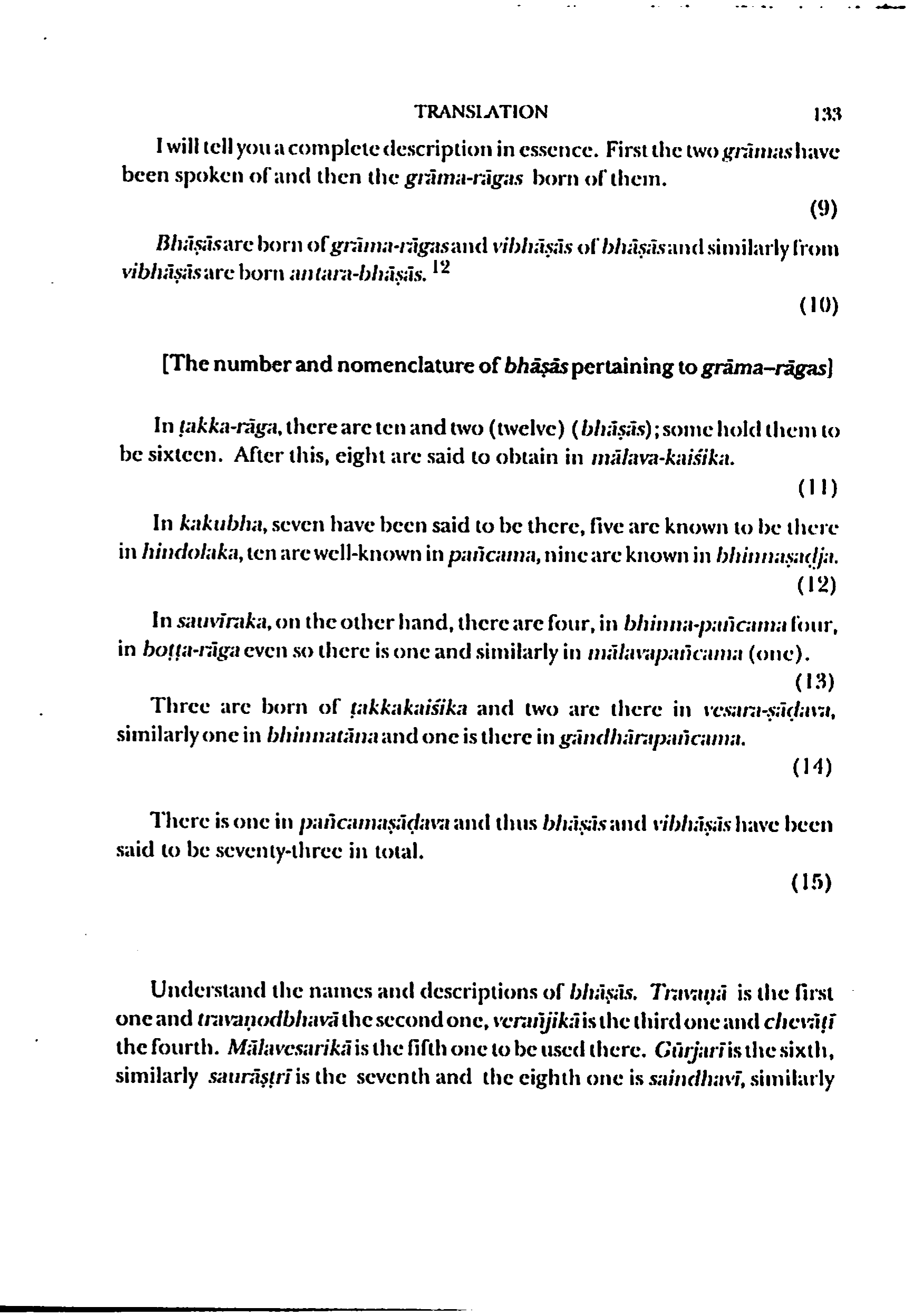
I will tell you a complete description in essence. First the two grāmas have been spoken of and then the grāma-rāgas born of them.4
(9)
Bhāṣāsare born of grāma-rāgasand vibhāṣās of bhāṣās1 and similarly from vibhāṣās are born antara-bhāṣās.3 12
(10)
[The number and nomenclature of bhāṣās pertaining to grāma-rāgas]
In ṭakka-rāga, there are ten and two (twelve) (bhāṣās); some hold them to be sixteen.5 After this, eight are said to obtain in mālava-kaiśika.6
(11)
In kakubha, seven have been said to be there,7 five are known to be there in hindolaka,8 ten are well-known in pañcama, nine are known in bhinnaṣaḍja.9
(12)
In sauvīrākā, on the other hand, there are four, in bhinna-paūcāma four, in boţṭa-rāga even so there is one and similarly in mālavapañcama (one).
(13)
Three are born of takkakaišika and two are there in vesara-ṣāḍava, similarly one in bhinnatāna and one is there in gāndhārapañcama.
(14)
There is one in pañcamaṣāḍava and thus bhāṣās and vibhāṣās have been said to be seventy-three in total.10
(15)
Understand the names and descriptions of bhāṣās. Travaṇā is the first one11 and travaṇodbhavā the second one,12 veranjikā is the third one13 and chevāṭī the fourth.14 Mālavesarikā is the fifth one to be used there.15 Gūrjarī is the sixth, similarly saurāṣṭrī is the seventh and the eighth one is saindhavī, similarly
1.[relation] Bhāṣās are born from grāma-rāgasग्रामरागोद्भवा भाषा भाषाभ्यश्च विभाषिकाः।
2.[relation] Vibhāṣās are born from bhāṣāsग्रामरागोद्भवा भाषा भाषाभ्यश्च विभाषिकाः।
3.[relation] Antara-bhāṣās are born from vibhāṣāsविभाषाभ्यश्च सञ्ज?ातास्तथा चान्तरभाषिकाः
4.[relation] Grāma-rāgas are born from the two grāmasपूर्वं ग्रामह्रयं प्रोक्तं ग्रामरागास्तदुद्भवा
5.[structural] Ṭakka-rāga has twelve bhāṣās, though some hold them to be sixteenटक्करागे दश हे च केचिदिच्छन्ति षोडश।
6.[structural] Mālava-kaiśika has eight bhāṣāsतत ऊर्ध्वं निगद्यन्ते चाष्टौ मालवकैशिके
7.[structural] Kakubha has seven bhāṣāsककुभे सप्त ये प्रोक्ता
8.[structural] Hindolaka has five bhāṣāsपञ्च हिन्दोलके स्मृता
9.[structural] Bhinnaṣaḍja has nine bhāṣāsभित्रषड्ज? नव स्मृताः
10.[structural] The total count of bhāṣās and vibhāṣās is seventy-threeभाषा विभाषाः कथितास्त्र्यधिका सप्ततिर्बुधैः
11.[structural] Travaṇā is the first bhāṣāप्रथमा त्रवणा ज?्ञेया
12.[structural] Travaṇodbhavā is the second bhāṣāद्वितीया त्रवणोद्भवा
13.[structural] Veranjikā is the third bhāṣāवेरिञ्जका तृतीया तु
14.[structural] Chevāṭī is the fourth bhāṣāछेवाटी च चतुर्थिका
15.[structural] Mālavesarikā is the fifth bhāṣāमालवेसरिका तत्र प्रयोक्तव्या तु पञ्चमी
1.[relation]Bhāṣās are born from grāma-rāgasBhāṣāsare born of grāma-rāgasand vibhāṣās of bhāṣās
2.[relation]Vibhāṣās are born from bhāṣāsBhāṣāsare born of grāma-rāgasand vibhāṣās of bhāṣās
3.[relation]Antara-bhāṣās are born from vibhāṣāsand similarly from vibhāṣās are born antara-bhāṣās.
4.[relation]Grāma-rāgas are born from the two grāmasFirst the two grāmas have been spoken of and then the grāma-rāgas born of them.
5.[structural]Ṭakka-rāga has twelve bhāṣās, though some hold them to be sixteenIn ṭakka-rāga, there are ten and two (twelve) (bhāṣās); some hold them to be sixteen.
6.[structural]Mālava-kaiśika has eight bhāṣāsAfter this, eight are said to obtain in mālava-kaiśika.
7.[structural]Kakubha has seven bhāṣāsIn kakubha, seven have been said to be there,
8.[structural]Hindolaka has five bhāṣāsfive are known to be there in hindolaka,
9.[structural]Bhinnaṣaḍja has nine bhāṣāsnine are known in bhinnaṣaḍja.
10.[structural]The total count of bhāṣās and vibhāṣās is seventy-threebhāṣās and vibhāṣās have been said to be seventy-three in total.
11.[structural]Travaṇā is the first bhāṣāTravaṇā is the first one
12.[structural]Travaṇodbhavā is the second bhāṣāand travaṇodbhavā the second one,
13.[structural]Veranjikā is the third bhāṣāveranjikā is the third one
14.[structural]Chevāṭī is the fourth bhāṣāand chevāṭī the fourth.
15.[structural]Mālavesarikā is the fifth bhāṣāMālavesarikā is the fifth one to be used there.