Source scans · vol_II_p142
recto · open full
scan recto
verso · open full
scan verso
Bṛhaddeśī · Volume II
pp. 266–267folio 142
Bṛhaddeśī
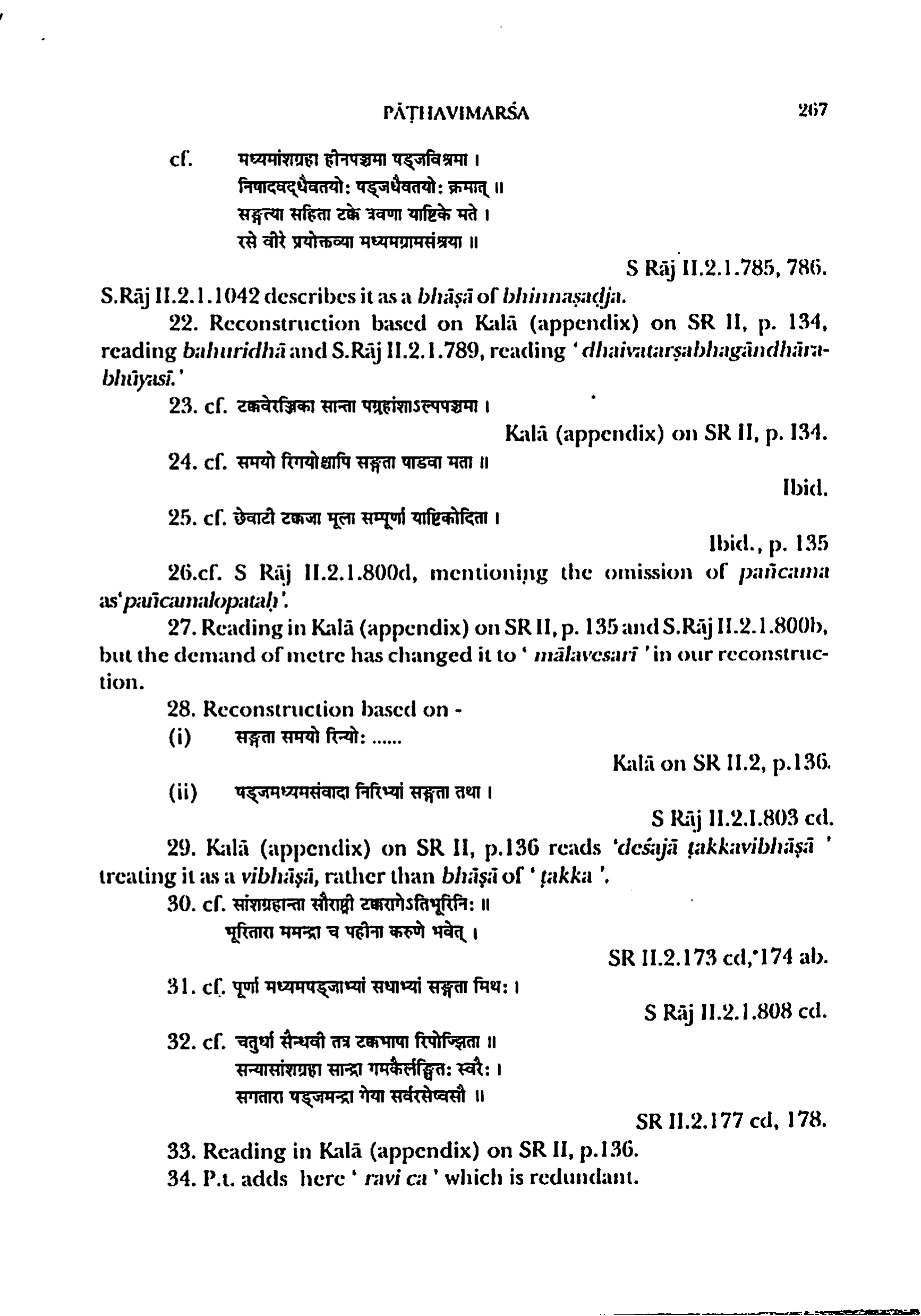
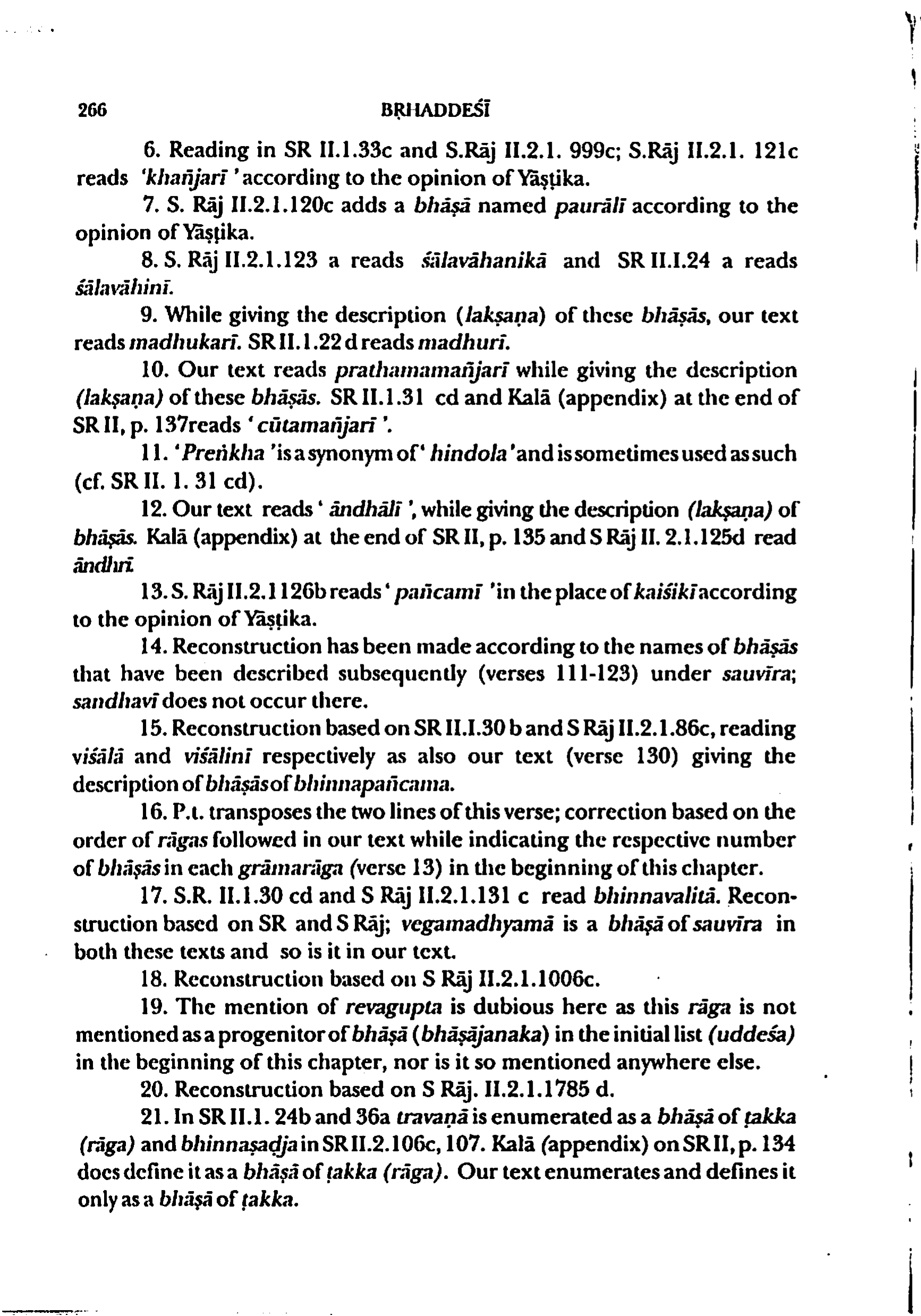
1 1 1 1 1 4 4 6. Reading in SR II.1.33c and S.Rāj II.2.1. 999c; S.Rāj II.2.1. 121c reads 'khanjarī' according to the opinion of Yāştika. 7. S. Rāj II.2.1.120c adds a bhāṣā named paurālī according to the opinion of Yāstika. 8. S. Rāj II.2.1.123 a reads śālavāhanikā and SR II.I.24 a reads śālavāhinī. 9. While giving the description (lakṣaṇa) of these bhāṣās, our text reads madhukarī. SR II.1.22 d reads madhurī. 10. Our text reads prathamamañjarī while giving the description (lakṣaṇa) of these bhāṣās. SR II.1.31 cd and Kalā (appendix) at the end of SR II, p. 137reads 'cūtamañjarī'. 11. 'Prenkha' is a synonym of 'hindola' and is sometimes used as such (cf. SR II. 1. 31 cd). 12. Our text reads ' āndhālī ', while giving the description (lakṣaṇa) of bhāṣās. Kalā (appendix) at the end of SR II, p. 135 and S Rāj II. 2.1.125d read āndhrī 13. S. Rāj II.2.1126b reads ‘pancamī’ in the place of kaiśikī according to the opinion of Yāṣṭika. 14. Reconstruction has been made according to the names of bhāṣās that have been described subsequently (verses 111-123) under sauvīra; sandhavī does not occur there. 15. Reconstruction based on SR II.I.30 b and S Rāj II.2.1.86c, reading viśālā and viśālinī respectively as also our text (verse 130) giving the description of bhāṣās of bhinnapañcama. 16. P.t. transposes the two lines of this verse; correction based on the order of rāgas followed in our text while indicating the respective number of bhāṣās in each grāmarāga (verse 13) in the beginning of this chapter. 17. S.R. II.1.30 cd and S Rāj II.2.1.131 c read bhinnavalitā. Recon- struction based on SR and S Rāj; vegamadhyamā is a bhāṣā of sauvīra in both these texts and so is it in our text. 18. Reconstruction based on S Rāj II.2.1.1006c. 19. The mention of revagupta is dubious here as this rāga is not mentioned as a progenitor of bhāṣā (bhāṣājanaka) in the initial list (uddeśa) in the beginning of this chapter, nor is it so mentioned anywhere else. 20. Reconstruction based on S Rāj. II.2.1.1785 d. 21. In SR II.1. 24b and 36a travaņā is enumerated as a bhāṣā of ṭakka (rāga) and bhinnaṣaḍja in SR II.2.106c, 107. Kalā (appendix) on SR II, p. 134 does define it as a bhāṣā of ṭakka (rāga). Our text enumerates and defines it only as a bhāṣā of ṭakka.
translation
PÄŢHAVIMARŚA cf.
मध्यमांशग्रहा हीनपञ्चमा षड्जविश्रमा ।
निषादवद्धैवतयोः पङ्जधैवतयोः क्रमात् ॥
सङ्गत्या सहिता टके त्रवणा याष्ट्रिके मते ।
रसे वीरे प्रयोक्तव्या मध्यमग्रामसंश्रया ॥
S Rāj II.2.1.785, 786. S.Rāj II.2.1.1042 describes it as a bhāṣā of bhinnaṣaḍja. 22. Reconstruction based on Kalā (appendix) on SR II, p. 134, reading bahuridhā and S.Rāj II.2.1.789, reading ‘dhaivatarṣabhagāndhāra- bhūyasī.’
23. cf. टक्कवेरञ्ज?िका सान्ता पग्रहांशाऽल्पपञ्चमा ।
Kalā (appendix) on SR II, p. I34.
24. cf. समयो रिगयोधापि सङ्गता पाडवा मता ॥
Ibid.
25. cf. छेवाटी टक्कजा मूला सम्पूर्णा याष्ट्रिकोदिता ।
Ibid., p. 135 26.cf. S Rāj II.2.1.800d, mentioning the omission of pañcama as‘ pañcamalopatalı’. 27. Reading in Kalā (appendix) on SR II, p. 135 and S.Rāj II.2.1.800b, but the demand of metre has changed it to 'mālavesarī' in our reconstruc- tion. 28. Reconstruction based on - सङ्गता समयो रिन्योः ..... (i) Kalā on SR II.2, p.136.
पड्जमध्यमसंवादा निरिभ्या सङ्गता तथा ।
(ii) S Rāj II.2.I.803 cd. 29. Kalā (appendix) on SR II, p.136 reads 'deśajā ţakkavibhāṣā ' treating it as a vibhāṣā, rather than bhāṣā of ' ṭakka '7.
30. cf. सांशग्रहान्ता सौराष्ट्री टक्करागेऽतिभूरिनिः ॥
भूरितारा ममन्द्रा च पहीना करुणे भवेत् ।
SR II.2.173 cd, 174 ab.
31. cf. पूर्णा मध्यमपङ्ज?ाध्या सधाध्या सङ्गता मिथः ।
S Rāj II.2.1.808 cd.
32. cf. चतुर्धा सैन्धवी तत्र टकभाषा रिपोण्झिता ॥
सन्यासांशग्रहा सान्द्रा गमकैलंङ्कितः स्वरैः ।
सगतारा पड्जमन्द्रा गेया सर्वरसेप्वसौ ॥
SR II.2.177 cd, 178. 33. Reading in Kalā (appendix) on SR II, p.136. 34. P.t. adds here 'ravi ca' which is redundant. and the second section is a second section of the second section in the second section is a second section of
1.[attribution]SR is a comparative source text cited alongside S.Rāj for variant readings of bhāṣā names and descriptionsSR II.1.22 d reads madhurī
2.[attribution]Kalā is an appendix to SR that provides additional definitions and variant readings of bhāṣāsKalā (appendix) at the end of SR II, p. 137reads 'cūtamañjarī'
3.[attribution]S.Rāj is a comparative treatise frequently cited as a source for variant readings and descriptions of bhāṣās and rāgasS. Rāj II.2.1. 999c; S.Rāj II.2.1. 121c reads 'khanjarī'
4.[citation]BRHADDEŚĪ is the primary treatise from which this page originates, containing systematic enumeration and description of bhāṣāsBRHADDEŚĪ 266
5.[definition]lakṣaṇa is a descriptive exposition used to characterize bhāṣāsWhile giving the description (lakṣaṇa) of these bhāṣās, our text reads madhukarī
6.[definition]uddeśa is an initial list at the beginning of a chapter that enumerates parent rāgas (bhāṣājanaka)in the initial list (uddeśa) in the beginning of this chapter
7.[definition]vibhāṣā is a variant category distinct from bhāṣā, sometimes used alternatively for the same musical formKalā (appendix) on SR II, p.136 reads 'deśajā ţakkavibhāṣā ' treating it as a vibhāṣā, rather than bhāṣā of ' ṭakka '
8.[definition]pañcamalopatalı refers to the omission of the pañcama (fifth tone) in a musical formationmentioning the omission of pañcama as' pañcamalopatalı'
9.[enumeration]sauvīra is a rāga with multiple bhāṣā varieties enumerated in verses 111-123Reconstruction has been made according to the names of bhāṣās that have been described subsequently (verses 111-123) under sauvīra
10.[enumeration]ṭakka is a rāga with multiple bhāṣā varieties including travaņā, chevaţī, and others enumerated in the textIn SR II.1. 24b and 36a travaņā is enumerated as a bhāṣā of ṭakka (rāga)
11.[relation]grāmarāga is a category with multiple bhāṣā varieties enumerated in verse 13while indicating the respective number of bhāṣās in each grāmarāga (verse 13) in the beginning of this chapter
12.[relation]bhinnaṣaḍja is a rāga that has bhāṣā varieties including travaņāand bhinnaṣaḍja in SR II.2.106c, 107
13.[relation]hindola has a synonym called prenkha that is sometimes used interchangeably'Prenkha' is a synonym of 'hindola' and is sometimes used as such
14.[structural]bhinnapañcama is a rāga with bhāṣā varieties characterized by omission or alteration of the fifth degree (pañcama)Reconstruction based on SR II.I.30 b and S Rāj II.2.1.86c, reading viśālā and viśālinī respectively as also our text (verse 130) giving the description of bhāṣās of bhinnapañcama
15.[structural]bhāṣā is a musical category that has multiple varieties derived from parent rāgas (bhāṣājanaka)nor is it so mentioned as a progenitor of bhāṣā (bhāṣājanaka) in the initial list (uddeśa)