Source scans · vol_II_p033
recto · open full
scan recto
verso · open full
scan verso
Bṛhaddeśī · Volume II
pp. 48–1400folio 033
Devanāgarī (Bṛhaddeśī)
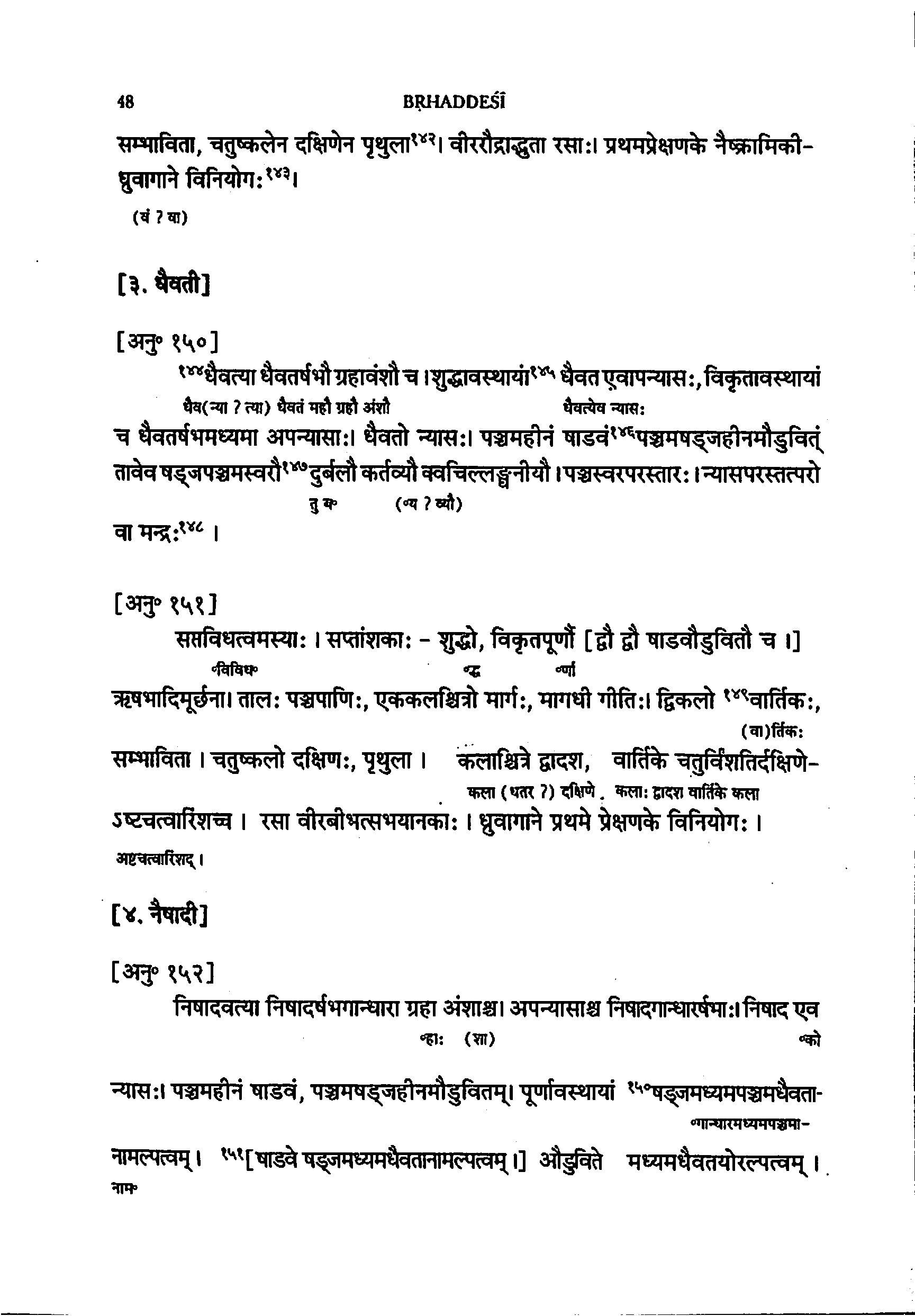
सम्भाविता, चतुष्कलेन दक्षिणेन पृथुला१४२। वीररौद्राद्धता रसा:। प्रथमप्रेक्षणके नैष्क्रामिकी-
धूवागाने विनियोगः१४३
(वं ? वा)
[३. धैवती]
[अनु॰ १५०]
१४४धैवत्या धैवतर्षभौ ग्रहावंशौ च10 ।शुद्धावस्थायां१४५ धैवत एवापन्यास:, विकृतावस्थायां धैव(न्या ? त्या) धैवतं महौ ग्रहौ अंशौ7धैवत्येव न्यासः च धैवतर्षभमध्यमा अपन्यासाः। धैवतो न्यासः। पञ्चमहीनं षाडवं11१४६पञ्चमषड्जहीनमौडुवित्12ं तावेव षड्जपञ्चमस्वरौ१४७दुर्बलौ कर्तव्यौ(व्य ? व्यौ) क्वचिल्लङ्घनीयौ । पञ्चस्वरपरस्तार: । न्यासपरस्तत्परो तु क
वा मन्द्र:१४८।
[अनु॰ १५१]<i>विविध</i>॰्ण सप्तविधत्वमस्या: । सप्तांशका: - शुद्धो, विकृतपूर्णो [द्वौ द्वौ षाडवौडुवितौ च ।] ऋषभादिमूर्छना4। ताल: पञ्चपाणि:, एककलश्चित्रो मार्ग:, मागधी गीति:5। द्विकलो १४९वार्तिक:.(वा)र्तिक: सम्भाविता । चतुष्कलो दक्षिण:, पृथुला । कलाश्चित्रे द्वादश, वार्तिके चतुर्विशतिर्दक्षिणे- कला (धतर ?) दक्षिणे . कला: द्वादश वार्तिके कला
ऽष्टचत्वारिंशच्च । रसा वीरबीभत्सभयानकाः । ध्रुवागाने प्रथमे प्रेक्षणके विनियोगः ।
अष्टचत्वारिशद् ।
[४. नैषादी]
[अनु॰ १५२]
निषादवत्या निषादर्षभगान्धारा ग्रहान्हाः अंशाश्च13(शा)। अपन्यासाश्च निषादगान्धारर्षभा:। निषाद एवको न्यासःनामः। पञ्चमहीनं षाडवं, पञ्चमषड्जहीनमौडुवितम्। पूर्णावस्थायां १५०षड्जमध्यमपञ्चमधैवता-<i>ान्धारमध्यमपञ्चमा</i>-
नामल्पत्वम् । १५१ [षाडवे षङ्जमध्यमधैवतानामल्पत्वम् ।] औडुविते मध्यमधैवतयोरल्पत्वम् ।
English — Sharma (translation)
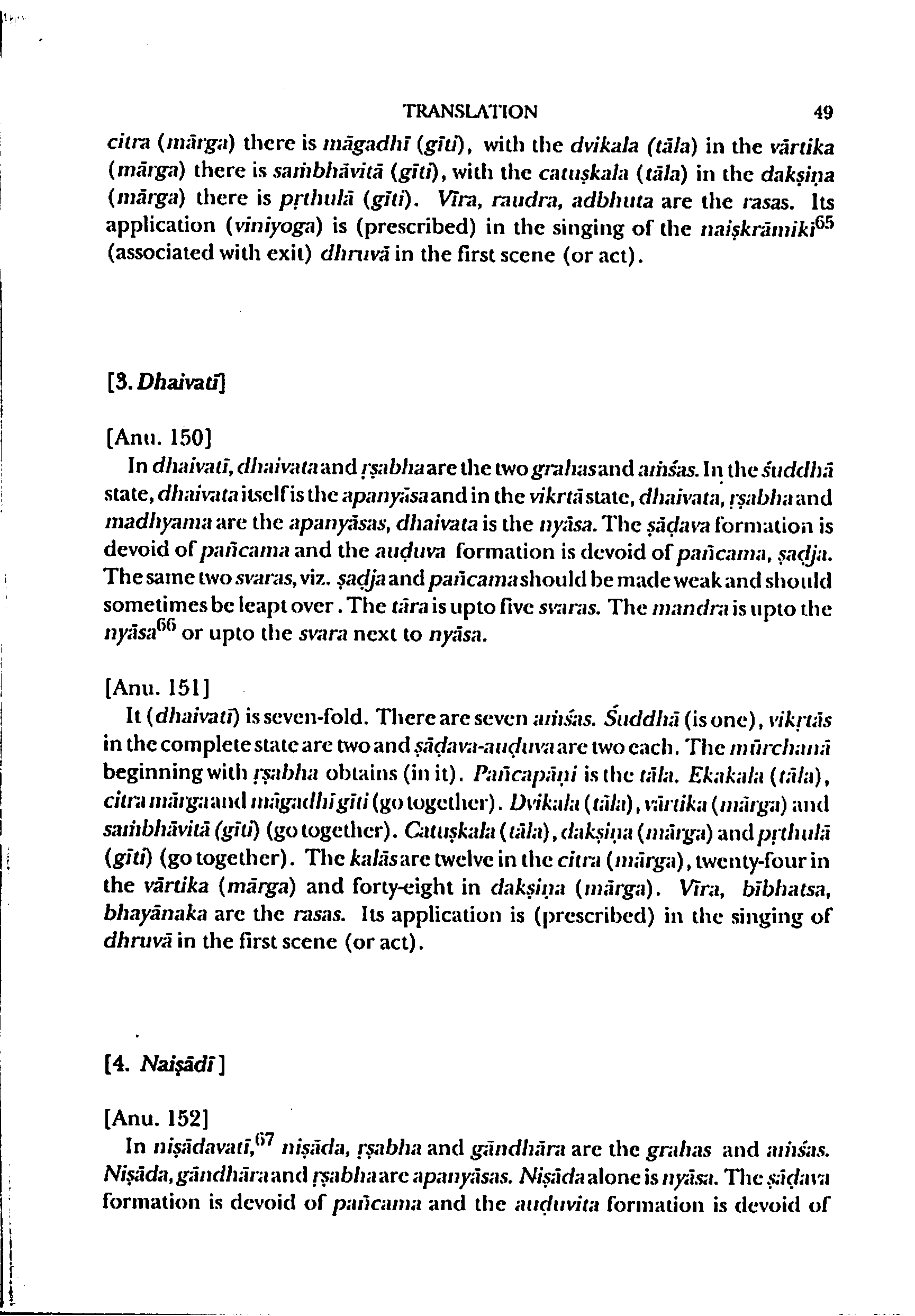
citra (mārga) there is māgadhī (gīti), with the dvikala (tāla) in the vārtika (mārga) there is sambhāvitā (gīti), with the catuṣkala (tāla) in the dakṣiṇa (mārga) there is pṛthulā (gīti). Vīra, raudra, adbhuta are the rasas. Its application (viniyoga) is (prescribed) in the singing of the naiskrāmiki65 (associated with exit) dhruvā in the first scene (or act).2
[Anu. 150]
In dhaivati, dhaivata and ṛṣabha are the two grahas and aṁśas.10 In the śuddhā state, dhaivataitself is the apanyāsa3 and in the vikrtā state, dhaivata, ṛṣabha and madhyama are the apanyāsas, dhaivata is the nyāsa. The ṣāḍava formation is devoid of pañcama11 and the auduva formation is devoid of pañcama, șadja.12 The same two svaras, viz. şadja and pañcama should be made weak and should sometimes be leapt over. The tara is upto five svaras. The mandra is upto the nyāsa66 or upto the svara next to nyāsa.
[Anu. 151]
It (dhaivatī) is seven-fold. There are seven amśas. Śuddhā (is one), vikṛtās in the complete state are two and ṣāḍava-auḍuva are two each.1 The mūrchanā beginning with ṛṣabha obtains (in it).4 Pañcapāṇi is the tāla. Ekakala (tāla), citra mārga and māgadhī gīti (go together).5 Dvikala (tāla), vārtika (mārga) and sambhāvitā (gīti) (go together). Catuṣkala (tāla), dakṣiṇa (mārga) and pṛthulā (gīti) (go together). The kalās are twelve in the citra (mārga), twenty-four in the vārtika (mārga) and forty-eight in dakṣiṇa (mārga). Vīra, bībhatsa, bhayānaka are the rasas. Its application is (prescribed) in the singing of dhruvā in the first scene (or act).6
[4. Naisādī]
[Anu. 152]
In niṣādavatī,67 niṣāda, ṛṣabha and gāndhāra are the grahas and aniśas.13 Niṣāda, gāndhāra and ṛṣabha are apanyāsas. Niṣāda alone is nyāsa.14 The ṣāḍava formation is devoid of pañcama and the auduvita formation is devoid of
4.[relation] In dhaivati, mūrchanā beginning with ṛṣabha obtainsऋषभादिमूर्छना
5.[relation] citra mārga is associated with ekakala tāla and māgadhī gītiएककलश्चित्रो मार्गः, मागधी गीतिः
6.[relation] Dhaivati has rasa of vīra, bībhatsa, and bhayānaka, with application in dhruvā of first sceneरसा वीरबीभत्सभयानका । ध्रुवागाने प्रथमे प्रेक्षणके विनियोगः ।
7.[relation] In the vikrtā state of dhaivati, dhaivata, ṛṣabha and madhyama are the apanyāsasविकृतावस्थाया धैव(न्या ? त्या) धैवतं महौ ग्रहौ अंशौ
10.[structural] Dhaivati has dhaivata and ṛṣabha as grahas and aṁśasधैवत्या धैवतर्षभौ ग्रहावंशौ च
11.[structural] The ṣāḍava formation of dhaivati is devoid of pañcamaपञ्चमहीनं षाडवं
12.[structural] The auduva formation of dhaivati is devoid of pañcama and șadjaपञ्चमषड्जहीनमौडुवित्
13.[structural] In niṣādavatī, niṣāda, ṛṣabha and gāndhāra are the grahas and aṁśasनिषादवत्या निषादर्षभगान्धारा ग्रहा अंशाश्च
1.[enumeration]Dhaivati is seven-fold with seven aṁśas: śuddhā, two vikṛtās in complete state, and two each of ṣāḍava-auḍuvaIt (dhaivatī) is seven-fold. There are seven amśas. Śuddhā (is one), vikṛtās in the complete state are two and ṣāḍava-auḍuva are two each.
2.[relation]naiskrāmiki is associated with exit and is used in the singing of dhruvā in the first scenenaiskrāmiki (associated with exit) dhruvā in the first scene (or act).
3.[relation]In the śuddhā state of dhaivati, dhaivata itself is the apanyāsaIn the śuddhā state, dhaivataitself is the apanyāsa
4.[relation]In dhaivati, mūrchanā beginning with ṛṣabha obtainsThe mūrchanā beginning with ṛṣabha obtains (in it).
5.[relation]citra mārga is associated with ekakala tāla and māgadhī gītiEkakala (tāla), citra mārga and māgadhī gīti (go together).
6.[relation]Dhaivati has rasa of vīra, bībhatsa, and bhayānaka, with application in dhruvā of first sceneVīra, bībhatsa, bhayānaka are the rasas. Its application is (prescribed) in the singing of dhruvā in the first scene (or act).
7.[relation]In the vikrtā state of dhaivati, dhaivata, ṛṣabha and madhyama are the apanyāsasin the vikrtā state, dhaivata, ṛṣabha and mmadhyama are the apanyāsas
8.[relation]vārtika mārga is associated with dvikala tāla and sambhāvitā gīti, with 24 kalāsDvikala (tāla), vārtika (mārga) and sambhāvitā (gīti) (go together). ... twenty-four in the vārtika (mārga)
9.[relation]māgadhī gīti is associated with ekakala tāla in the citra mārga with twelve kalāsEkakala (tāla), citra mārga and māgadhī gīti (go together). The kalās are twelve in the citra (mārga)
10.[structural]Dhaivati has dhaivata and ṛṣabha as grahas and aṁśasIn dhaivati, dhaivata and ṛṣabha are the two grahas and aṁśas.
11.[structural]The ṣāḍava formation of dhaivati is devoid of pañcamaThe ṣāḍava formation is devoid of pañcama
12.[structural]The auduva formation of dhaivati is devoid of pañcama and șadjathe auduva formation is devoid of pañcama, șadja.
13.[structural]In niṣādavatī, niṣāda, ṛṣabha and gāndhāra are the grahas and aṁśasIn niṣādavatī,67 niṣāda, ṛṣabha and gāndhāra are the grahas and aniśas.
14.[structural]Naisādī employs niṣāda as the primary nyāsa with apanyāsas of niṣāda, gāndhāra and ṛṣabhaNiṣāda, gāndhāra and ṛṣabha are apanyāsas. Niṣāda alone is nyāsa.